

A/B-Tests vergleichen zwei Varianten einer Variable. Multivariate Tests (MVT) prüfen mehrere Variablen gleichzeitig. So siehst du nicht nur, welche Variante gewinnt, sondern auch, welche Kombination das beste Ergebnis liefert. Bei Deep-Link-Kampagnen testest du damit CTA-Text, Layout der Landingpage und Zielbildschirm gleichzeitig, statt drei Tests nacheinander zu fahren.
Die Grundlagen zu A/B-Tests findest du unter A/B-Tests für Deep Links und Landingpages. Zur Planung der Stichprobengröße siehe Rechner für den Stichprobenumfang bei A/B-Tests mit Deep Links.
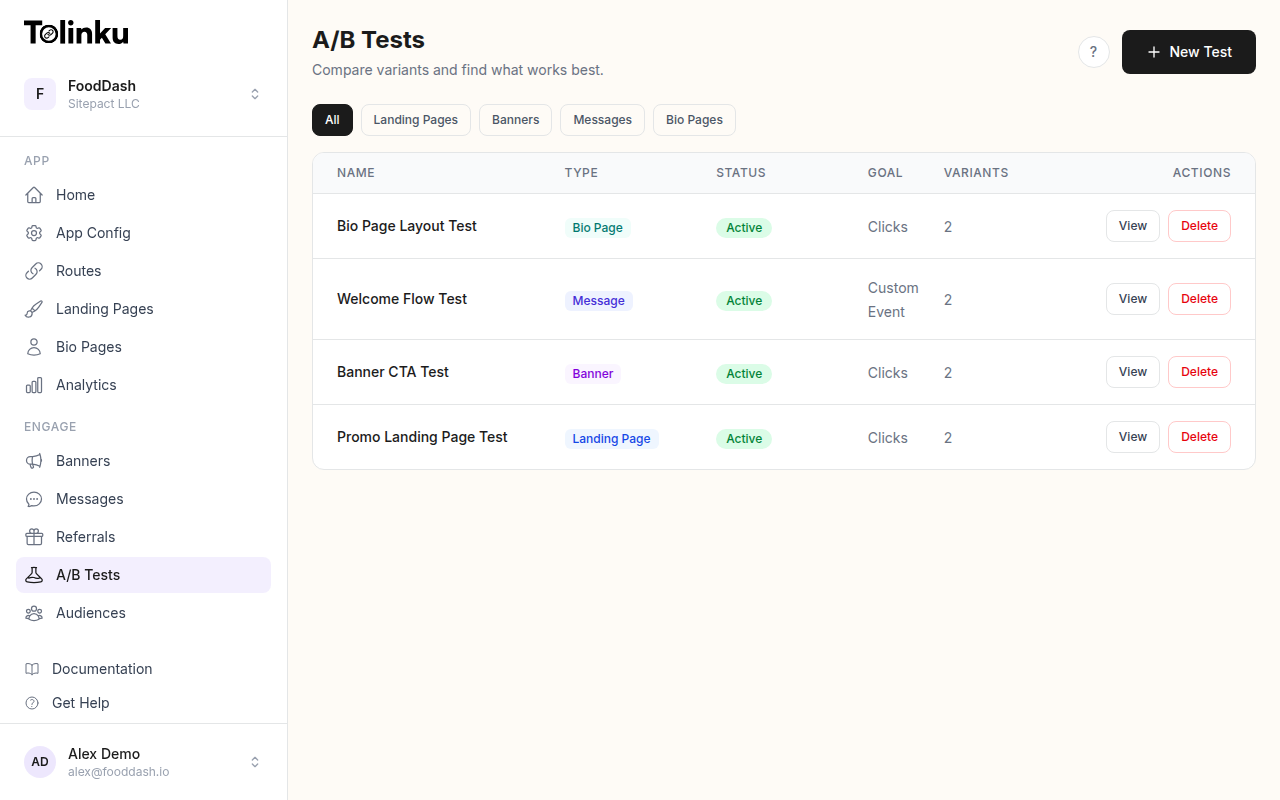 Die Übersicht der A/B-Tests mit Testnamen, Status, Typen und Anzahl der Varianten.
A/B-Tests vs. multivariate Tests
| Aspekt | A/B-Tests | Multivariate Tests |
|---|---|---|
| Getestete Variablen | 1 | 2 oder mehr gleichzeitig |
| Varianten | 2-4 | Dutzende möglich (faktoriell) |
| Benötigter Traffic | Mittel | Hoch |
| Dauer bis zu Ergebnissen | Wochen | Wochen bis Monate |
| Erkenntnisse | "B schlägt A" | "Diese Kombination ist optimal" |
| Interaktionseffekte | Nicht erkannt | Erkannt |
| Komplexität | Niedrig | Mittel bis hoch |
Wann du MVT einsetzen solltest
Multivariate Tests lohnen sich, wenn:
- Du hast viel Traffic (10.000+ tägliche Impressionen auf der getesteten Fläche)
- Du vermutest Interaktionseffekte zwischen Variablen (z. B. funktioniert eine bestimmte Überschrift nur mit einem bestimmten CTA)
- Du willst mehrere Elemente auf einmal optimieren statt nacheinander A/B-Tests laufen zu lassen
- Die getesteten Elemente liegen auf der gleichen Seite oder Fläche
Bei A/B-Tests bleibst du, wenn:
- Der Traffic ist gering (< 5.000 tägliche Impressionen)
- Du testest eine einzelne große Änderung (neues Design gegen altes)
- Du willst schnell Ergebnisse sehen
So funktioniert MVT
Vollfaktorielles Design
Teste jede Kombination aus allen Variablenstufen:
function generateFullFactorial(variables) {
  // variables = { headline: ['A', 'B'], cta: ['X', 'Y', 'Z'], layout: ['short', 'long'] }
  const keys = Object.keys(variables);
  const combinations = [];

  function combine(index, current) {
    if (index === keys.length) {
      combinations.push({ ...current });
      return;
    }

    const key = keys[index];
    for (const value of variables[key]) {
      current[key] = value;
      combine(index + 1, current);
    }
  }

  combine(0, {});
  return combinations;
}

// Example
const variants = generateFullFactorial({
  headline: ['benefit', 'feature'],
  cta: ['download', 'try_free', 'get_started'],
  layout: ['short', 'long'],
});

console.log(variants.length); // 2 x 3 x 2 = 12 combinations
Teilfaktorielles Design
Wenn ein vollfaktorieller Test zu viele Kombinationen hat, teste gezielt eine Teilmenge:
function generateFractionalFactorial(variables, fraction) {
  const full = generateFullFactorial(variables);

  // Orthogonales Array verwenden, um eine ausgewogene Teilmenge auszuwählen
  // Bei einem Anteil von 1/2: die Hälfte der Kombinationen testen
  // und trotzdem die Haupteffekte schätzen können
  const selected = selectOrthogonalSubset(full, fraction);

  return {
    combinations: selected,
    fullSize: full.length,
    fractionSize: selected.length,
    canEstimate: 'Haupteffekte + einige Wechselwirkungen',
    cannotEstimate: 'Wechselwirkungen höherer Ordnung',
  };
}

// Ein Taguchi-L8-Array, um 7 Faktoren mit je zwei Stufen in nur 8 Durchläufen zu testen
const taguchiL8 = [
  { headline: 'A', cta: 'X', layout: 'short', image: 'yes', badge: 'yes', social: 'count', urgency: 'no' },
  { headline: 'A', cta: 'X', layout: 'short', image: 'no', badge: 'no', social: 'rating', urgency: 'yes' },
  { headline: 'A', cta: 'Y', layout: 'long', image: 'yes', badge: 'yes', social: 'rating', urgency: 'yes' },
  { headline: 'A', cta: 'Y', layout: 'long', image: 'no', badge: 'no', social: 'count', urgency: 'no' },
  { headline: 'B', cta: 'X', layout: 'long', image: 'yes', badge: 'no', social: 'count', urgency: 'yes' },
  { headline: 'B', cta: 'X', layout: 'long', image: 'no', badge: 'yes', social: 'rating', urgency: 'no' },
  { headline: 'B', cta: 'Y', layout: 'short', image: 'yes', badge: 'no', social: 'rating', urgency: 'no' },
  { headline: 'B', cta: 'Y', layout: 'short', image: 'no', badge: 'yes', social: 'count', urgency: 'yes' },
];
Implementierung
MVT-Konfiguration
const mvtExperiment = {
  id: 'landing_page_mvt_v1',
  type: 'multivariate',
  variables: {
    headline: {
      levels: [
        { id: 'benefit', value: 'Spare jede Woche 2 Stunden' },
        { id: 'social', value: 'Werde Teil von 500K+ Teams' },
      ],
    },
    cta: {
      levels: [
        { id: 'download', value: 'Kostenlos herunterladen' },
        { id: 'try', value: 'Jetzt kostenlos testen' },
        { id: 'start', value: 'Jetzt loslegen' },
      ],
    },
    socialProof: {
      levels: [
        { id: 'rating', value: { type: 'stars', rating: 4.8 } },
        { id: 'count', value: { type: 'userCount', count: '500K+' } },
      ],
    },
  },
  design: 'full_factorial', // 2 x 3 x 2 = 12 Kombinationen
  primaryMetric: 'app_install',
  minSamplePerCombination: 500,
  // Insgesamt benötigt: 12 x 500 = 6.000
};
Variantenzuweisung
function assignMVTVariant(userId, experiment) {
  const existing = storage.get(`mvt_${experiment.id}_${userId}`);
  if (existing) return existing;

  // Generate all combinations
  const combinations = generateFullFactorial(
    Object.fromEntries(
      Object.entries(experiment.variables).map(([key, config]) => [
        key,
        config.levels.map(l => l.id),
      ])
    )
  );

  // Deterministic assignment
  const hash = djb2Hash(`${userId}-${experiment.id}`);
  const index = hash % combinations.length;
  const assignment = combinations[index];

  // Resolve to actual values
  const resolved = {};
  for (const [variable, levelId] of Object.entries(assignment)) {
    const level = experiment.variables[variable].levels.find(l => l.id === levelId);
    resolved[variable] = level.value;
  }

  const variant = {
    combinationIndex: index,
    assignment,
    resolved,
  };

  storage.set(`mvt_${experiment.id}_${userId}`, variant);
  return variant;
}
Seite rendern
function LandingPage({ experiment }) {
  const variant = useMVTVariant(experiment);

  return (
    <Page>
      <Hero>
        <Heading>{variant.resolved.headline}</Heading>
        <CTAButton>{variant.resolved.cta}</CTAButton>
      </Hero>

      <SocialProof config={variant.resolved.socialProof} />

      <TrackImpression
        experimentId={experiment.id}
        combination={variant.assignment}
      />
    </Page>
  );
}
MVT-Ergebnisse auswerten
Haupteffekte
Der Haupteffekt einer Variable ist ihre durchschnittliche Wirkung über alle Stufen der übrigen Variablen:
async function calculateMainEffects(experimentId) {
  const experiment = getExperiment(experimentId);
  const results = await getAllCombinationResults(experimentId);

  const mainEffects = {};

  for (const [variable, config] of Object.entries(experiment.variables)) {
    mainEffects[variable] = {};

    for (const level of config.levels) {
      // Alle Kombinationen holen, in denen diese Variable auf dieser Stufe steht
      const matching = results.filter(r => r.assignment[variable] === level.id);
      const avgConversion = matching.reduce((sum, r) => sum + r.conversionRate, 0) / matching.length;

      mainEffects[variable][level.id] = {
        avgConversion: (avgConversion * 100).toFixed(2) + '%',
        sampleSize: matching.reduce((sum, r) => sum + r.impressions, 0),
      };
    }
  }

  return mainEffects;
}

// Beispielausgabe:
// {
//   headline: { benefit: { avg: '4.2%' }, social: { avg: '3.8%' } },
//   cta: { download: { avg: '4.5%' }, try: { avg: '3.9%' }, start: { avg: '3.6%' } },
//   socialProof: { rating: { avg: '4.1%' }, count: { avg: '3.9%' } },
// }
Interaktionseffekte
Wechselwirkungen treten auf, wenn Variablen sich gegenseitig beeinflussen:
async function calculateInteractions(experimentId) {
  const results = await getAllCombinationResults(experimentId);
  const experiment = getExperiment(experimentId);
  const variables = Object.keys(experiment.variables);

  const interactions = [];

  // Check all pairs of variables
  for (let i = 0; i < variables.length; i++) {
    for (let j = i + 1; j < variables.length; j++) {
      const varA = variables[i];
      const varB = variables[j];

      // For each combination of levels
      const levelsA = experiment.variables[varA].levels;
      const levelsB = experiment.variables[varB].levels;

      const grid = {};
      for (const la of levelsA) {
        grid[la.id] = {};
        for (const lb of levelsB) {
          const matching = results.filter(r =>
            r.assignment[varA] === la.id && r.assignment[varB] === lb.id
          );
          grid[la.id][lb.id] = matching.reduce((sum, r) => sum + r.conversionRate, 0) / matching.length;
        }
      }

      // Check if effect of varA differs by level of varB
      const hasInteraction = checkInteraction(grid, levelsA, levelsB);
      if (hasInteraction.significant) {
        interactions.push({
          variables: [varA, varB],
          grid,
          strength: hasInteraction.strength,
        });
      }
    }
  }

  return interactions;
}
Beispiel: Eine Wechselwirkung liegt vor, wenn "Kostenlos herunterladen" (CTA) mit "Spare jede Woche 2 Stunden" (Headline) besser funktioniert, "Jetzt kostenlos testen" aber besser mit "Werde Teil von 500K+ Teams" wirkt. Ohne MVT würdest du das übersehen.
Die beste Kombination finden
async function findWinner(experimentId) {
  const results = await getAllCombinationResults(experimentId);

  // Nach Conversion-Rate sortieren
  const sorted = results.sort((a, b) => b.conversionRate - a.conversionRate);

  // Prüfen, ob die beste Kombination deutlich besser ist als die übrigen
  const best = sorted[0];
  const secondBest = sorted[1];

  const significance = zTest(
    secondBest.conversions, secondBest.impressions,
    best.conversions, best.impressions
  );

  return {
    winner: best.assignment,
    conversionRate: (best.conversionRate * 100).toFixed(2) + '%',
    lift: ((best.conversionRate - secondBest.conversionRate) / secondBest.conversionRate * 100).toFixed(1) + '%',
    vsSecondBest: significance,
    allResults: sorted.map(r => ({
      combination: r.assignment,
      rate: (r.conversionRate * 100).toFixed(2) + '%',
      impressions: r.impressions,
    })),
  };
}
Traffic-Bedarf
Vollfaktoriell
function mvtTrafficRequirement(variables, baselineRate, mde, perCombinationSample = 500) {
  const numCombinations = Object.values(variables).reduce(
    (product, levels) => product * levels.length,
    1
  );

  const totalRequired = numCombinations * perCombinationSample;

  return {
    combinations: numCombinations,
    perCombination: perCombinationSample,
    totalRequired,
    note: `Benötigt insgesamt ${totalRequired.toLocaleString()} Impressionen`,
  };
}

// 2 x 3 x 2 = 12 Kombinationen x 500 je = 6.000 insgesamt
// Bei 1000 pro Tag = 6 Tage (für wöchentliche Muster sind aber mindestens 14 nötig)
Kurzübersicht
| Variablen | Stufen pro Variable | Kombinationen | Mindestverkehr (500/Kombi) |
|---|---|---|---|
| 2 Variablen | je 2 | 4 | 2,000 |
| 2 Variablen | je 3 | 9 | 4,500 |
| 3 Variablen | je 2 | 8 | 4,000 |
| 3 Variablen | je 3 | 27 | 13,500 |
| 4 Variablen | je 2 | 16 | 8,000 |
| 4 Variablen | je 3 | 81 | 40,500 |
Bei mehr als 3 Variablen mit je 3 Stufen solltest du einen teilfaktoriellen Versuchsplan erwägen, um den Traffic-Bedarf zu senken.
Deep-Link-MVT-Szenarien
Szenario 1: Landingpage optimieren
Teste Headline, CTA und Social Proof auf der Fallback-Landingpage:
const landingPageMVT = {
  id: 'landing_mvt_v1',
  variables: {
    headline: {
      levels: [
        { id: 'benefit', value: 'Spare jede Woche 2 Stunden' },
        { id: 'social', value: 'Werde Teil von 500K+ Teams' },
      ],
    },
    cta: {
      levels: [
        { id: 'download', value: 'Kostenlos herunterladen' },
        { id: 'try', value: 'Jetzt kostenlos testen' },
      ],
    },
    proof: {
      levels: [
        { id: 'stars', value: '4,8 Sterne im App Store' },
        { id: 'users', value: 'Von über 500K+ Teams genutzt' },
      ],
    },
  },
  // 2 x 2 x 2 = 8 Kombinationen, überschaubar
};
Szenario 2: Smart Banner konfigurieren
Teste Banner-Text, Position und Einblendzeitpunkt:
const bannerMVT = {
  id: 'banner_mvt_v1',
  variables: {
    copy: {
      levels: [
        { id: 'benefit', value: 'Besseres Erlebnis in der App' },
        { id: 'action', value: 'Weiter in der App' },
      ],
    },
    position: {
      levels: [
        { id: 'top', value: 'top' },
        { id: 'bottom', value: 'bottom' },
      ],
    },
    timing: {
      levels: [
        { id: 'immediate', value: 0 },
        { id: 'delayed', value: 3000 },
      ],
    },
  },
  // 2 x 2 x 2 = 8 Kombinationen
};
Szenario 3: Elemente einer E-Mail-Kampagne
Teste Betreffzeile, CTA und Linkziel:
const emailMVT = {
  id: 'email_mvt_v1',
  variables: {
    subject: {
      levels: [
        { id: 'direct', value: 'Deine Bestellung ist fertig' },
        { id: 'app', value: 'Deine Bestellung ist fertig - in der App verfolgen' },
      ],
    },
    cta: {
      levels: [
        { id: 'generic', value: 'Bestellung ansehen' },
        { id: 'specific', value: 'Lieferung verfolgen' },
      ],
    },
    destination: {
      levels: [
        { id: 'order_page', value: '/orders/:id' },
        { id: 'tracking', value: '/orders/:id/tracking' },
      ],
    },
  },
  // 2 x 2 x 2 = 8 Kombinationen
};
Best Practices
- Begrenze dich auf 2 bis 3 Variablen: Mehr Variablen bedeuten exponentiell mehr Kombinationen und Traffic.
- Nutze nach Möglichkeit 2 Stufen pro Variable: Von 2 auf 3 Stufen steigt die Zahl der Kombinationen pro Variable um den Faktor 1,5.
- Lass den Test mindestens 14 Tage laufen: Wochenmuster wirken sich auf alle Kombinationen aus.
- Auf Wechselwirkungen prüfen: Der größte Vorteil von MVT gegenüber nacheinander laufenden A/B-Tests sind die entdeckten Wechselwirkungen. Lass diese Auswertung nicht aus.
- Mit A/B starten, dann auf MVT umsteigen: Lass zuerst A/B-Tests laufen, um die wichtigen Variablen zu finden, und nutze dann MVT für die beste Kombination.
- Bei Tests mit vielen Variablen einen teilfaktoriellen Plan erwägen: Du brauchst nicht immer jede Kombination.
Zu A/B-Tests für Features siehe A/B-Tests in Tolinku. Zur Einrichtung der Tests siehe die A/B-Testing-Doku.
Deep-Linking-Tipps direkt in Ihr Postfach
Eine E-Mail pro Woche. Kein Spam.