

The first time a user opens your app after installing it is the most critical moment in their journey. If they came from a shared link, an ad, or a referral, they expect to see the content that brought them there. Instead, most apps show a generic onboarding flow: welcome screens, account creation, permission prompts, and feature tours. By the time the user reaches the content they wanted, they have either forgotten why they installed the app or given up entirely.
Deferred deep linking solves the technical problem: it preserves the link context across the app install so your app knows where the user intended to go. But resolving the deferred link is only half the challenge. The other half is designing the first-open experience around that context so the transition feels seamless. This guide covers how to do that. For the technical foundations, see how deferred deep linking works.
The Problem with Default Onboarding
A typical first-open flow:
1. Splash screen (1-3 seconds)
2. Welcome carousel (3-5 swipeable screens)
3. "Create account" or "Sign in" prompt
4. Email verification
5. Permission prompts (notifications, location, tracking)
6. Feature tour
7. Home screen
For a user who tapped a link to a specific product, this is seven steps between their intent and the content they wanted. Each step is an opportunity to lose them. Industry data suggests roughly 25% of apps are used only once after install, and a slow or irrelevant first experience is a major contributing factor.
When you have deferred link context, you can skip or compress most of these steps.
Designing Around Deferred Context
Principle 1: Show the Content First
If the deferred link points to specific content (a product, an article, a profile, a shared playlist), show it immediately. Move onboarding to later.
With deferred link context:
1. Splash screen (brief)
2. Deferred link resolves → route to content
3. User sees the product/article/profile they wanted
4. Onboarding happens later (in-context, progressive)

Without deferred link context (organic install):
1. Splash screen
2. Standard onboarding flow
3. Home screen
The key decision: resolve the deferred link before starting the onboarding flow, not after.
// Android: resolve deferred link in the launcher activity
class LauncherActivity : AppCompatActivity() {

    override fun onCreate(savedInstanceState: Bundle?) {
        super.onCreate(savedInstanceState)

        resolveDeferredLink { deferredPath ->
            if (deferredPath != null) {
                // Skip onboarding, go directly to content
                navigateToContent(deferredPath)
            } else {
                // No deferred link; show standard onboarding
                navigateToOnboarding()
            }
        }
    }

    private fun navigateToContent(path: String) {
        // Show the content with a minimal "welcome" banner
        val intent = DeepLinkRouter.resolve(this, path)
        intent.putExtra("isFirstOpen", true) // So the content screen can show contextual onboarding
        startActivity(intent)
        finish()
    }
}
Principle 2: Defer Account Creation
Many apps require account creation before showing content. For deferred link users, this creates friction. Consider letting them browse the linked content as a guest first:
// iOS: let users see content before creating an account
func handleDeferredLink(_ path: String) {
    // Create a temporary guest session
    SessionManager.shared.createGuestSession()

    // Navigate to the content
    let viewController = DeepLinkRouter.resolve(path)

    // Add a subtle "Sign up to save" prompt, not a blocking modal
    viewController.showGuestBanner(
        message: "Sign up to save your progress",
        action: { self.showSignUpFlow() }
    )

    navigationController?.pushViewController(viewController, animated: true)
}
The user sees the content that brought them to the app. They can decide to create an account after experiencing the value, not before.
Principle 3: Contextual Onboarding
Instead of a generic onboarding flow, tailor onboarding to the deferred link context:
fun getOnboardingForContext(deferredPath: String?): OnboardingFlow {
    return when {
        // User came from a referral link
        deferredPath?.startsWith("/invite/") == true -> OnboardingFlow(
            steps = listOf(
                WelcomeStep("Your friend invited you!"),
                QuickSignUpStep(), // Simplified sign-up
                // Skip feature tour; go straight to the referral reward
            ),
            destination = deferredPath
        )

        // User came from a product link
        deferredPath?.startsWith("/products/") == true -> OnboardingFlow(
            steps = listOf(
                // Skip welcome carousel entirely
                QuickSignUpStep(), // Or skip if guest access is allowed
            ),
            destination = deferredPath
        )

        // User came from a shared content link
        deferredPath?.startsWith("/shared/") == true -> OnboardingFlow(
            steps = emptyList(), // No onboarding at all; go straight to content
            destination = deferredPath
        )

        // Organic install (no deferred link)
        else -> OnboardingFlow(
            steps = listOf(
                WelcomeStep("Welcome to the app!"),
                FeatureTourStep(),
                SignUpStep(),
                PermissionsStep()
            ),
            destination = "/home"
        )
    }
}
Handling Common Scenarios
Scenario: Referral Links
When a user installs via a referral link, the deferred context includes the referrer's identity and possibly a reward. The first-open experience should:
- Acknowledge the referral ("You were invited by Sarah").
- Show the reward ("You both get $10 off").
- Make sign-up easy (pre-fill the referral code).
- Route to the relevant content or offer.
func handleReferralDeepLink(referrerName: String, rewardAmount: String, code: String) {
    let welcomeVC = ReferralWelcomeViewController()
    welcomeVC.configure(
        title: "\(referrerName) invited you!",
        subtitle: "You both get \(rewardAmount) off your first order",
        referralCode: code
    )
    welcomeVC.onSignUp = { [weak self] in
        // Pre-apply the referral code during sign-up
        self?.showSignUpFlow(prefillReferralCode: code)
    }
    navigationController?.setViewControllers([welcomeVC], animated: true)
}
Scenario: Shared Content Links
When a user installs to view shared content (an article, a playlist, a photo album), the experience should be frictionless:
- Show the content immediately (no onboarding screens).
- Allow guest browsing.
- Prompt for sign-up only when the user tries to take an action that requires an account (like, save, comment).
Scenario: Campaign / Promotional Links
When a user installs from an ad or promotional campaign, the deferred context often includes a campaign identifier and possibly a promotional offer:
- Show the promoted content or offer.
- Apply the promotional discount automatically (if applicable).
- Compress onboarding to the minimum needed for the conversion (e.g., just payment setup for an e-commerce offer).
Scenario: No Deferred Context
When no deferred link is resolved (organic install, failed match, expired link), fall back to the standard onboarding. Do not show an error or a blank screen. The user should never know that a deferred link resolution was attempted and failed.
Technical Implementation Tips
Resolve Early, Route Once
Resolve the deferred link as early as possible in the app lifecycle. Do not wait until the onboarding flow is complete:
// Application class: resolve deferred link before any activity starts
class MyApplication : Application() {

    var deferredLinkPath: String? = null

    override fun onCreate() {
        super.onCreate()

        // Start resolving immediately
        DeferredLinkResolver.resolve(this) { path ->
            deferredLinkPath = path
        }
    }
}
The launcher activity checks deferredLinkPath and routes accordingly. This avoids the jarring experience of starting onboarding and then suddenly jumping to different content.
Handle the Timing Race
Deferred link resolution may be asynchronous (especially if it requires a server call). Handle the race between resolution completing and the UI needing to render:
class LauncherViewController: UIViewController {

    private var hasResolved = false

    override func viewDidAppear(_ animated: Bool) {
        super.viewDidAppear(animated)

        // Show a brief loading state (splash animation)
        showSplashAnimation()

        // Wait for deferred link resolution (with timeout)
        DeferredLinkResolver.shared.resolve(timeout: 3.0) { [weak self] path in
            guard let self = self, !self.hasResolved else { return }
            self.hasResolved = true

            if let path = path {
                self.navigateToContent(path)
            } else {
                self.navigateToOnboarding()
            }
        }
    }
}
Set a timeout (2-3 seconds). If resolution takes longer, proceed to onboarding. The user should never stare at a loading screen waiting for a deferred link to resolve.
Persist the Deferred Context
If the user goes through a sign-up flow before reaching the deferred content, persist the deferred path so it is not lost:
// Save deferred path before starting sign-up
SharedPreferences.edit().putString("pending_deferred_path", path).apply()

// After sign-up completes, check for pending path
val pendingPath = SharedPreferences.getString("pending_deferred_path", null)
if (pendingPath != null) {
    SharedPreferences.edit().remove("pending_deferred_path").apply()
    navigateToContent(pendingPath)
} else {
    navigateToHome()
}
Measuring Success
Track these metrics to evaluate your first-open experience for deferred link users:
- Time to content: How long from app open to the user seeing the deferred link destination? Target: under 5 seconds.
- Deferred link completion rate: Of users with a resolved deferred link, how many actually reach the destination content? (Should be near 100% if your flow is correct.)
- Onboarding completion rate by source: Compare onboarding completion rates for deferred link users vs. organic installs. Deferred link users who see relevant content first often have higher completion rates.
- Day-1 retention by source: Users who land on relevant content on first open tend to have higher retention than users who go through generic onboarding.
Tolinku Integration
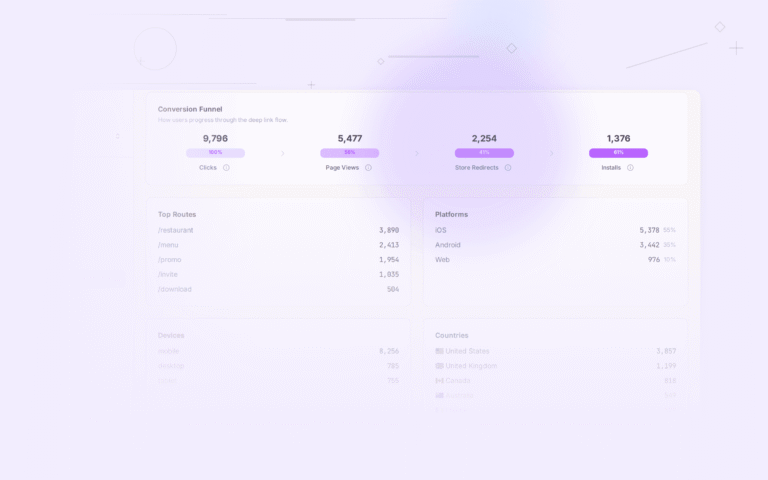
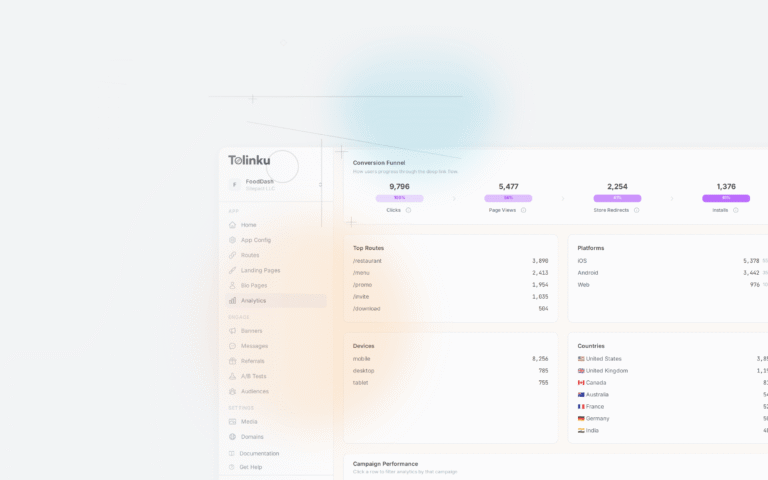
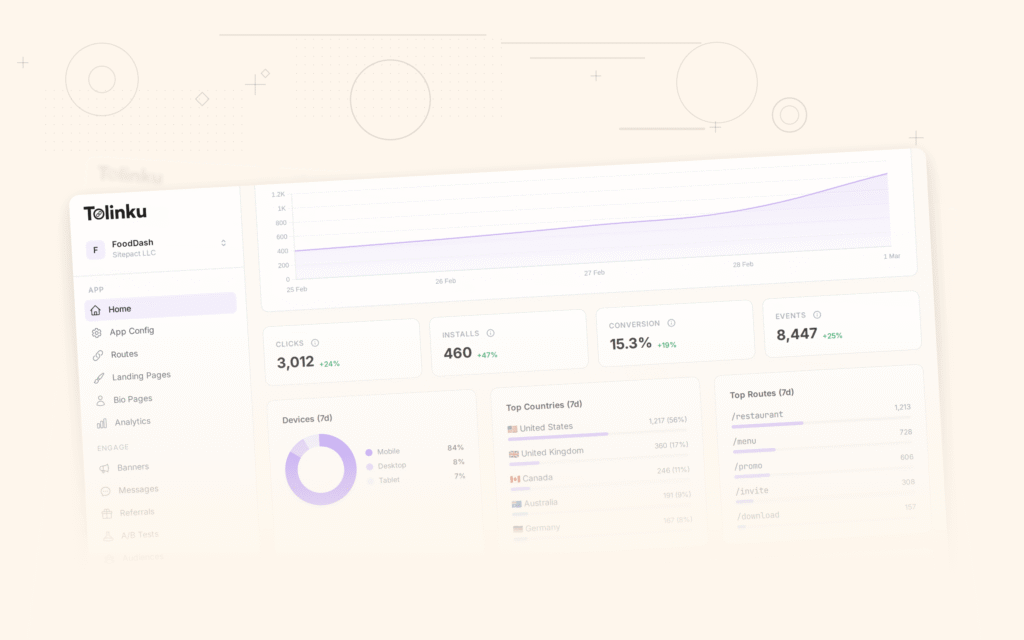
Tolinku's SDK provides deferred link resolution with callbacks that integrate into your first-open flow. The SDK resolves the deferred link asynchronously and returns the destination path, which you can use to route the user before or during onboarding.
Configure your deferred deep linking in the Tolinku dashboard. For onboarding-specific deep linking patterns, see deferred deep linking for onboarding. For the full deferred linking overview, see how deferred deep linking works.
Get deep linking tips in your inbox
One email per week. No spam.