

Deep linking has its own vocabulary. This glossary defines the key terms so you can communicate clearly with your team and understand documentation without guessing.
For the complete deep linking overview, see the complete guide to deep linking in 2026. For types of deep links, see types of deep links: standard, deferred, and contextual.
A
AASA (Apple App Site Association)
A JSON file hosted at /.well-known/apple-app-site-association on your domain. It tells iOS which app is associated with the domain and which URL paths the app handles. Required for Universal Links. See Apple's documentation.
App Clip
A lightweight portion of an iOS app (under 15MB) that can be launched from a Universal Link, QR code, or NFC tag without installing the full app. Introduced in iOS 14. Useful for providing a quick experience before the user commits to a full install.
App Link
Android's equivalent of Universal Links. An HTTPS link that opens a specific screen in an Android app when the domain is verified via assetlinks.json. Requires android:autoVerify="true" in the Intent filter. See Android's documentation.
assetlinks.json
A JSON file hosted at /.well-known/assetlinks.json on your domain. It verifies that a specific Android app is authorized to handle links from that domain. Required for App Links.
Attribution
The process of determining which marketing channel, campaign, or deep link drove a user action (install, purchase, sign-up). Deep link attribution connects the click to the conversion.
Attribution Window
The time period after a click during which a conversion is attributed to that click. Common windows: 1 hour, 24 hours, 7 days, 30 days.
B
Bounce Page
A web page that detects in-app browsers and provides a button to open the link in the system browser, where Universal Links can activate. Used to work around in-app browser limitations in apps like Facebook and Instagram.
Bundle ID
The unique identifier for an iOS app (e.g., com.example.myapp). Used in the AASA file to associate the domain with the app.
C
Click-Through Rate (CTR)
The percentage of people who click a deep link out of those who see it. Calculated as: (clicks / impressions) x 100.
Contextual Deep Link
A deep link that carries data (parameters, metadata) through the user journey. Even if the user installs the app after clicking, the context (product ID, referral code, campaign) is preserved and available on first open. See contextual deep linking.
Conversion Rate
The percentage of deep link clicks that result in a desired action (purchase, sign-up, feature use).
Custom URL Scheme
A non-HTTP URL format registered by an app (e.g., myapp://products/123). The original deep linking mechanism. Lacks ownership verification and web fallback. Largely superseded by Universal Links and App Links.
D
Deep Link
A URL that opens a specific screen or content within a mobile app, rather than the app's home screen. The term covers Universal Links, App Links, custom URL schemes, and deferred deep links.
Deferred Deep Link
A deep link that works even when the app is not installed. The user clicks the link, installs the app from the store, and on first open, the app navigates to the originally intended content. Requires matching the click to the install (via fingerprinting, referrer parameters, or clipboard).
Disambiguation Dialog
On Android, when multiple apps can handle a URL and none is verified as the default, the OS shows a dialog asking the user to choose which app to use.
Domain Verification
The process by which an operating system confirms that an app developer controls a domain. iOS verifies via AASA, Android via assetlinks.json. Verification prevents link hijacking.
F
Fallback
What happens when a deep link cannot open the app (app not installed, verification failed, in-app browser). Typically, the user sees a web page with the same content and an option to install the app.
Fallback Rate
The percentage of deep link clicks that land on the web fallback instead of opening the app.
Fingerprinting (Device)
A technique for matching a web click to an app open by comparing device attributes (IP address, user agent, screen size, language) between the two events. Used for deferred deep link matching. Increasingly restricted by privacy regulations and platform policies.
I
IDFA (Identifier for Advertisers)
A unique identifier assigned by Apple to each iOS device. Used for advertising attribution. Requires user consent via ATT (App Tracking Transparency) since iOS 14.5.
In-App Browser
A web browser embedded within another app (e.g., Facebook's built-in browser). In-app browsers typically block Universal Links, which is why bounce pages are needed.
Instant App
Android's equivalent of App Clips. A lightweight version of an app that can be launched from a URL without full installation. Requires Android 5.0+.
Intent Filter
An Android manifest declaration that specifies which URLs an app can handle. Required for both deep links and App Links.
L
Link Resolution
The process by which a deep link URL is resolved to a specific app screen. Involves domain verification, path matching, and app routing.
Link Wrapping
When a service (email provider, social media platform, URL shortener) replaces your URL with a tracking URL that redirects to your original URL. This breaks Universal Links because the tapped URL domain is the wrapper's domain, not yours.
O
Open Rate (App Open Rate)
The percentage of deep link clicks that successfully open the app. Differs from CTR because it measures what happens after the click.
P
Package Name
The unique identifier for an Android app (e.g., com.example.myapp). Used in assetlinks.json to associate the domain with the app.
Path Matching
The process of comparing a URL's path against patterns defined in the AASA or Intent filters to determine if the app should handle the URL.
Q
QR Code Deep Link
A QR code that encodes a deep link URL. When scanned, the device opens the URL, which can trigger Universal Links or App Links. Useful for offline-to-online transitions.
R
Redirect Chain
A sequence of HTTP redirects between the clicked URL and the final destination. Long redirect chains can break Universal Links (iOS does not follow redirects for Universal Link activation) and increase latency.
Referrer
The source that sent the user to the deep link. In HTTP, the Referer header (note the historical misspelling) indicates the previous page. In deep linking, the referrer can also be a campaign source (email, push, social).
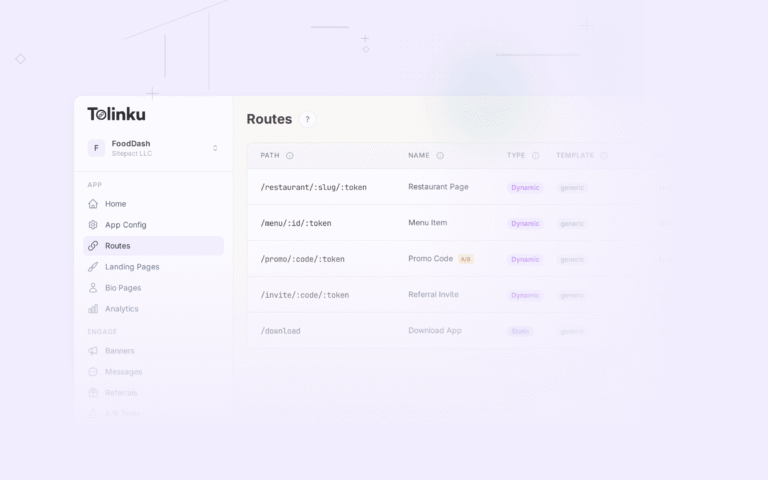
Route
A URL path pattern that maps to a specific screen in the app. For example, /products/:id maps to the product detail screen.
S
SHA-256 Fingerprint
A cryptographic hash of the signing certificate used to build an Android app. Included in assetlinks.json to verify the app's identity. If you use Google Play App Signing, include both the upload key and the Play signing key fingerprints.
SKAdNetwork
Apple's privacy-preserving framework for measuring ad-driven app installations without revealing user-level data. Does not provide deep link data, only install attribution.
Smart Banner
A banner displayed on a web page that prompts users to open the content in the app or install the app. Apple provides a native Safari smart banner via a meta tag. Custom smart banners can be built with JavaScript.
T
Team ID
A 10-character identifier assigned to an Apple Developer account. Used in the AASA file as part of the appID (format: TEAMID.bundleID).
U
Universal Link
Apple's HTTPS-based deep linking system for iOS. A Universal Link is a standard HTTPS URL that opens a specific screen in an iOS app when the domain is verified via an AASA file. Falls back to the website if the app is not installed. See Apple's documentation.
URI (Uniform Resource Identifier)
A string that identifies a resource. URLs are a subset of URIs. In deep linking, both https:// URLs and myapp:// custom schemes are URIs.
URL Scheme
See Custom URL Scheme.
UTM Parameters
Urchin Tracking Module parameters appended to URLs for campaign tracking: utm_source, utm_medium, utm_campaign, utm_content, utm_term. Named after Urchin Software, acquired by Google in 2005 to create Google Analytics.
W
WebView
A component that renders web content inside a native app. When a deep link opens in a WebView (in-app browser), Universal Links typically do not activate. This is one of the most common deep linking challenges.
Tolinku-Specific Terms
Appspace
Tolinku's organizational unit. One Appspace represents one mobile app. Contains routes, banners, analytics, and team members. See Tolinku's documentation.
Route (Tolinku)
A deep link path configuration in Tolinku. Defines the URL pattern, the app screen it maps to, and the fallback behavior. Configured in the Tolinku dashboard.
Further Reading
Get deep linking tips in your inbox
One email per week. No spam.