Cross-promotion is the practice of using one app's audience to drive installs for another app. It works between your own apps (if you have a portfolio) or between partner apps that share an audience. Done well, cross-promotion delivers high-quality users at near-zero marginal cost.
For deep linking fundamentals, see the deep linking concepts guide. For influencer partnerships, see influencer marketing for mobile apps.
Cross-Promotion Models
Own Portfolio Cross-Promotion
If you publish multiple apps, your existing user base is your best acquisition channel for new titles:
| Format | Description | Example |
|---|---|---|
| In-app banners | Show a banner promoting your other app | A weather app shows a banner for your travel app |
| Interstitials | Full-screen promotion at natural transition points | Between game levels, show your new game |
| Settings/about page | Link to your other apps | "More from [Studio Name]" section |
| Post-action prompt | After the user completes a task, suggest a related app | After completing a workout, promote your nutrition app |
| Cross-app rewards | Give users benefits in App A for installing App B | "Install [App B] and get 500 bonus coins in [App A]" |
Key principle: Promote at moments when the user has just experienced value, not when they are frustrated or mid-task.
Partner Cross-Promotion
Exchange visibility with apps that share your target audience but are not direct competitors:
| Your App | Partner App | Shared Audience |
|---|---|---|
| Running tracker | Nutrition planner | Health-conscious users |
| Budget planner | Investment tracker | Financially engaged users |
| Language learning | Travel guide | Travel enthusiasts |
| Recipe app | Grocery delivery | Home cooks |
| Meditation | Sleep tracker | Wellness-focused users |
Partner arrangements can be:
- Equal exchange: Each app shows the other's promotion. No money changes hands.
- Revenue share: If one app has a larger audience, the smaller app pays a CPI or revenue share.
- Network: Multiple apps in a cross-promotion network, rotating promotions.
Cross-Promotion Networks
Several networks facilitate cross-promotion between unrelated apps:
- Chartboost: Gaming-focused cross-promotion and ad exchange.
- AdColony: Video-based cross-promotion.
- Custom exchanges: Direct deals between app developers.
Networks handle the matching and serving, but you lose control over which apps promote yours. Direct partnerships give more control over brand alignment.
Implementation
In-App Banner Cross-Promotion
The simplest format. Show a banner within your app that links to the promoted app:
┌─────────────────────────────────┐
│  [App Icon] Try BudgetBee!      │
│  Track expenses in 30 seconds.  │
│  [Install]              [×]     │
└─────────────────────────────────┘
Best practices:
- Use a dismiss button (forced promotions annoy users).
- Show the banner after the user has completed a positive action.
- Limit frequency: once per session or once per day.
- Track impressions, taps, and installs to measure effectiveness.
Deep Links in Cross-Promotion
Every cross-promotion link should be a deep link that takes the user to a specific screen, not just the app store:
https://yourpartner.com/promo/running-plans?ref=budgetbee
When the user taps:
- If the partner app is installed, it opens to the promoted content.
- If not installed, the user sees a preview and is redirected to the app store. After installation, the app opens to the promoted content via deferred deep linking.
Without deep links, the user installs the partner app and lands on a generic home screen with no context about why they installed.
Smart Banners on Websites
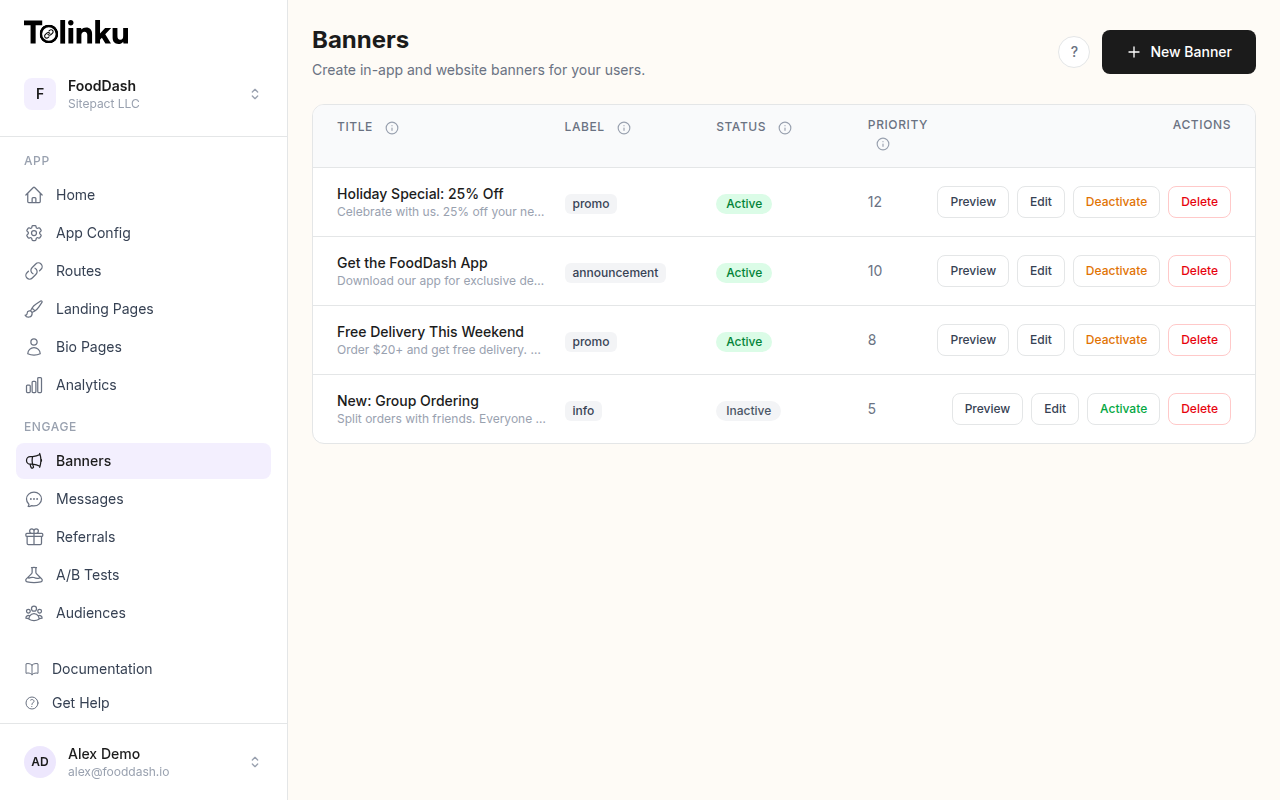 Tolinku smart banner configuration for cross-promotion across web properties.
If you have a web presence, use smart banners to cross-promote your apps based on the page context:
- Blog post about recipes → Show a banner for your recipe app.
- Blog post about budgeting → Show a banner for your finance app.
- Documentation page → Show a banner for the relevant app.
Smart banners detect the user's platform (iOS/Android) and link to the correct app store.
Timing and Targeting
When to Show Cross-Promotions
| Timing | Effectiveness | User Experience |
|---|---|---|
| After completing a task | High (user is satisfied) | Good |
| During loading screens | Medium (captive audience) | Neutral |
| In settings/about page | Low (few users visit) | Good |
| Before core features | Low (user is annoyed) | Poor |
| Between content (feeds) | Medium (native-feeling) | Neutral |
The best timing is after a positive moment: completing a workout, saving money, finishing a level. The user is in a good mood and more receptive.
Audience Targeting
Not every user is a good candidate for cross-promotion. Target users who:
- Are active and retained (they are engaged enough to try another app).
- Have interests that align with the promoted app (use in-app behavior signals).
- Have not already installed the promoted app (check with platform APIs or your own backend).
Avoid cross-promoting to:
- New users who have not yet found value in the current app.
- Users in the middle of a paid flow or conversion funnel.
- Users who have previously dismissed the promotion multiple times.
Measuring Cross-Promotion
Metrics to Track
| Metric | Formula | Good Benchmark |
|---|---|---|
| Impression rate | Impressions / DAU | 20-40% (not all users should see promos) |
| Tap-through rate | Taps / Impressions | 2-5% |
| Install rate | Installs / Taps | 20-40% (since users are already in an app context) |
| Cost per install | Value of lost engagement / Installs | Should be lower than paid CPI |
| Cannibalization rate | Decline in source app engagement after cross-promo | Under 5% |
Cannibalization Risk
The main risk of cross-promotion: users leave your app and never come back. Monitor:
- Session length: Does it drop after cross-promotion exposure?
- Retention: Do users who see cross-promotions retain at the same rate?
- Revenue: Does ARPU change for users exposed to cross-promotions?
If cross-promotion is cannibalizing your source app, reduce frequency, improve targeting, or switch to less intrusive formats (settings page instead of interstitials).
Attribution
Track the full funnel from impression in App A to install and engagement in App B:
- Impression: User sees the cross-promotion in App A.
- Click: User taps the promotion.
- Redirect: User lands on the app store or, if App B is installed, opens App B.
- Install: User installs App B (if new).
- Activation: User completes onboarding in App B.
- Retention: User remains active in App B after 7 and 30 days.
Use unique tracking parameters in your deep links (e.g., ?ref=appA&campaign=cross-promo-jan) to attribute each step.
Common Mistakes
| Mistake | Impact | Fix |
|---|---|---|
| Promoting to brand-new users | Disrupts onboarding, increases churn in source app | Only cross-promote to retained users (day 7+) |
| No frequency cap | Users feel spammed | Limit to once per day or once per session |
| Generic app store link (no deep link) | User installs but has no context, low activation | Use deep links with deferred deep linking |
| Promoting irrelevant apps | Low conversion, user annoyance | Partner with apps that share your audience |
| Not measuring cannibalization | Source app engagement drops unnoticed | Track source app metrics for cross-promo-exposed users |
| Full-screen interstitials during core flows | Rage-inducing UX, negative reviews | Only show promotions at natural break points |
Tolinku for Cross-Promotion
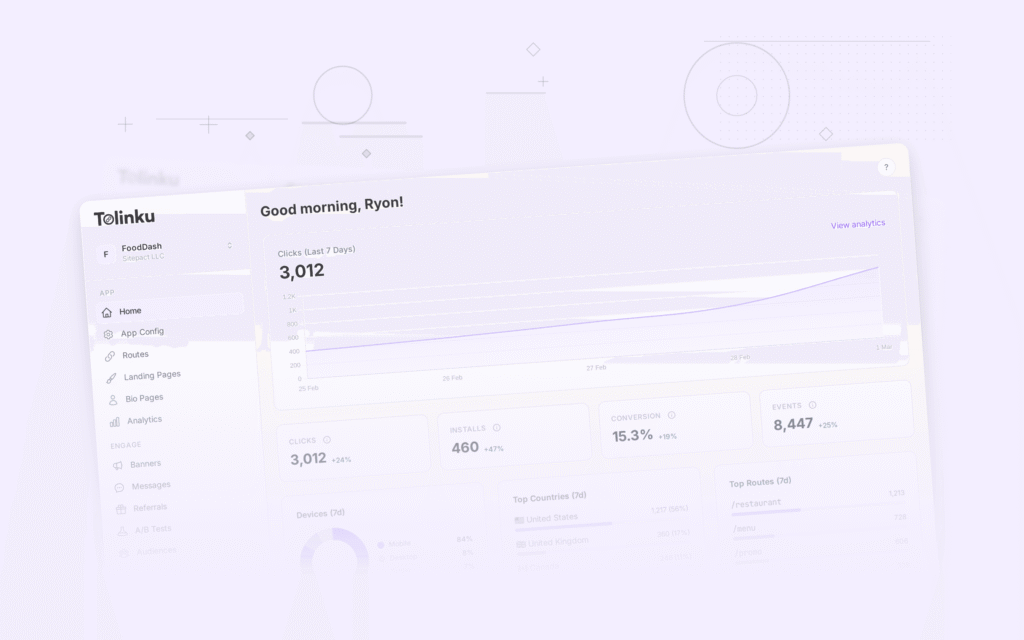
Tolinku provides deep links for cross-promotion that handle platform detection and deferred deep linking. Create a route like /promo/:partner and use it across all cross-promotion placements. Analytics show clicks, installs, and conversions per partner, so you can measure which partnerships deliver the best results.
For the full growth guide, see mobile app growth: 25 strategies that work in 2026. For smart banner strategies, see smart app banners: beyond Apple's default.
Get deep linking tips in your inbox
One email per week. No spam.