

Standard deep links take every user to the same destination. Personalized deep links route different users to different experiences based on their profile, behavior, and preferences. A deep link to /deals could show sneaker deals to one user and laptop deals to another, based on their browsing history.
For product recommendation deep links, see product recommendation deep links. For personalized banners, see personalized smart banners: dynamic content that converts.
How Personalized Deep Links Work
Static vs Personalized
| Type | Example | Behavior |
|---|---|---|
| Static deep link | /sale/summer |
Every user sees the same summer sale page |
| Personalized deep link | /for-you/summer |
Each user sees summer items tailored to their preferences |
Personalization happens server-side. The deep link carries a user identifier or segment parameter, and the app fetches the personalized content when the link is opened.
Personalization Methods
| Method | How It Works | Precision |
|---|---|---|
| User ID | Link includes user ID; app fetches their personalized content | High (individual) |
| Segment | Link includes segment (e.g., "new-user," "high-spender"); app shows segment-specific content | Medium |
| Context | Link includes contextual data (location, time, source); app adapts | Low-medium |
Personalization Strategies
By Purchase History
Tailor deep link destinations based on what the user has bought:
| User Profile | Deep Link Destination |
|---|---|
| Bought running shoes last month | Cross-sell: running socks, insoles, apparel |
| Purchased baby items | New arrivals in baby category |
| High-value electronics buyer | Premium tech accessories |
| First-time buyer | Welcome offer + popular items in their browsed category |
Example deep link for a post-purchase email:
/recommended?based-on=last-purchase&ref=email-cross-sell
The app looks up the user's last purchase and shows complementary products.
By Browse Behavior
Use browsing patterns to personalize:
| Behavior | Personalization |
|---|---|
| Frequently browses women's fashion | Show women's fashion deals first |
| Viewed but never purchased electronics | Show electronics with social proof ("1,200 people bought this") |
| Searches for "organic" products | Highlight organic and natural products |
| Browses sale items only | Show deepest discounts first |
By User Segment
| Segment | Deep Link Experience |
|---|---|
| New users (0-7 days) | Onboarding-focused: popular items, how the app works |
| Active non-buyers | Conversion-focused: limited-time offers, social proof |
| Regular buyers | Retention-focused: loyalty perks, early access |
| Lapsed users (30+ days) | Win-back: exclusive discount, "what you missed" |
| VIP/high-value | Exclusive access, premium products, personal shopper |
By Location
Geo-personalized deep links:
/deals?location=new-york
| Location Signal | Personalization |
|---|---|
| User's city | Show local store availability, local delivery options |
| Climate | Show season-appropriate products (winter coats for cold climates) |
| Currency | Display prices in local currency |
| Store proximity | Highlight BOPIS options when near a store |
Implementation
Dynamic Route Resolution
Set up a single route that resolves to different content per user:
Route: /for-you
When the app receives this deep link:
- Identify the user (logged in, or via deferred deep linking token).
- Fetch their personalization profile from the backend.
- Request personalized content (product recommendations, curated collections).
- Render the personalized page.
Personalized Notifications
Each notification can carry a personalized deep link:
Push to User A (fitness enthusiast):
"New workout gear just dropped"
Deep link: /browse/fitness?sort=newest&for=userA

Push to User B (home cook):
"New kitchen tools just dropped"
Deep link: /browse/kitchen?sort=newest&for=userB
Same campaign, different deep link destinations.
Email Personalization
Dynamic email templates generate unique deep links per recipient:
<a href="https://yourstore.com/for-you/{{user_id}}?ref=weekly-email">
  Shop your personalized picks
</a>
Each email recipient gets a unique link that resolves to their personalized product selection.
Measuring Personalization Impact
A/B Test: Personalized vs Generic
Run a controlled test:
| Group | Deep Link | Metric |
|---|---|---|
| Control | /sale/summer (same for everyone) |
Baseline conversion |
| Test | /for-you/summer (personalized per user) |
Test conversion |
Measure the delta in:
| Metric | Expected Improvement |
|---|---|
| Click-through rate | 20-40% higher |
| Add-to-cart rate | 15-30% higher |
| Purchase conversion | 10-25% higher |
| Average order value | 5-15% higher |
Per-Segment Performance
Track how each segment responds to personalization:
| Segment | Generic CTR | Personalized CTR | Lift |
|---|---|---|---|
| New users | 3.2% | 5.1% | +59% |
| Active buyers | 8.5% | 11.2% | +32% |
| Lapsed users | 1.8% | 3.4% | +89% |
Lapsed users often show the largest lift because generic content is not compelling enough to bring them back, but personalized content showing items they previously expressed interest in can reignite engagement.
Privacy Considerations
Personalization relies on user data. Handle it responsibly:
| Requirement | Implementation |
|---|---|
| Transparency | Show users what data drives their recommendations ("Because you viewed…") |
| Consent | Obtain opt-in for personalized marketing (GDPR, CCPA requirements) |
| Data minimization | Only collect data needed for personalization |
| Opt-out | Let users disable personalized experiences |
| Security | Never pass PII in deep link URLs; use opaque tokens |
The deep link URL should not contain personal data. Use a user ID or session token that resolves server-side:
Good: /for-you?token=abc123
Bad:  /for-you?name=John&[email protected]&purchased=shoes
Common Mistakes
| Mistake | Impact | Fix |
|---|---|---|
| Personal data in URL parameters | Privacy violation, data leaks | Use opaque tokens, resolve personalization server-side |
| Same personalized content for weeks | Users see stale recommendations | Refresh personalization data regularly |
| Personalizing before enough data | Poor recommendations, negative experience | Use segment-level personalization until you have sufficient user data |
| No fallback for unknown users | New or logged-out users see empty pages | Show popular or trending items as a default |
| Over-personalization (filter bubble) | Users never discover new categories | Mix personalized items with serendipitous suggestions |
| Not measuring the lift | Cannot justify personalization investment | A/B test personalized vs generic for every campaign |
Tolinku for Personalized Deep Links
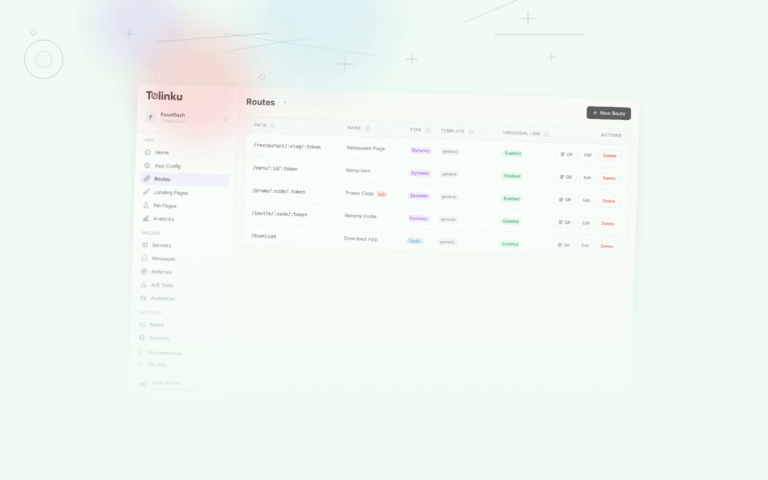
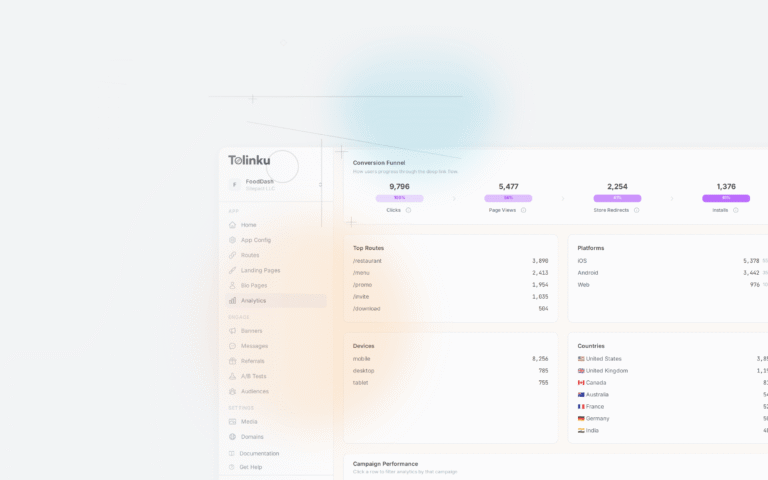
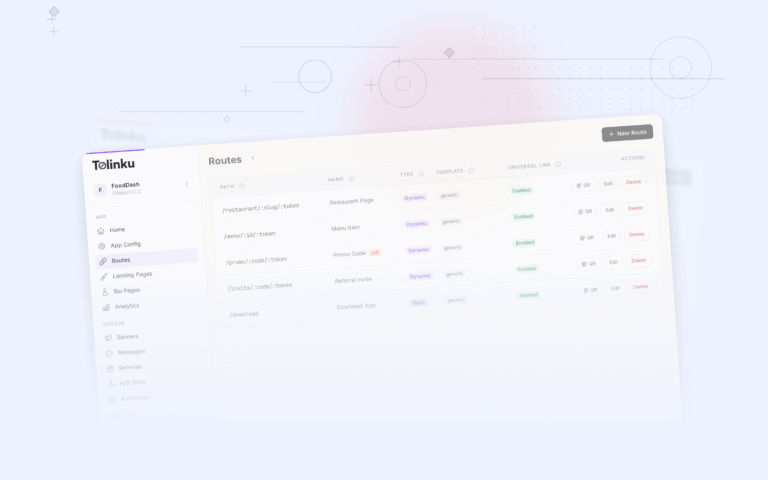
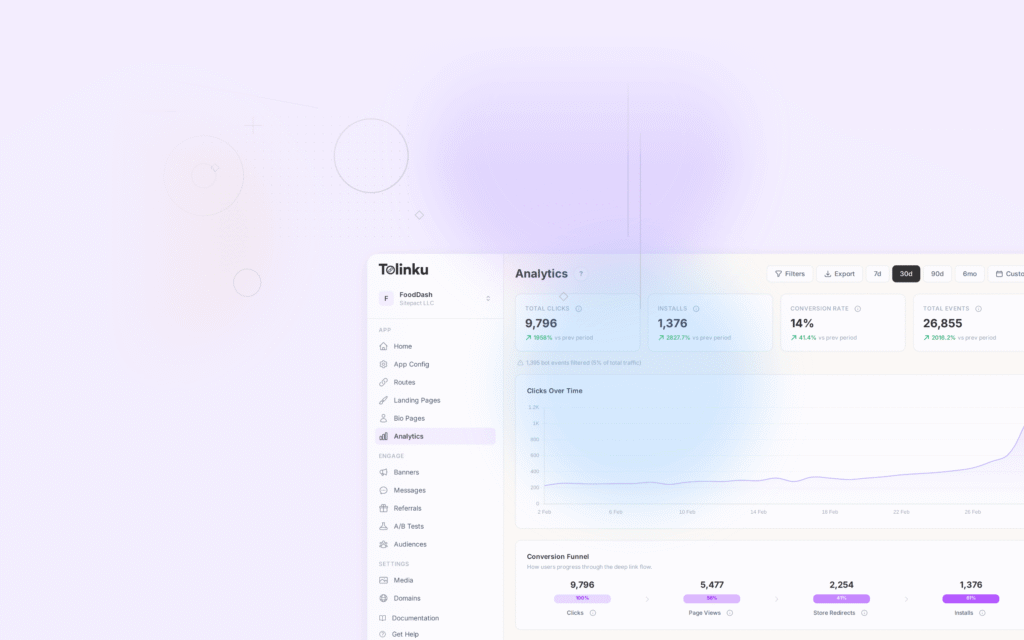
Tolinku supports dynamic routes with query parameters for personalization. Set up routes like /for-you or /deals that your app resolves differently per user. Deferred deep linking preserves personalization context through app installation. Analytics show performance per campaign and segment, so you can measure the impact of personalized vs generic deep links.
For the complete e-commerce guide, see deep linking for e-commerce apps. For product recommendations, see product recommendation deep links.
Get deep linking tips in your inbox
One email per week. No spam.