

When a user taps a deep link, where should they land? The product page? A campaign-specific landing screen? The home feed with the product highlighted? Each destination produces different conversion rates, and the only way to know which works best is to test. A/B testing deep link destinations lets you split traffic between different in-app screens and measure which one drives the most purchases, signups, or engagement.
For CTA testing, see CTA A/B Testing for App Install and Deep Links. For conversion funnel analysis, see Conversion Funnel Analysis for Deep Links.
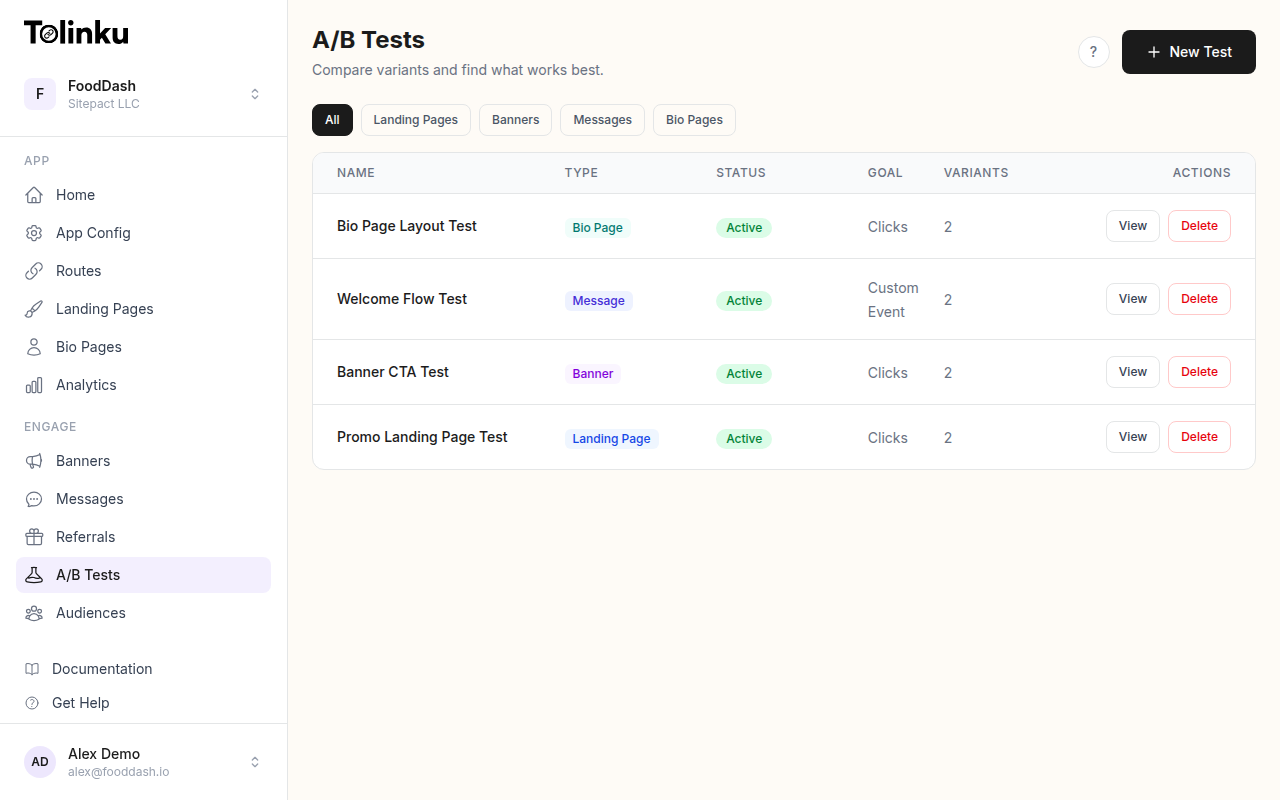 The A/B tests list page showing test names, status, types, and variant counts.
What to Test
Common Destination Comparisons
| Test | Variant A | Variant B | Primary Metric |
|---|---|---|---|
| Product link | Product detail page | Product in collection view | Purchase rate |
| Campaign link | Campaign landing page | Category page with banner | Conversion rate |
| Referral link | Referral welcome screen | Home feed with referral banner | Signup completion |
| Content share | Full article view | Article preview + signup prompt | Account creation |
| Re-engagement | Last viewed screen | Home with "what's new" | Session depth |
| Onboarding | Feature tour first | Content first | D7 retention |
When Destination Testing Matters
Destination testing has the highest impact when:
- High traffic links: Ad campaigns, email blasts, popular shared content
- High-value actions: Purchase flows, subscription prompts, account creation
- New user flows: Deferred deep links where first impressions are critical
For low-traffic links (< 100 clicks/week), destination testing takes too long to reach significance.
Implementation
Route-Level A/B Testing
Implement testing at the deep link routing layer:
function routeDeepLink(url, userId) {
  const path = new URL(url).pathname;
  const params = Object.fromEntries(new URL(url).searchParams);

  // Check for active experiments on this route
  const experiment = getActiveExperiment(path);

  if (experiment) {
    const variant = assignVariant(userId, experiment.id);
    const destination = variant.destination;

    analytics.track('experiment_impression', {
      experimentId: experiment.id,
      variantId: variant.id,
      originalPath: path,
      actualDestination: destination,
    });

    return navigateTo(destination, params);
  }

  // No experiment, use default routing
  return navigateTo(path, params);
}
Experiment Configuration
const destinationExperiments = {
  product_destination_v2: {
    id: 'product_destination_v2',
    routePattern: '/product/:id',
    variants: [
      {
        id: 'product_page',
        weight: 50,
        destination: '/product/:id', // Direct product page
      },
      {
        id: 'product_in_collection',
        weight: 50,
        destination: '/collection/:category?highlight=:id', // Product visible in collection
      },
    ],
    primaryMetric: 'purchase',
    secondaryMetrics: ['add_to_cart', 'time_on_screen', 'bounce_rate'],
    minSampleSize: 2000,
  },

  campaign_destination_v1: {
    id: 'campaign_destination_v1',
    routePattern: '/campaign/:slug',
    variants: [
      {
        id: 'landing_page',
        weight: 50,
        destination: '/campaign/:slug/landing', // Custom landing page
      },
      {
        id: 'category_with_banner',
        weight: 50,
        destination: '/category/:category?banner=:slug', // Category + promotional banner
      },
    ],
    primaryMetric: 'conversion',
    secondaryMetrics: ['engagement_time', 'items_viewed'],
    minSampleSize: 1500,
  },
};
Variant Assignment
Use a deterministic hash for consistent assignment:
function assignVariant(userId, experimentId) {
  // Check for existing assignment
  const existing = storage.get(`experiment_${experimentId}_${userId}`);
  if (existing) return existing;

  // Deterministic assignment based on user ID
  const hash = djb2Hash(`${userId}-${experimentId}`);
  const experiment = destinationExperiments[experimentId];
  const totalWeight = experiment.variants.reduce((sum, v) => sum + v.weight, 0);
  let bucket = hash % totalWeight;

  for (const variant of experiment.variants) {
    bucket -= variant.weight;
    if (bucket < 0) {
      storage.set(`experiment_${experimentId}_${userId}`, variant);
      return variant;
    }
  }

  return experiment.variants[0]; // Fallback
}

function djb2Hash(str) {
  let hash = 5381;
  for (let i = 0; i < str.length; i++) {
    hash = ((hash << 5) + hash) + str.charCodeAt(i);
  }
  return Math.abs(hash);
}
Tracking and Analysis
Event Tracking
Track the complete funnel for each variant:
// Impression (user saw the destination)
analytics.track('destination_viewed', {
  experimentId: 'product_destination_v2',
  variantId: 'product_page',
  productId: 'prod_123',
  source: 'ad_campaign',
});

// Engagement (user interacted)
analytics.track('destination_engaged', {
  experimentId: 'product_destination_v2',
  variantId: 'product_page',
  action: 'add_to_cart',
  productId: 'prod_123',
});

// Conversion (user completed the goal)
analytics.track('destination_converted', {
  experimentId: 'product_destination_v2',
  variantId: 'product_page',
  conversionType: 'purchase',
  revenue: 42.50,
});
Results Analysis
async function analyzeExperiment(experimentId) {
  const experiment = destinationExperiments[experimentId];

  for (const variant of experiment.variants) {
    const impressions = await countEvents('destination_viewed', {
      experimentId, variantId: variant.id,
    });
    const engagements = await countEvents('destination_engaged', {
      experimentId, variantId: variant.id,
    });
    const conversions = await countEvents('destination_converted', {
      experimentId, variantId: variant.id,
    });
    const revenue = await sumRevenue('destination_converted', {
      experimentId, variantId: variant.id,
    });

    console.log(variant.id, {
      impressions,
      engagementRate: (engagements / impressions * 100).toFixed(2) + '%',
      conversionRate: (conversions / impressions * 100).toFixed(2) + '%',
      revenuePerImpression: (revenue / impressions).toFixed(2),
      avgOrderValue: conversions > 0 ? (revenue / conversions).toFixed(2) : 'N/A',
    });
  }
}
Statistical Significance
function isSignificant(controlConversions, controlTotal, treatmentConversions, treatmentTotal) {
  const p1 = controlConversions / controlTotal;
  const p2 = treatmentConversions / treatmentTotal;
  const pPooled = (controlConversions + treatmentConversions) / (controlTotal + treatmentTotal);

  const se = Math.sqrt(pPooled * (1 - pPooled) * (1 / controlTotal + 1 / treatmentTotal));
  const z = (p2 - p1) / se;

  // z > 1.96 means p < 0.05 (95% confidence)
  return {
    zScore: z.toFixed(3),
    significant: Math.abs(z) > 1.96,
    lift: ((p2 - p1) / p1 * 100).toFixed(1) + '%',
    confidence: Math.abs(z) > 2.58 ? '99%' : Math.abs(z) > 1.96 ? '95%' : 'Not significant',
  };
}
Common Test Patterns
Pattern 1: Product Page vs. Collection View
When a user clicks a product ad, do they convert better landing on the product detail page or seeing the product in a browsable collection?
Typical result: Product detail pages win for high-intent sources (search ads, email). Collection views win for discovery sources (social ads, content shares).
Pattern 2: Custom Landing vs. Existing Screen
Should you build a custom campaign landing page or route to an existing app screen?
Typical result: Custom landing pages win for conversion rate but cost more to build and maintain. Existing screens win for ROI when the uplift doesn't justify the build cost.
Pattern 3: Auth-First vs. Content-First
For new users arriving via deep links, should they sign up first or see content first?
Typical result: Content-first wins by 20-40% for signup completion because users see value before committing. Auth-first wins for time-sensitive actions (limited offers, expiring content).
Best Practices
1. Test One Variable at a Time
Only change the destination, not the copy, design, or pricing. If you change multiple things, you can't attribute the result.
2. Run for Minimum 2 Weeks
Day-of-week effects are real. Weekend traffic behaves differently from weekday traffic. Run every test for at least 14 days.
3. Segment Your Results
The winning variant might differ by source:
async function analyzeBySource(experimentId) {
  const sources = ['ad', 'email', 'social', 'referral', 'organic'];

  for (const source of sources) {
    const results = await getExperimentResults(experimentId, { source });
    console.log(source, results);
  }
}
4. Track Long-Term Impact
A variant that wins on immediate conversion might lose on D30 retention. Track downstream metrics for at least 30 days before declaring a permanent winner.
For A/B testing features, see Tolinku A/B testing. For test setup, see the A/B testing documentation.
Get deep linking tips in your inbox
One email per week. No spam.