Your referral program lives or dies by the emails around it. The initial invitation, the follow-up reminder, the reward notification, the milestone celebration. Each one is a conversion point where a user either takes action or ignores you.
Most referral emails fail because they focus on the mechanics ("Use code XYZ123 to get $10") instead of the relationship ("Sarah thought you'd love this"). The best referral emails feel like a personal recommendation, not a marketing campaign.
This guide covers templates for every stage of the referral funnel. Each template is tested against email marketing benchmarks and follows principles from referral programs that consistently outperform. For the overall referral program strategy, see building referral programs that actually work. For sharing across social platforms, see the social sharing guide.
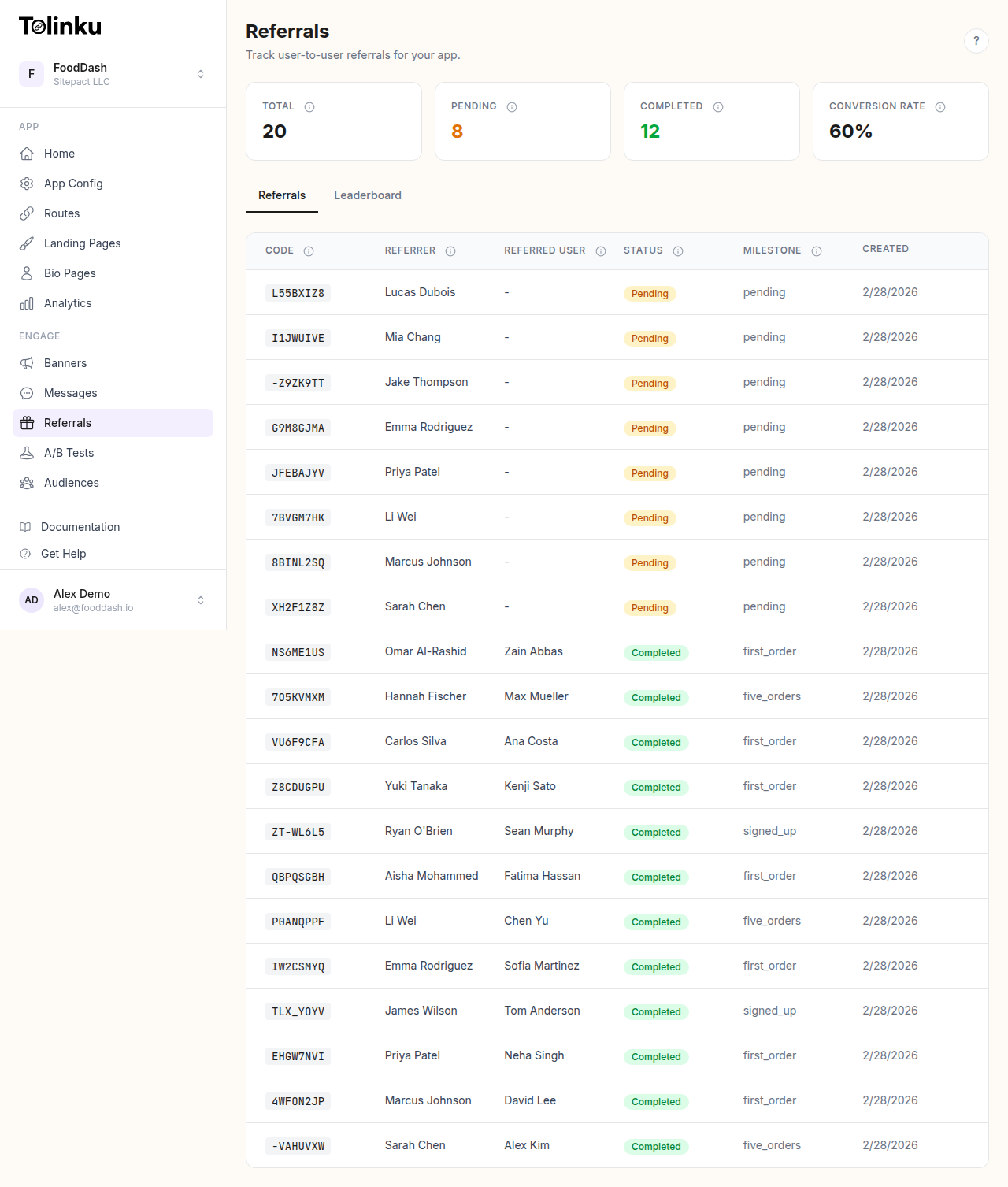 The referrals page with stats cards, referral list, and leaderboard tabs.
Principles for Referral Emails
Before the templates, here are the principles they're all built on:
1. Lead with the relationship, not the reward. "Your friend Sarah invited you" is stronger than "Get $10 off." The reward matters, but trust in the referrer is what drives the click.
2. One CTA per email. Every referral email should have exactly one action: click the referral link. Don't distract with feature lists, social links, or unrelated promotions.
3. Make the link prominent. The referral link should be a large, obvious button. Not a text link buried in a paragraph. Not a code the user has to remember and type in later.
4. Keep it short. Referral emails should be 50-100 words of body text. The decision to click is emotional (trust in the referrer) and immediate. Long emails give the reader reasons to procrastinate.
5. Use the referrer's name. "[Friend's name] thinks you should try [Product]" outperforms "[Product]: You've been referred!" in every test.
Template 1: The Initial Invitation
Sent by the referrer to their friend (or sent on behalf of the referrer by your system).
Subject Lines (Pick One)
[Referrer Name] invited you to try [Product][Referrer Name] sent you a giftYou have a [Product] invitation from [Referrer Name]
Body
Hi [Friend Name],

[Referrer Name] thought you'd like [Product] and sent you an
invitation with [reward description, e.g., "$10 credit" or
"a free month"].

[LARGE CTA BUTTON: "Accept [Referrer Name]'s Invitation"]

[One sentence about what the product does.]

The invitation expires in [timeframe, e.g., "14 days"].

— The [Product] Team
Why It Works
- The subject line includes the referrer's name, which triggers recognition and trust.
- The body leads with the personal connection ("thought you'd like").
- The CTA uses the referrer's name again, reinforcing the social element.
- The expiration creates urgency without being aggressive.
Technical Notes
The CTA button should link to your referral deep link. When the recipient clicks, deferred deep linking ensures the referral attribution survives the app install process. The recipient installs the app, opens it, and the referral is automatically credited to the referrer.
Template 2: The Reminder (to the Referrer)
Sent to existing users who haven't shared their referral link yet, or who shared it once and stopped.
Subject Lines
Your friends are missing out on [reward]You have [X] invitations left to shareEarn [reward] for each friend who joins
Body
Hi [User Name],

You have [reward, e.g., "$10"] waiting for you. Share your
personal referral link with a friend, and you both get [reward]
when they sign up.

[LARGE CTA BUTTON: "Share Your Link"]

Here's your link if you'd rather copy and paste:
[referral link]

So far, [X] people have used your link. [Or: "Be the first
to share and start earning."]

— The [Product] Team
Why It Works
- Frames the email around the user's benefit ("waiting for you").
- Provides both a share button and a plain-text link (different users prefer different methods).
- The social proof line ("X people have used your link") motivates users who've already had some success.
Timing
Send the first reminder 7 days after the user signs up (they've had time to experience the product). Send a second reminder 30 days after signup if they still haven't shared. Don't send more than two unsolicited reminders; after that, only trigger reminders based on product usage events (e.g., after a successful transaction).
Template 3: The Nudge (to the Referred Friend)
Sent to the referred friend if they clicked the link but didn't complete signup.
Subject Lines
[Referrer Name] is still waiting for youYour [reward] from [Referrer Name] is about to expireFinish signing up and get [reward]
Body
Hi [Friend Name],

[Referrer Name] invited you to [Product] [X days ago], and
your [reward] is still waiting.

[LARGE CTA BUTTON: "Claim Your [Reward]"]

[One sentence about value prop, e.g., "Join 50,000 users
who manage their finances with [Product]."]

This invitation expires on [date].

— The [Product] Team
Why It Works
- Re-invokes the referrer's name to maintain the social connection.
- The "still waiting" framing implies the referrer will be notified (social obligation).
- The expiration date creates concrete urgency.
Timing
Send 2-3 days after the initial click if the friend hasn't signed up. Send a final reminder 1-2 days before the invitation expires. Two nudges maximum.
Template 4: The Reward Notification
Sent to the referrer when their referral is successful and their reward is credited.
Subject Lines
You earned [reward]! Thanks for sharing [Product][reward] credited to your account[Friend Name] just joined, and you earned [reward]
Body
Hi [User Name],

Great news: [Friend Name] signed up using your referral, and
[reward] has been credited to your account.

Your referral stats:
• Total referrals: [X]
• Total earned: [amount]

[LARGE CTA BUTTON: "Invite More Friends"]

— The [Product] Team
Why It Works
- Immediate positive reinforcement. The reward notification is a dopamine hit that makes the user want to share again.
- Showing cumulative stats ("Total referrals: X") gives the user a sense of progress.
- The CTA strikes while the iron is hot: they just got rewarded, so they're primed to share again.
Timing
Send immediately when the reward is credited. Don't batch these. The connection between "friend signed up" and "I got rewarded" should feel instant.
Template 5: The Milestone Alert
Sent when the referrer hits a significant referral count.
Subject Lines
You just hit [X] referrals![Badge name] unlocked: [X] friends referredYou're in the top [X]% of referrers
Body
Hi [User Name],

You've referred [X] friends to [Product]. That makes you
one of our top referrers.

[If badge earned: "You've earned the [Badge Name] badge.
It's now displayed on your profile."]

[If tier unlocked: "You've unlocked [Tier Name] status,
which means [benefit, e.g., '2x referral bonuses on your
next 5 referrals']."]

[LARGE CTA BUTTON: "View Your Referral Dashboard"]

— The [Product] Team
Why It Works
- Milestone alerts celebrate achievement and reinforce the user's identity as a referrer.
- Badges and tiers give the user something concrete to show for their effort.
- The CTA sends them to the dashboard, where they'll see the leaderboard and be motivated to keep going.
Template 6: The Inactive Re-Engagement
Sent to referrers who were previously active but stopped sharing.
Subject Lines
Your referral bonus just increasedWe miss you (and so does your [reward])New: earn [higher reward] for each referral
Body
Hi [User Name],

It's been a while since you shared your referral link. We've
made some updates to the program:

[Highlight one improvement, e.g., "Referral bonuses are now
$15 (up from $10)" or "You can now earn rewards when friends
make their first purchase."]

[LARGE CTA BUTTON: "Share Your Updated Link"]

Your personal link: [referral link]

— The [Product] Team
Why It Works
- Gives a concrete reason to re-engage (program improvement).
- Only send this when you've actually improved something. Don't fabricate urgency.
Timing
Send 60-90 days after the user's last referral activity. Only send once. If they don't re-engage, respect their decision.
Email Deliverability
Referral emails have specific deliverability challenges:
Sender reputation. If your referral emails are sent from the same domain as your transactional emails, a spam complaint on a referral email can hurt delivery of password resets and receipts. Use a subdomain (e.g., refer.yourapp.com) for referral emails.
SPF, DKIM, and DMARC. These email authentication standards are table stakes. Without them, referral emails land in spam. Configure all three for your sending domain.
Unsubscribe headers. Include a List-Unsubscribe header in every referral email. Gmail and other providers use this to show a one-click unsubscribe button, which reduces spam complaints.
Frequency caps. Don't send more than 2-3 referral-related emails per user per month. Beyond that, you're training users to ignore your emails.
Deep Link Integration
Every CTA button in these templates should use a Tolinku referral link as the destination URL. This ensures:
Attribution survives the install. When a new user clicks the referral link in an email, visits the app store, installs the app, and opens it for the first time, deferred deep linking preserves the referral context through the entire journey.
Platform-appropriate routing. The referral link detects the user's platform and sends them to the right app store, or to the web experience if they're on desktop.
Tracking. Every click, install, and referral completion is tracked through Tolinku analytics, giving you visibility into which email templates drive the most conversions.
For email-specific deep linking considerations (link wrapping, click tracking interference, Universal Links in email clients), see the guide on Universal Links in email campaigns.
Measuring Email Performance
Track these metrics for each template:
Metric Target Notes Open rate 30-50% Referral emails should outperform marketing emails because they're triggered by user actions Click rate 10-20% The single-CTA design should drive high click rates Referral conversion rate 5-15% % of email recipients who complete the referral action Revenue per email Varies Track the downstream revenue from referred users A/B test subject lines continuously. Subject line is the single biggest driver of open rate, and open rate is the single biggest driver of everything downstream.
For the complete referral program framework, see building referral programs that actually work. For reward design, see the referral reward strategies guide.
Get deep linking tips in your inbox
One email per week. No spam.