

Deep linking has matured from a niche mobile development technique to a foundational part of mobile product strategy. In 2026, Universal Links and App Links are the standard. Custom URI schemes are legacy. Deferred deep linking is expected, not optional. And privacy regulations have reshaped how attribution and fingerprinting work.
This report covers the current state of deep linking across platforms, industries, and use cases. For platform-specific trends, see deep linking platform trends for 2026. For what comes next, see the future of mobile deep linking.
Platform Changes
iOS 18 and Universal Links
Apple continued strengthening Universal Links in iOS 18:
- Faster AASA file validation. Apple's CDN (
app-site-association.cdn-apple.com) now refreshes AASA files more frequently, reducing the delay between publishing a new route and it becoming active. - Better error reporting. The Apple Search Ads Attribution API and Console.app provide clearer diagnostics when Universal Links fail.
- App Clip improvements. App Clips now support more Universal Link patterns, allowing deeper content routing without a full app install.
- Privacy Manifests. Apps must declare their use of tracking APIs in privacy manifest files. Deep linking SDKs that use device fingerprinting must disclose this.
Android 15 and App Links
Google made App Links more robust in Android 15:
- Verified Links improvements. The Digital Asset Links verification process is more reliable, with better caching and fallback behavior.
- Intent filter auto-verification. Android now verifies intent filters more aggressively at install time, reducing broken link states.
- Privacy Sandbox maturation. The Android Privacy Sandbox continues rolling out, affecting how attribution works for deferred deep links.
- Instant Apps evolution. Google Play Instant now integrates more closely with App Links, enabling seamless transitions from web to instant app to full app.
Privacy Landscape
The End of Device Fingerprinting
The most significant change in deep linking for 2026 is the continued erosion of device fingerprinting as an attribution method:
| Signal | Status in 2026 |
|---|---|
| IP address | Increasingly unreliable (VPN adoption, iCloud Private Relay) |
| User-Agent string | Frozen/reduced by Chrome UA reduction and Safari |
| Screen resolution | Too many devices share common resolutions |
| Timezone + language | Low-entropy signals, high false positive rate |
| Canvas/WebGL fingerprint | Blocked by Safari, restricted in Chrome |
Deferred deep linking (routing a user to specific content after they install the app) relied heavily on fingerprinting to match the pre-install click to the post-install open. In 2026, the accuracy of fingerprint-based deferred deep linking has dropped significantly.
What Replaced Fingerprinting
Install Referrer (Android). Google's Play Install Referrer API provides deterministic attribution for Android installs. This is the most reliable method and does not require fingerprinting.
Clipboard-based linking. Copying a token to the clipboard before redirecting to the app store. The app reads the clipboard on first open. This is deterministic but requires user consent on iOS (the paste permission dialog).
SKAdNetwork / AdAttributionKit (iOS). Apple's privacy-preserving attribution frameworks provide conversion data without user-level tracking. Limited to ad campaigns, not organic deep links.
Server-side matching with consent. For authenticated users (logged in on web, installs app), server-side matching based on user ID is deterministic and privacy-compliant.
Regulation Impact
- GDPR (EU): Fingerprinting for attribution is considered personal data processing and requires consent.
- DMA (EU): The Digital Markets Act affects how gatekeepers (Apple, Google) handle deep linking through their platforms.
- CCPA/CPRA (California): Users can opt out of cross-context behavioral tracking, which affects deferred deep linking attribution.
- App Tracking Transparency (Apple): ATT consent rates remain around 25-30%, meaning the majority of iOS users cannot be tracked across apps.
Industry Adoption
Deep Linking by Category
Deep linking adoption varies by app category:
Category Universal/App Link Adoption Deferred Deep Linking Smart Banners E-commerce 95%+ Common Very common Social media 90%+ Common Less common (prefer in-app browsers) Fintech 85%+ Growing Common Travel 80%+ Common Very common Food delivery 90%+ Common Common Healthcare 70%+ Less common Less common Education 65%+ Less common Growing B2B / Enterprise 75%+ Less common Rare Gaming 60%+ Less common Less common E-commerce and food delivery lead because the ROI is directly measurable: a deep link to a product or restaurant drives immediate revenue.
Link Resolution Performance
Industry benchmarks for link resolution time (tap to content displayed):
Percentile Universal Link (app installed) Web Fallback (no app) Deferred Deep Link P50 150ms 1.2s 2.5s P90 350ms 2.8s 6s P99 800ms 5s 12s The gap between Universal Links (near-instant) and deferred deep links (seconds) highlights why getting users to install the app is critical for performance.
Technology Trends
The Rise of Link Previews
Link previews (in iMessage, WhatsApp, Slack, Discord) have become a significant driver of deep link engagement. Open Graph tags determine what users see before they tap:
- Messages with rich previews (image, title, description) have 2-3x higher tap-through rates than plain URLs.
- Each messaging platform has its own preview renderer with different requirements.
- Preview images are cached aggressively; updating them requires cache-busting strategies.
QR Codes as Deep Link Entry Points
QR code usage for app deep linking has stabilized after the pandemic-era surge:
- Retail: QR codes on product packaging linking to product details, reviews, or warranty registration.
- Restaurants: Digital menus via QR codes are now permanent, not just a pandemic measure.
- Events: QR codes on tickets linking to event details, maps, and schedules.
- Print media: Magazines and billboards use QR codes to bridge physical and digital.
The key challenge: QR codes must resolve quickly and handle the "app not installed" case gracefully.
Cross-Platform Deep Linking
The expectation is now that a single link works everywhere:
- Tap on iOS: opens the iOS app.
- Tap on Android: opens the Android app.
- Tap on desktop: opens the web app.
- Tap in email: detects the platform and routes accordingly.
- Scanned as QR code: works on any device.
This cross-platform expectation has driven adoption of deep linking platforms that handle the routing logic server-side rather than with client-side detection scripts.
AI and Deep Linking
AI assistants (Siri, Google Assistant, ChatGPT) are generating links and routing users to app content. This creates new requirements:
- Links shared by AI must be properly formatted with correct deep link parameters.
- Apps need to handle traffic from AI-generated deep links, which may have different referrer patterns.
- Structured data (Schema.org markup, Firebase App Indexing) helps AI understand what content is available in your app.
What is Not Working
Custom URI Schemes
Custom URI schemes (
yourapp://path) are effectively deprecated for production use:- They show error dialogs when the app is not installed.
- They do not support web fallback.
- They are not verified (any app can claim any scheme).
- They do not work reliably across all contexts (some apps strip custom schemes from messages).
Universal Links and App Links are the standard. Custom schemes should only be used as a fallback for very old OS versions.
JavaScript App-Detection Hacks
The pattern of using JavaScript to try opening a custom URI scheme, then falling back to the web after a timeout, is unreliable:
// This pattern is unreliable in 2026
window.location.href = 'yourapp://path';
setTimeout(() => {
  window.location.href = 'https://apps.apple.com/app/yourapp/id123';
}, 2000);
This produces inconsistent behavior across browsers and OS versions. Universal Links eliminate the need for this approach entirely.
Overly Long Redirect Chains
Deep links that pass through multiple redirects (tracking service, URL shortener, CDN, analytics platform) suffer from:
- Added latency (each redirect adds 100-300ms).
- Broken Universal Links (iOS does not follow server-side redirects for Universal Link interception).
- Lost referrer data (some redirects strip the referrer header).
Minimizing redirect hops remains critical for deep link performance and reliability.
Tolinku in 2026
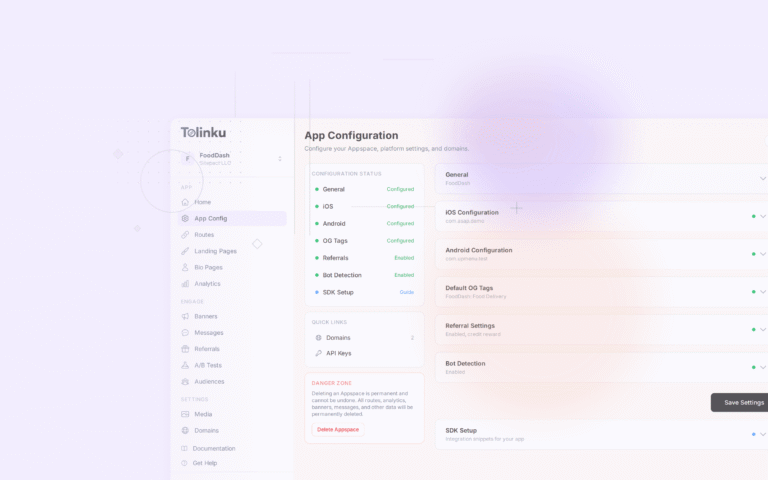
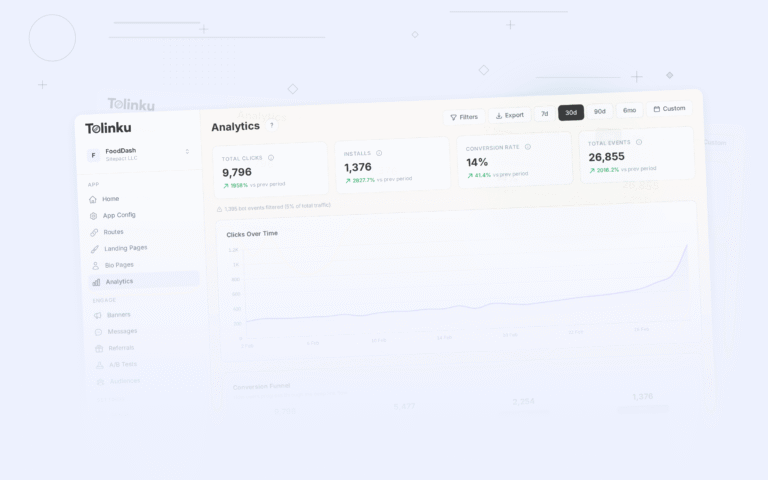
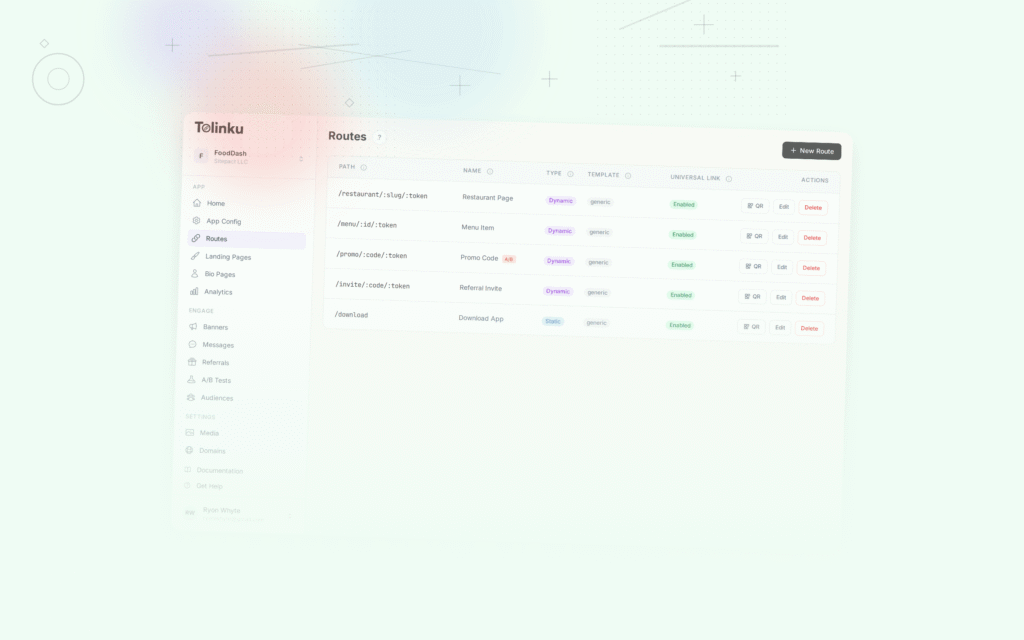
Tolinku was built for the current state of deep linking: Universal Links and App Links as the primary mechanism, web fallback for users without the app, and privacy-compliant attribution. Configure your deep links, routes, and smart banners in the Tolinku dashboard.
For how deep linking standards have evolved, see deep linking standards in 2026.
Get deep linking tips in your inbox
One email per week. No spam.