

Google deprecated Firebase Dynamic Links in August 2025. Existing links continue to work, but no new features are being developed, and the service will eventually shut down. If you relied on Firebase Dynamic Links (FDL), you need a replacement.
This guide compares the available alternatives and helps you choose the right one. For a detailed migration guide, see migrating from Firebase Dynamic Links. For background on the shutdown, see Firebase Dynamic Links shutdown: what happened.
Why Firebase Dynamic Links Shut Down
Firebase Dynamic Links was a free deep linking service bundled with Firebase. Google deprecated it for several reasons:
- No revenue model. FDL was free with no paid tier, making it unsustainable.
- Limited investment. The product had not received significant updates in years. Features like smart banners and advanced analytics were never added.
- Reliability issues. FDL had well-documented problems with link resolution reliability, particularly on iOS where Universal Link behavior was inconsistent.
- Firebase focus shift. Google refocused Firebase on core services (auth, database, hosting, cloud functions) rather than peripheral products.
What You Lose
When Firebase Dynamic Links fully shuts down, you lose:
- Hosted deep links. Links at
yourapp.page.linkwill stop resolving. - Deferred deep linking. Post-install routing to specific content.
- Platform detection. Automatic routing between iOS app, Android app, and web fallback.
- Analytics. Basic link click and open tracking.
- Firebase console integration. Link creation and management in the Firebase console.
You need to replace all of these capabilities.
Alternative 1: Tolinku
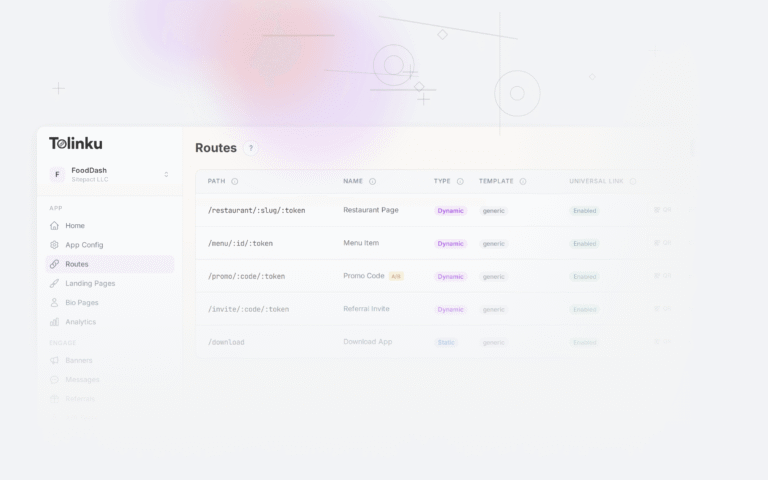
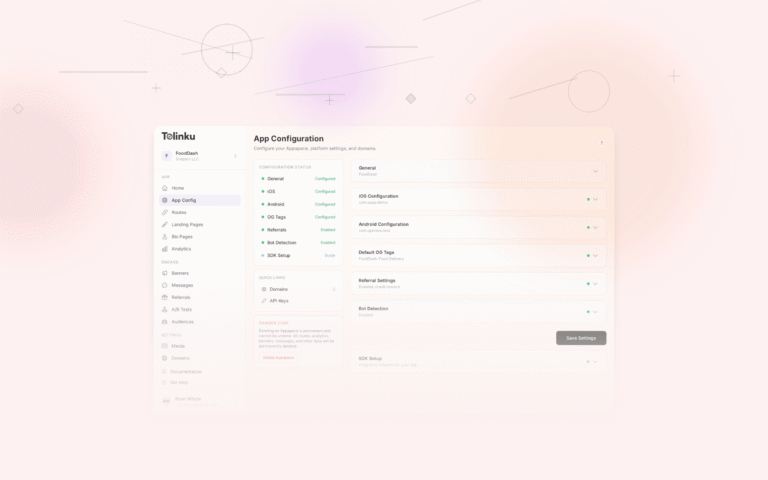
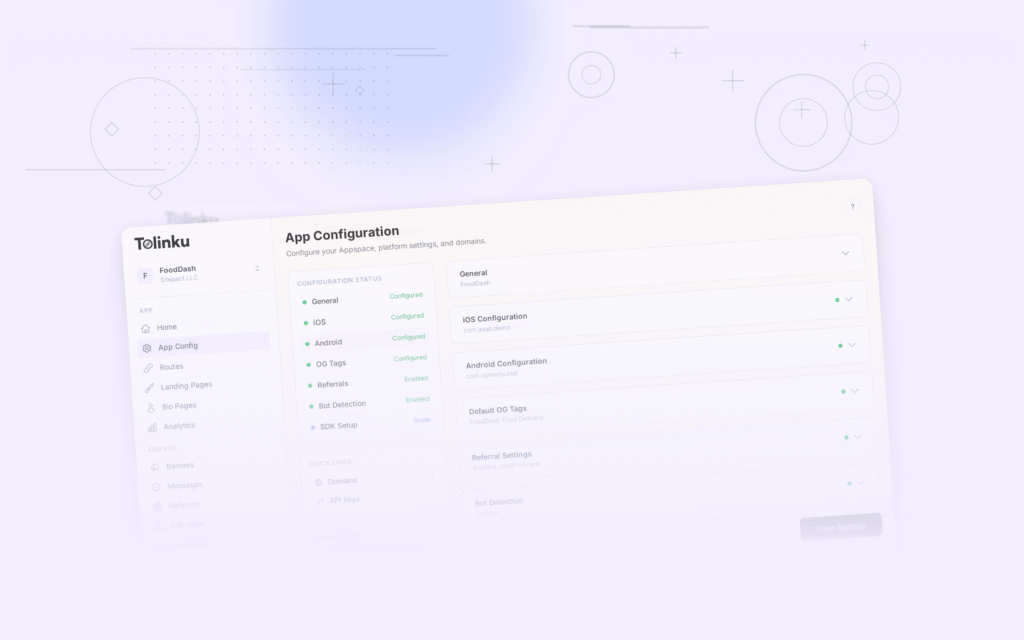
Tolinku is a direct replacement for Firebase Dynamic Links with additional features FDL never had.
What Tolinku Replaces
| FDL Feature | Tolinku Equivalent |
|---|---|
| Deep links (page.link) | Custom domain links |
| Universal Links (iOS) | Universal Links (managed AASA) |
| App Links (Android) | App Links (managed assetlinks.json) |
| Deferred deep linking | Deferred deep linking (Install Referrer + clipboard) |
| Platform detection | Automatic platform routing |
| Link analytics | Full link analytics with click, open, and conversion tracking |
| Firebase console | Tolinku dashboard |
What Tolinku Adds
Features FDL never had:
- Smart banners. Customizable banners on your website to promote your app.
- QR code generation. Create QR codes for any deep link.
- Route patterns. Define path-based routes with parameters, not just static links.
- Custom domains. Use your own branded domain instead of a generic one.
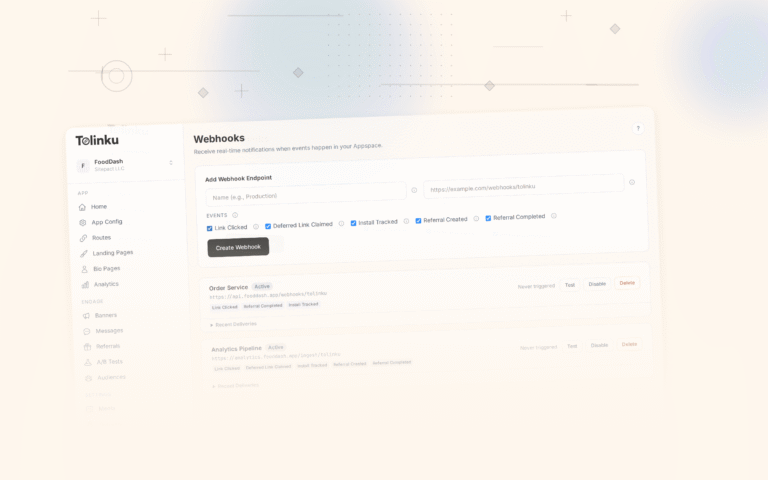
- Webhooks. Get notified when links are clicked or apps are opened.
- Team management. Multiple team members with role-based access.
Pricing
Tolinku has a free tier that covers small apps:
| Tier | Price | Clicks/month |
|---|---|---|
| Free | $0 | 1,200 |
| Standard | $39/Appspace/mo | 50,000 |
| Growth | $79/Appspace/mo | 250,000 |
| Scale | $149/Appspace/mo | 500,000 |
FDL was free, so any paid alternative is a cost increase. However, Tolinku's free tier covers apps with low traffic, and the paid tiers are affordable for apps that outgrow the free limits.
Migration Effort
Migration from FDL to Tolinku involves:
- Creating a Tolinku Appspace and configuring routes.
- Setting up your custom domain.
- Replacing the Firebase Dynamic Links SDK with the Tolinku SDK.
- Updating deep link handling code.
- Redirecting existing
page.linkURLs to new Tolinku links.
For a step-by-step walkthrough, see migrating from Firebase Dynamic Links.
Alternative 2: Native Deep Linking (No Platform)
You can implement deep linking without any third-party platform using Apple's Universal Links and Google's App Links directly.
What You Build
- AASA file: Host
apple-app-site-associationon your web server. - assetlinks.json: Host
assetlinks.jsonon your web server. - Web fallback pages: Build landing pages for users without the app.
- Deferred deep linking: Implement your own post-install routing using Install Referrer (Android) and clipboard (iOS).
- Analytics: Track link clicks and app opens with your own analytics.
Pros
- No third-party dependency.
- No recurring cost.
- Full control over every aspect.
Cons
- Significant development effort (weeks to months for a production-quality implementation).
- You maintain the AASA/assetlinks infrastructure.
- Deferred deep linking is complex to implement reliably.
- No smart banners, QR codes, or analytics dashboard out of the box.
- Every edge case (in-app browsers, email clients, social media apps) requires custom handling.
This approach works for teams with strong engineering resources who want complete control, but it is not a quick migration path from FDL.
Alternative 3: Attribution Platforms with Deep Linking
MMPs (Mobile Measurement Partners) like Branch, AppsFlyer, and Adjust include deep linking as part of their attribution platforms.
Pros
- Deep linking and attribution in one platform.
- Mature products with extensive documentation.
- Large ecosystem of ad network integrations.
Cons
- Expensive. These platforms are priced for attribution use cases, starting at hundreds to thousands of dollars per month.
- Complex. You get a full attribution suite when you may only need deep linking.
- Large SDKs. Attribution SDKs are 2-3 MB, adding to app size and cold start time.
- Vendor lock-in. Attribution data tied to the platform makes switching costly.
If you already use an MMP for attribution, adding deep linking through that MMP makes sense. If you only need deep linking, an MMP is overkill.
Comparison Matrix
| Tolinku | Native DIY | MMP (Branch/AppsFlyer/Adjust) | |
|---|---|---|---|
| Setup time | Hours | Weeks-months | Days |
| Monthly cost | $0-149 | $0 (dev time) | $500-10,000+ |
| Universal Links | Managed | Self-managed | Managed |
| App Links | Managed | Self-managed | Managed |
| Deferred deep linking | Yes | Build it yourself | Yes |
| Smart banners | Yes | Build it yourself | Yes (basic) |
| QR codes | Yes | Build it yourself | Yes |
| Analytics | Yes | Build it yourself | Yes |
| Attribution | Basic (UTM) | Build it yourself | Full |
| SDK size | < 500 KB | N/A | 2-3 MB |
Migration Timeline
Regardless of which alternative you choose, start migrating now. Google has not announced a final shutdown date, but the product is deprecated and will stop working eventually.
Recommended timeline:
- Week 1-2: Choose your replacement and set up the new platform.
- Week 3-4: Implement the new SDK and update deep link handling in your app.
- Week 5-6: Test all deep link flows (Universal Links, App Links, deferred, web fallback).
- Week 7-8: Redirect existing FDL links to new links. Update all marketing materials.
- Week 9+: Monitor, remove the Firebase Dynamic Links SDK from your next app release.
Do not wait until Google announces a final date. Migrating under deadline pressure leads to broken links and lost users.
Tolinku for FDL Migration
Tolinku is the closest feature match to Firebase Dynamic Links, with a free tier that covers small apps and a straightforward migration path. Set up your Appspace, configure your routes, and start migrating today.
For the complete migration walkthrough, see migrating from Firebase Dynamic Links. For a broader comparison of all deep linking platforms, see deep linking platform comparison.
Get deep linking tips in your inbox
One email per week. No spam.