

Enterprise deep linking has requirements that go beyond features and pricing. Security reviews, compliance certifications, SLA guarantees, data residency, and procurement processes all influence which platform you can actually use. A platform that works for a startup may not pass your enterprise security review.
This guide covers what enterprise teams should evaluate when selecting a deep linking platform. For platform comparisons, see deep linking platform comparison. For migration considerations, see switching costs analysis.
Security Requirements
Data Handling
Enterprise teams must understand how the platform handles data:
- What data is collected? Link clicks, device information, IP addresses, referrer data.
- Where is data stored? Which cloud provider, which region, which country.
- How long is data retained? Retention policies and data deletion capabilities.
- Who has access? Internal access controls, employee access to customer data.
- Is data encrypted? At rest and in transit.
Ask every platform vendor these questions. Document the answers as part of your security review.
Compliance Certifications
| Certification | What It Covers | Relevance |
|---|---|---|
| SOC 2 Type II | Security, availability, processing integrity | Standard for SaaS vendors |
| ISO 27001 | Information security management | International standard |
| GDPR compliance | EU data protection | Required for EU users |
| HIPAA BAA | Health data protection | Required for healthcare apps |
| CCPA compliance | California consumer privacy | Required for CA users |
| PCI DSS | Payment card data | Required if links carry payment context |
Not every app needs every certification. Healthcare apps need HIPAA. Financial apps need SOC 2 and potentially PCI DSS. Apps serving EU users need GDPR compliance.
Penetration Testing
Enterprise security teams typically require:
- Annual third-party penetration test results.
- Vulnerability disclosure policy.
- Incident response plan.
- Bug bounty program (or documented testing process).
SLA Requirements
Uptime
Deep links are critical infrastructure. If the deep linking platform goes down, links stop resolving, and users see error pages instead of your app content.
| SLA Level | Annual Downtime | Typical Tier |
|---|---|---|
| 99.9% | 8.76 hours | Standard |
| 99.95% | 4.38 hours | Premium |
| 99.99% | 52.6 minutes | Enterprise |
For enterprise apps, 99.9% is the minimum acceptable SLA. High-traffic apps (e-commerce, fintech) should target 99.95% or higher.
Response Times
Enterprise SLAs should include support response times:
| Severity | Target Response | Resolution Target |
|---|---|---|
| Critical (service down) | 15 minutes | 4 hours |
| High (feature degraded) | 1 hour | 24 hours |
| Medium (non-critical issue) | 4 hours | 3 business days |
| Low (question/request) | 1 business day | 5 business days |
Scale Requirements
Link Volume
Enterprise apps process millions of link clicks per month. The platform must handle:
- Sustained throughput: Consistent performance at your average traffic level.
- Burst capacity: Handling traffic spikes (marketing campaigns, viral content, seasonal peaks).
- Geographic distribution: Low latency across all regions where your users are.
Ask vendors about their infrastructure: CDN usage, edge computing, auto-scaling, and capacity limits.
API Limits
If you create links programmatically (transactional emails, notifications, user-generated content), API rate limits matter:
- Link creation rate: How many links can you create per second/minute?
- Link resolution rate: How many clicks can the system handle per second?
- Analytics query rate: How quickly can you retrieve reporting data?
Integration Requirements
SDK Stability
Enterprise apps cannot tolerate SDK instability:
- Backward compatibility: SDK updates should not break existing integrations.
- Semantic versioning: Clear major/minor/patch versioning with changelogs.
- Deprecation policy: Minimum 6-month notice before removing features.
- Platform support: Support for the latest and previous 2-3 OS versions.
API Maturity
Enterprise integrations rely on stable APIs:
- API versioning: Versioned endpoints with long support windows.
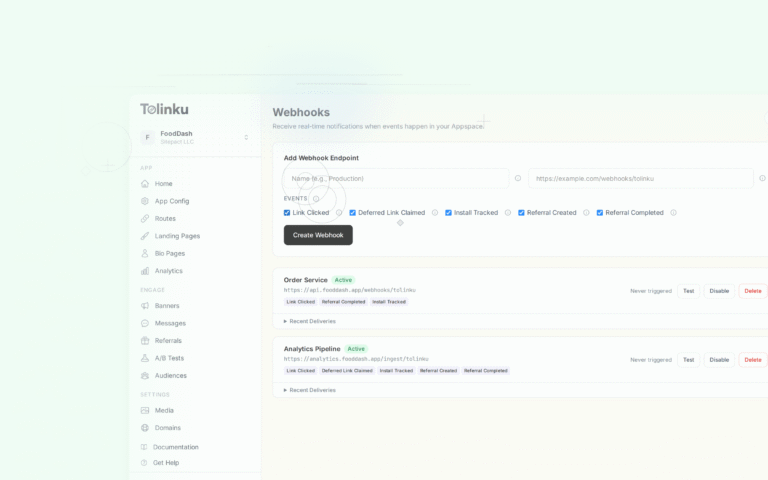
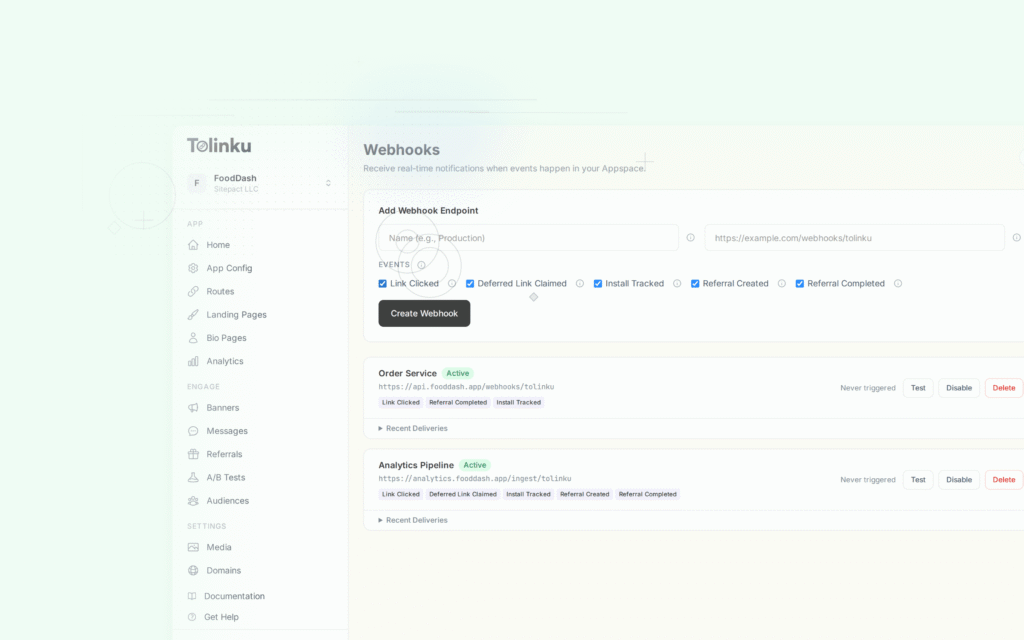
- Webhooks: Reliable webhook delivery with retry logic and signature verification.
- Documentation: Complete, accurate, and up-to-date API documentation.
- SDKs: Official SDKs for all target platforms (iOS, Android, web).
Procurement and Commercial
Pricing Transparency
Enterprise procurement teams need clear pricing:
- Published pricing: Can you estimate costs before talking to sales?
- Predictable billing: Is pricing based on predictable metrics (clicks, users)?
- No surprise overages: Are overage charges capped or predictable?
- Annual billing options: Discounts for annual commitments.
Contract Terms
- Contract length: Monthly vs. annual vs. multi-year.
- Termination clause: Can you exit with reasonable notice?
- Data portability: Can you export your data when you leave?
- Vendor lock-in risk: How difficult is it to migrate to another platform?
For lock-in analysis, see switching costs analysis.
Evaluation Checklist
Use this checklist during your platform evaluation:
Must-Have
- Universal Links (iOS) and App Links (Android) support
- Deferred deep linking
- Custom domain support
- 99.9%+ uptime SLA
- SOC 2 Type II (or equivalent security certification)
- GDPR compliance
- Responsive support with defined SLAs
- Stable, well-documented SDKs
- Data encryption at rest and in transit
Should-Have
- Smart banners
- QR code generation
- Webhook support
- Team management with role-based access
- Analytics dashboard
- API for programmatic link creation
- Published, transparent pricing
Nice-to-Have
- A/B testing
- Advanced audience segmentation
- Custom analytics integrations
- Self-service provisioning (no sales calls needed)
Tolinku for Enterprise
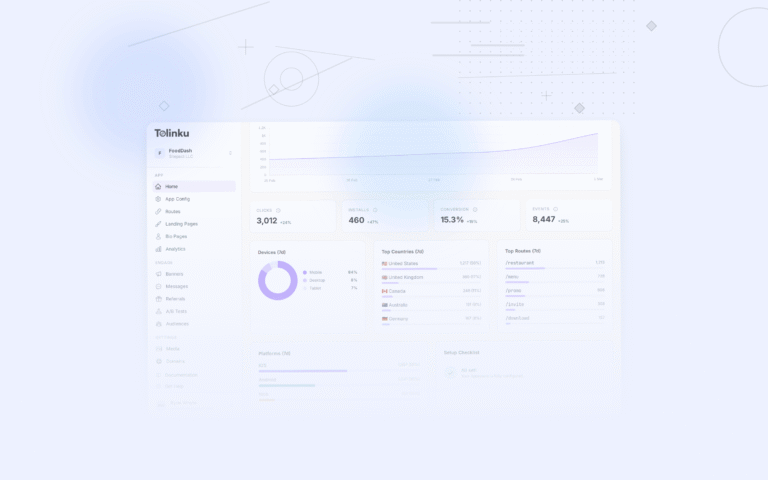
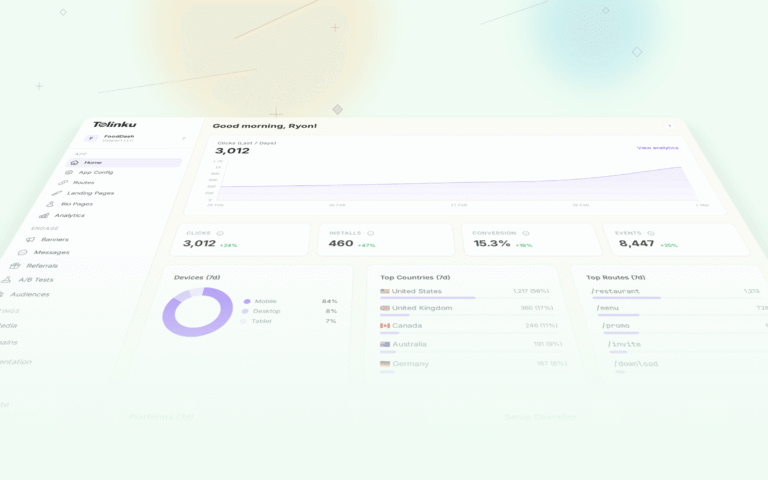
Tolinku provides enterprise-ready deep linking with transparent pricing, full SDK support for iOS, Android, React Native, Flutter, and web, and a dashboard for route management and analytics. The Scale tier ($149/Appspace/month) supports 500,000 clicks with all features. For higher volumes, contact the team.
For migration planning, see enterprise app migration. For total cost analysis, see total cost of ownership for deep linking.
Get deep linking tips in your inbox
One email per week. No spam.