


Short links redirect users from a compact URL to the destination page. The SEO question is whether that redirect costs you anything. The short answer: properly configured 301 redirects pass link equity. But there are nuances around redirect chains, third-party domains, and crawl behavior that matter.
For branded short link setup, see branded short links: setup and best practices. For the complete guide, see QR codes and short links for mobile apps.
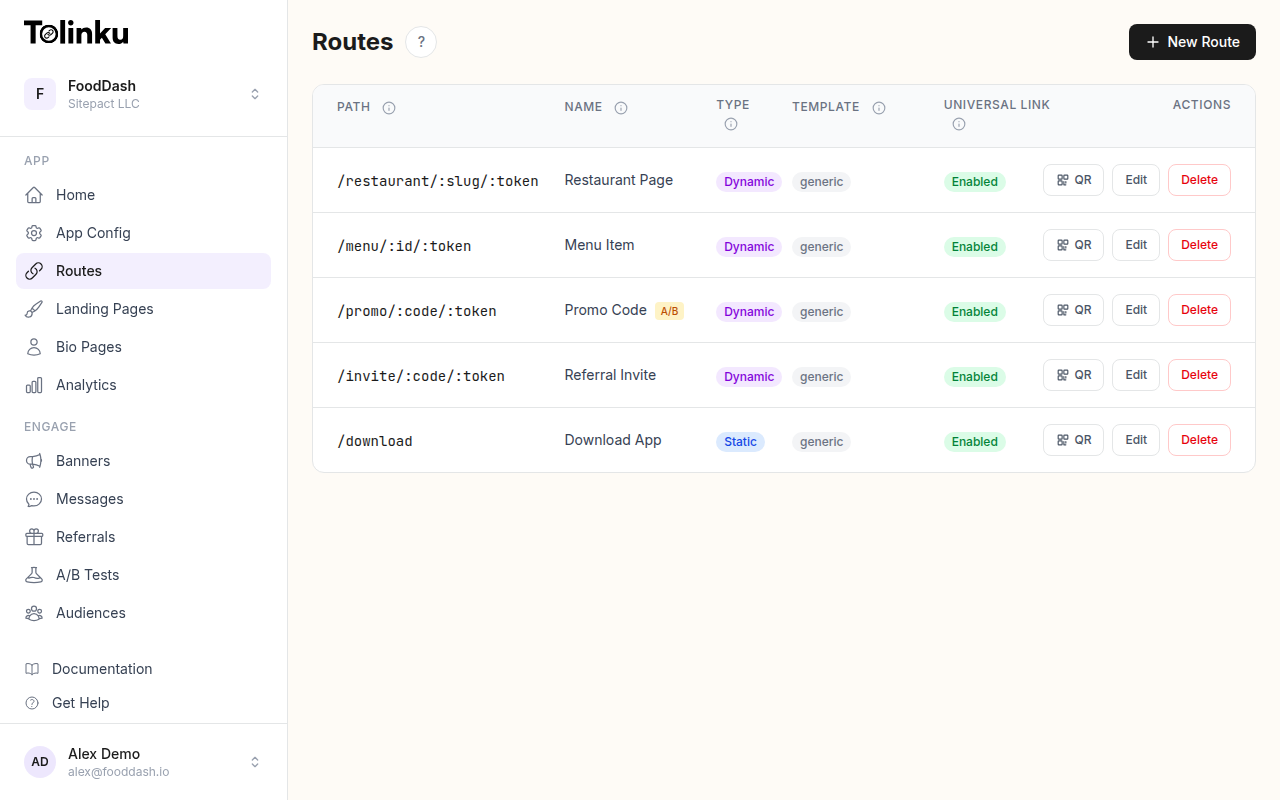 Tolinku route configuration with QR code generation for each deep link.
How Search Engines Handle Short Links
When someone shares a short link (e.g., https://tolk.ink/abc123) and it gets embedded on a website, the search engine crawler follows the redirect to discover the destination URL.
301 Redirects Pass Link Equity
Google has confirmed that 301 redirects pass PageRank. When a page links to https://tolk.ink/abc123 which 301-redirects to https://yourdomain.com/products/summer-sale, the link equity flows to your product page.
The search engine indexes the destination URL, not the short link. The short link URL itself does not appear in search results.
302 Redirects
302 redirects (temporary) historically did not pass full link equity. Google has improved handling of 302s, but 301s are still the standard for permanent redirects. URL shorteners should use 301 redirects for SEO.
JavaScript Redirects
Some link shorteners use JavaScript-based redirects (window.location.href = ...). These are less reliable for SEO because some crawlers do not execute JavaScript. Use server-side 301 redirects.
When Short Links Help SEO
Social Media Distribution
Short links make URLs shareable on platforms with character limits or where long URLs look untrustworthy. More shares can lead to more backlinks, which benefits SEO indirectly.
Tracking Without URL Clutter
Instead of appending UTM parameters to a long URL:
https://yourdomain.com/products/summer-sale?utm_source=twitter&utm_medium=social&utm_campaign=summer2026&utm_content=promo-tweet
Use a short link:
https://tolk.ink/summer26
The destination URL stays clean while the short link tracks the source. This means if someone copies and shares the destination URL (without UTM parameters), the URL is cleaner and more likely to be shared further.
Branded Domain Trust
Short links on a branded domain (e.g., links.yourcompany.com) carry more trust than generic shortener domains. Search engines can associate the branded short domain with your main domain, which may slightly benefit perceived authority.
When Short Links Can Hurt SEO
Redirect Chains
If a short link redirects to another redirect, you create a chain:
tolk.ink/abc → yoursite.com/old-page → yoursite.com/new-page
Google follows redirect chains (up to about 5 hops), but each hop introduces latency and a small risk of the crawler abandoning the chain. Keep it to one redirect.
Third-Party Shortener Risk
Using a generic third-party shortener (like bit.ly or t.co) means your links depend on that service. If the shortener goes down, changes their redirect behavior, or is flagged as spam, your links break.
Branded short links on your own domain avoid this risk entirely.
Link Dilution Across Short Domains
If you use multiple short link domains for different campaigns, the link equity is split across those domains. Consolidate on one branded short domain.
Nofollow and UGC Attributes
Some platforms automatically add rel="nofollow" to all outbound links, including short links. This applies regardless of whether you use a short link or a full URL. The short link does not cause this; the platform does.
Best Practices
Use 301 Redirects
Ensure your short link service uses 301 (permanent) redirects, not 302 (temporary). Most reputable services default to 301.
To check:
curl -I https://tolk.ink/your-link
Look for:
HTTP/2 301
location: https://yourdomain.com/destination
Use a Branded Domain
A branded short domain (e.g., go.yourcompany.com or links.yourcompany.com) is better for SEO than a generic shortener:
- Trust: Users and search engines associate it with your brand.
- Control: You own the domain. If you switch providers, you update the DNS.
- Consistency: All your short links build authority on one domain.
Avoid Redirect Chains
When updating a destination URL, update the short link's target directly. Do not add another redirect:
Good:
tolk.ink/summer → yoursite.com/sales/summer-2026 (updated target)
Bad:
tolk.ink/summer → yoursite.com/sales/summer-2025 → yoursite.com/sales/summer-2026
Canonical URLs
If a short link URL is somehow indexed (rare), the destination page should have a canonical tag pointing to itself:
<link rel="canonical" href="https://yourdomain.com/products/summer-sale" />
This tells search engines that the destination URL is the authoritative version.
Do Not Use Short Links in On-Page Content
Short links are for sharing on external platforms (social media, email, print). On your own website, use full URLs:
- Internal links: Always use the full destination URL. There is no reason to add a redirect hop within your own site.
- Sitemaps: Use full URLs.
- Blog posts: Use full URLs for internal and external links.
Short Links for Link Building
When doing outreach (guest posts, PR, partnerships), use full URLs, not short links. The full URL shows the destination, which builds trust with the linking site's editor. Short links in guest post content may be rejected as spam.
However, short links are useful in:
- Email outreach: Tracking which recipients click.
- Social media profiles: Clean, branded URLs.
- Business cards and print: Scannable, memorable URLs.
- QR codes: Short URLs generate simpler QR codes with fewer modules.
QR Codes and Short Links
QR codes encode URLs. Shorter URLs produce simpler QR codes (fewer modules), which are:
- Easier to scan, especially at small sizes or in low light.
- More tolerant of printing imperfections.
- Easier to brand with a logo overlay.
A URL like https://yourdomain.com/products/summer-collection-2026?utm_source=print&utm_medium=flyer&utm_campaign=summer produces a dense, hard-to-scan QR code. A short link like https://tolk.ink/summer26 produces a clean, easily scannable code.
Measuring Short Link SEO Impact
Track two things:
1. Backlink Attribution
Use a backlink analysis tool (Ahrefs, Moz, Semrush) to check if your short domain has backlinks. These backlinks effectively point to your destination pages through the redirect.
2. Referral Traffic
In your analytics, check if traffic arrives via your short link domain. Most analytics tools resolve the redirect and attribute traffic to the referrer who shared the short link, not to the short link domain itself.
Tolinku for Short Links
Tolinku provides branded short links with custom domains. All redirects use 301 status codes. Each short link includes click analytics, and you can update destinations without changing the short link URL.
For app indexing and SEO, see app indexing and SEO for mobile apps. For branded link setup, see branded short links: setup and best practices.
Get deep linking tips in your inbox
One email per week. No spam.