Abstract strategies are useful, but seeing how real companies applied them is more instructive. This article presents five growth case studies from different app categories, each illustrating a specific tactic: deep linking, referral programs, smart banners, email-to-app conversion, and content-driven growth.
For deep linking fundamentals, see deep linking concepts. For the full growth playbook, see mobile app growth: 25 strategies that work in 2026.
Note: These case studies are composites based on publicly available growth strategies and documented industry patterns. Company-specific metrics are approximations drawn from public disclosures, industry benchmarks, and published interviews.
Case Study 1: Duolingo's Referral Loop
Category: Education Tactic: Incentivized referral program with deep links Outcome pattern: Referrals as a top-3 acquisition channel
What They Did
Duolingo built referral mechanics directly into the learning experience:
- Users earn "gems" (in-app currency) for each friend who installs and completes their first lesson.
- The referral link takes the invitee directly to the sign-up screen with the referrer's name displayed.
- Both sides are rewarded: the referrer gets gems, the invitee gets a welcome bonus.
Why It Worked
| Element | Implementation |
|---|---|
| Natural sharing moment | After completing a milestone ("I finished Spanish Level 3!") |
| Deep linked referral | Invitee sees referrer's name and language, creating social context |
| Double-sided reward | Both parties benefit, increasing acceptance rate |
| Low friction | One-tap share to messaging apps |
Key Takeaway
The referral is triggered at a moment of accomplishment, not randomly. Users feel proud and want to share. The deep link preserves context (who referred them, which language), making the first experience personal rather than generic.
For building your own referral program, see building referral programs that actually work.
Case Study 2: Pinterest's Web-to-App Deep Linking
Category: Social / Discovery Tactic: Deep linking from web content to app Outcome pattern: Significant increase in app installs from web traffic
What They Did
Pinterest has billions of indexed web pages. Their growth strategy:
- Users discover Pinterest content via Google search.
- The web page shows the content with a prompt: "See more in the app."
- Tapping the prompt opens the Pinterest app directly to that pin (if installed) or redirects to the app store.
- After installation, deferred deep linking opens the app to the exact pin the user was viewing on the web.
Why It Worked
| Element | Implementation |
|---|---|
| Massive organic traffic | SEO-driven content indexed by search engines |
| Contextual app prompt | Shows the specific content the user was viewing, not a generic "download our app" |
| Deferred deep linking | Preserves the exact content through the install flow |
| Progressive value reveal | Shows some content on web, implies the app experience is richer |
Key Takeaway
Pinterest does not just drive app installs. They drive contextual app installs. The user was looking at a specific recipe or design idea on the web; the app opens to that exact content. This dramatically improves day-1 retention compared to users who install from a generic app store browse.
Deep linking from web to app is one of the highest-value implementations. For technical details, see the deep linking concepts guide.
Case Study 3: Spotify's Social Sharing Mechanics
Category: Music / Streaming Tactic: Content-driven viral sharing Outcome pattern: Millions of organic shares driving app installs
What They Did
Spotify built multiple sharing mechanics that produce genuinely interesting content:
- Spotify Wrapped: Annual personalized listening summary. Users share their top artists, minutes listened, and listening personality on social media.
- Share cards: Beautiful, branded cards showing the currently playing song, ready for Instagram Stories.
- Collaborative playlists: Invite friends to add songs to shared playlists.
- Lyrics sharing: Share a specific lyric snippet as a visual card.
Why It Worked
| Element | Implementation |
|---|---|
| Content is the product | Shared content (Wrapped cards, song shares) is genuinely interesting to recipients |
| Social currency | Sharing music taste signals identity ("Here's who I am") |
| Platform-optimized format | Share cards are sized for Instagram Stories, Twitter, etc. |
| Deep linked content | Each shared link opens the specific song, playlist, or artist in the app |
Key Takeaway
Spotify Wrapped is arguably the most successful viral mechanic in mobile app history. It works because the content is about the user, not about Spotify. People share it because it is genuinely interesting to their social circle, and every share includes an implicit endorsement of the app.
The lesson: build sharing mechanics around content users want to share for their own reasons, not because you are asking them to promote your app.
Case Study 4: Airbnb's Email-to-App Conversion
Category: Travel / Marketplace Tactic: Deep linked emails driving app engagement Outcome pattern: Measurable increase in booking completion rates from email campaigns
What They Did
Airbnb sends transactional and marketing emails with deep links to in-app content:
- Booking confirmations: "View your reservation" links open the app to the booking details, not the mobile web.
- Saved listing updates: "The price dropped on your saved listing" opens the specific listing in the app.
- Search follow-ups: "New listings matching your search in Barcelona" opens the app to a pre-filtered search.
- Host messages: "Your host sent a message" opens the messaging thread in the app.
Why It Worked
| Element | Implementation |
|---|---|
| Contextual deep links | Every email link goes to a specific in-app screen |
| Higher conversion in-app | App users have saved payment methods and preferences, reducing friction |
| Platform detection | Links detect iOS vs Android and open the correct app or app store |
| Fallback to web | If the user does not have the app, the link opens the mobile web version |
Key Takeaway
Email is not just a web channel. By deep linking emails to in-app content, Airbnb shifts users from the lower-converting mobile web experience to the higher-converting app experience. The key is that every link is contextual: the user taps on a specific listing and lands on that exact listing in the app.
For technical implementation, deep links with platform detection and fallbacks are a core feature of deep linking platforms.
Case Study 5: Calm's Content-Driven Growth
Category: Health & Wellness Tactic: SEO content driving app installs Outcome pattern: Organic search as a major acquisition channel
What They Did
Calm invested heavily in content marketing targeting searches related to their app's domain:
- Blog posts targeting keywords like "how to fall asleep faster," "guided meditation for beginners," "breathing exercises for anxiety."
- Each blog post provides genuine value (not a thin teaser) and includes calls to action: "Try this exercise in the Calm app."
- Landing pages for specific use cases (sleep, focus, stress) with app download links.
- YouTube videos with meditation exercises, descriptions linking to the app.
Why It Worked
| Element | Implementation |
|---|---|
| Problem-first content | Articles solve the user's problem (can't sleep, stressed), then position the app as the next step |
| SEO compounding | Content published years ago still drives daily traffic |
| Multiple content formats | Blog posts, videos, social media, podcasts |
| Deep linked CTAs | "Try this in the app" links go to the specific meditation or exercise |
Key Takeaway
Calm's content strategy works because it targets users with a problem the app solves, not users searching for "meditation app." Someone searching "how to sleep better" is a higher-intent user than someone browsing the app store, and the blog post builds trust before asking for the install.
Content-driven growth compounds over time. A blog post published today continues driving installs next year. Paid ads stop the moment you stop paying.
Patterns Across Case Studies
| Pattern | Case Studies | Implementation |
|---|---|---|
| Deep linking preserves context | All five | Every shared link, email link, or web prompt opens specific in-app content |
| Sharing is about the user, not the app | Duolingo, Spotify | Users share accomplishments and tastes, not app advertisements |
| Web-to-app bridges convert browsers to users | Pinterest, Calm | SEO content drives discovery; deep links drive app installs |
| Transactional emails drive engagement | Airbnb | Every email is an opportunity to bring users back into the app |
| Rewards incentivize but do not force | Duolingo | Referral rewards enhance natural sharing moments |
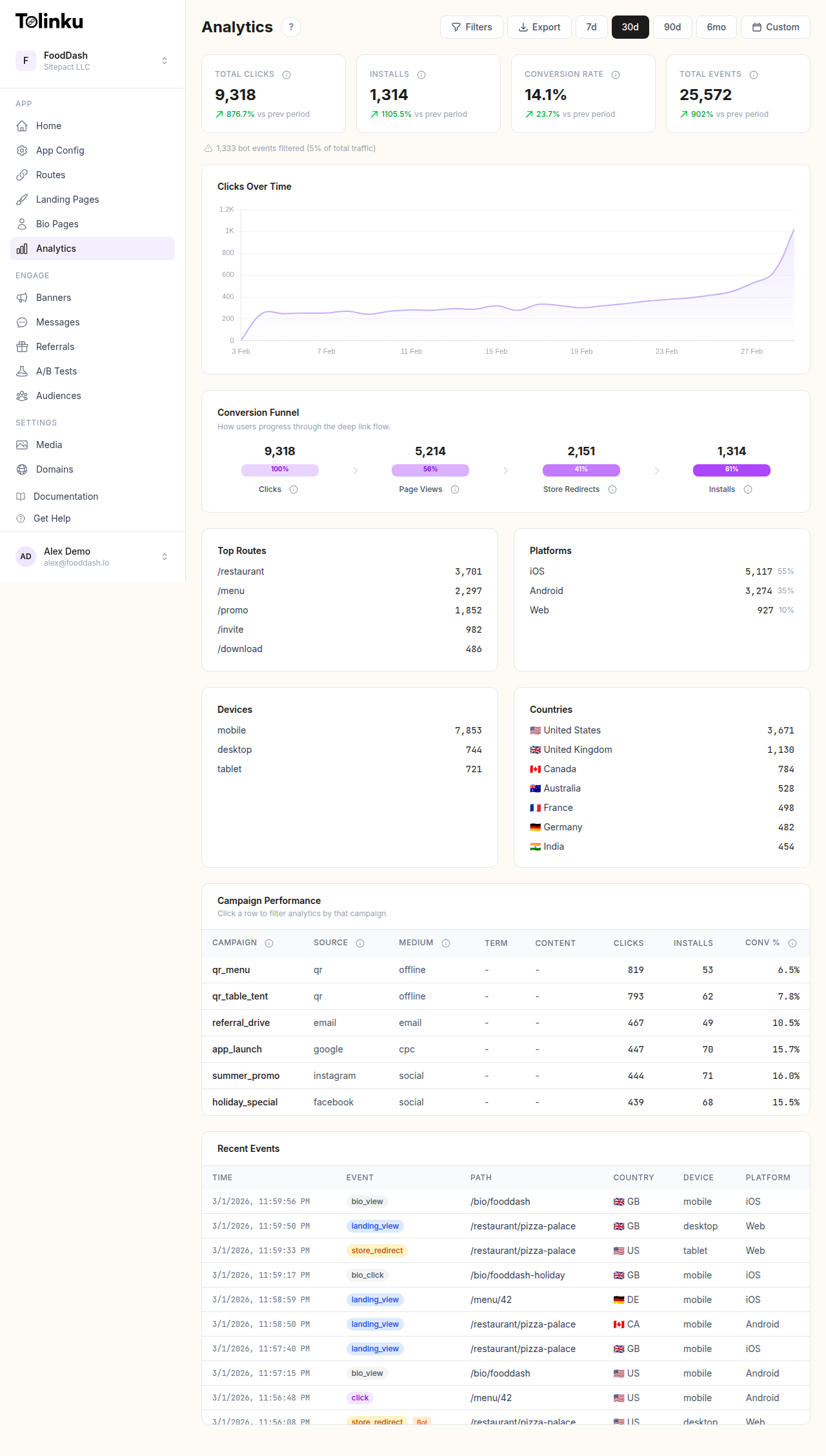 Use analytics to track which growth tactics drive the most installs and revenue.
Applying These Patterns
You do not need Spotify's scale or Airbnb's brand to apply these tactics:
- Identify your shareable moments: What achievements, creations, or discoveries do your users experience? Add share cards at those moments.
- Deep link everything: Every link from email, web, social media, or referral should land the user on the relevant in-app content.
- Build for the recipient: When a user shares something, the person who receives it should understand and see the value immediately.
- Invest in content: Write blog posts that solve problems your users have. Include deep-linked CTAs to relevant app features.
- Measure the full funnel: Track from share or click through install, activation, and retention, not just installs.
Tolinku for Growth Tactics
Tolinku provides the deep linking infrastructure behind several of these patterns: referral links with attribution, web-to-app deep links with deferred deep linking, and campaign-specific routes with analytics. Whether you are building a referral program, linking emails to in-app content, or bridging web content to your app, deep linking is the technical foundation.
For measuring deep linking ROI, see measuring deep linking ROI for your mobile app. For building referral programs, see building referral programs that actually work.
Get deep linking tips in your inbox
One email per week. No spam.