People trust their friends more than they trust your ads. That is not a new insight, but it is one that most companies still fail to act on properly. According to Nielsen's Global Trust in Advertising report, 88% of consumers trust recommendations from people they know over any other form of marketing. Paid acquisition costs keep climbing. The average cost per install for a mobile app reached $3.52 on iOS and $1.12 on Android in 2024, and those numbers have only gone up since.
Referral programs flip the economics. Instead of paying a platform to show your ad to someone who may or may not care, you reward your existing users for bringing in people who are already interested. The result is lower acquisition costs, higher retention rates, and users who arrive with built-in trust.
But most referral programs fail. They launch with a splash, generate a brief spike in sign-ups, then fade into obscurity. The reason is almost always the same: poor design, weak incentives, broken tracking, or some combination of all three.
This guide covers how to build referral programs that actually sustain growth, from incentive design to fraud prevention to the technical infrastructure that holds everything together.
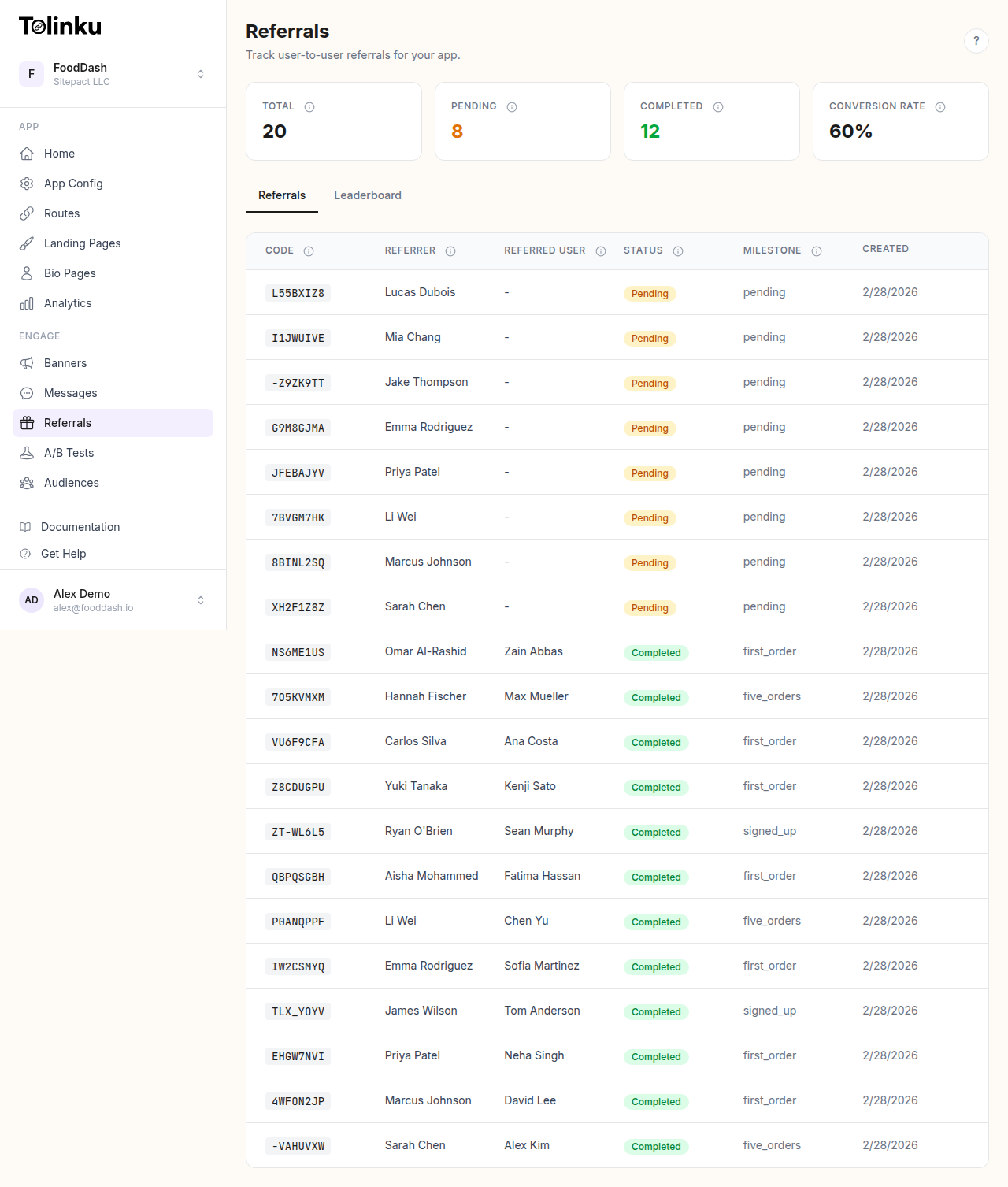 The referrals page with stats cards, referral list, and leaderboard tabs.
Anatomy of a Referral Program
Every referral program has four core components. Miss any one of them and the whole thing breaks down.
The referrer is your existing user who shares the invitation. They need a reason to share (the incentive), a way to share (the mechanic), and visibility into what happened after they shared (tracking and feedback).
The referee is the new user who receives the invitation. Their experience is just as important as the referrer's. If the link they click drops them on a generic homepage instead of a personalized onboarding flow, you have lost most of the goodwill the referrer built for you.
The reward is what both parties get. This can be monetary (credits, discounts, cash), product-based (free storage, premium features), or social (badges, leaderboard positions). The reward structure shapes behavior more than almost any other design decision.
The tracking layer connects everything. It answers the questions: who referred whom, when did the conversion happen, and was it legitimate? Without reliable attribution, you cannot reward anyone accurately, and the program collapses.
Incentive Structures That Work
The most common mistake in referral program design is offering the wrong incentive. A $5 credit means nothing if your product costs $200 per month. A 50% discount is too generous if your margins are thin. The incentive needs to match both your unit economics and your users' perception of value.
Double-Sided Rewards
Both the referrer and the referee get something. This is the most effective structure for most products because it gives both parties a reason to act. For a detailed breakdown of incentive models, see double-sided referral incentives. The referrer is motivated to share, and the referee feels like they are getting a deal rather than being sold to.
PayPal pioneered this approach in its early days, offering $10 to both the referrer and the new user. It was expensive, but it worked: PayPal grew from 1 million to 5 million users in a matter of months.
Single-Sided Rewards
Only the referrer gets rewarded. This works when the product itself is compelling enough that new users do not need an extra push to sign up. It is simpler to implement and cheaper to run, but conversion rates on the referee side tend to be lower.
Tiered Rewards
The reward increases as the referrer brings in more people. Refer 3 friends, get a month free. Refer 10, get a year free. This structure encourages your most enthusiastic users to keep sharing, and it naturally surfaces your best advocates.
Milestone Rewards
Instead of rewarding per referral, you reward at specific milestones. This gamifies the process and can reduce fraud because individual referrals are less valuable on their own. It also gives you natural checkpoints to verify that referrals are legitimate.
Matching Rewards to Your Product
The best referral incentive is more of the thing your users already value. Dropbox gave extra storage space, not cash. Uber gave ride credits, not Amazon gift cards. When the reward reinforces product usage, you get a compounding effect: the referrer uses your product more because of the reward, which makes them more likely to refer again. For subscription services, offer a free month or billing discount. For marketplaces, give credits that can only be spent on your platform. Keep the reward inside your product's value loop.
The Technical Side: Deep Linking for Referrals
Here is where most referral programs quietly break. For a technical guide to configuring these links, see referral deep links. A user shares a link. The recipient taps it on their phone. They do not have the app installed, so they are sent to the app store. They download the app, open it, and land on the home screen with no context. The referral attribution is lost, and neither party gets their reward.
This is the problem that deferred deep linking solves. A deferred deep link carries context (the referral code, the referrer's identity, the specific content being shared) through the app store install process. When the new user opens the app for the first time, the deep link fires and delivers them to the right screen with the referral already attributed.
Without deferred deep linking, you are relying on users to manually enter a referral code after installing. The drop-off rate at that step is brutal. Research from Google has shown that every additional step in a mobile conversion flow costs you roughly 20% of your audience. Asking someone to remember and type a code is at least two extra steps.
How Referral Links Should Work
A well-built referral link handles three scenarios:
- App installed: The link opens the app directly and passes the referral parameters. The user sees the referral context immediately.
- App not installed, mobile: The link routes the user to the correct app store (iOS or Android), then passes the referral parameters when the app opens after installation.
- Desktop or unsupported device: The link falls back to a web experience, either a landing page or a web app, with the referral parameters preserved in the URL.
Each scenario requires different technical handling, and the link needs to detect the user's platform and route accordingly. This is not trivial to build from scratch, which is why most teams use a dedicated deep linking service for their referral links.
Designing the Referral Flow
The best referral incentive in the world will not help if the sharing flow is clunky. You need to make it almost effortless for users to share, and the experience for the recipient needs to feel personal.
Share Mechanics
Give users multiple ways to share. At a minimum, you need:
- Direct link copying so users can paste into any channel
- Native share sheet on mobile (iOS and Android both have share APIs)
- Messaging app integration for WhatsApp, iMessage, Telegram, and other popular channels
- Email for users who prefer a more formal invitation
- Social media for users who want to share publicly
Pre-populate the share message with text that the referrer can edit. The default message should sound like something a real person would say, not a marketing blurb. "Hey, I've been using [Product] and thought you'd like it. Here's my link for [reward]" works better than "Join [Product] today and save! Use my exclusive referral link below!"
The Invite Screen
Your in-app referral screen should include:
- The user's unique referral link or code
- A clear explanation of the reward (what they get, what their friend gets)
- A one-tap share button
- A progress tracker showing how many people they have referred and what rewards they have earned
- Social proof, such as "2,341 users have earned rewards this month"
Attribution on the Receiving End
When the referee arrives (via the app or web), the experience should acknowledge the referral immediately. "You were invited by [Referrer Name]" with the referrer's profile picture creates a moment of social proof that increases conversion rates. It also confirms to the new user that the referral link worked, which builds trust in the program.
Preventing Fraud
Every referral program attracts fraud. If you are giving away something of value, someone will try to game the system. The most common types:
Self-Referrals
A user creates a second account using their own referral link to collect both sides of the reward. Prevention strategies include device fingerprinting (flag when the same device is used for both accounts), IP matching (block referrals from the same IP address, with allowances for shared networks), email pattern detection (watch for [email protected], [email protected]), and phone number verification.
Fake Accounts
Organized fraud rings create hundreds of fake accounts to collect referral rewards. Counter this by requiring a qualifying action before the reward is granted, rate limiting how many referrals a single user can make per day, adding manual review for users who exceed a threshold, and delaying payouts so you have time to verify referrals.
Device Farms
Groups of people (or automated scripts) using multiple devices to farm referral rewards. Detection involves behavioral analysis (real users browse and use features; fake accounts follow identical paths), geographic clustering (50 referrals from the same city block is a signal), and time pattern analysis (real referrals happen at irregular intervals; fraud clusters in time).
The key principle: never reward at the moment of sign-up. Always require a downstream action that proves the new user is real and engaged. This single rule eliminates the majority of referral fraud.
Measuring Referral Program Success
You need clear metrics to know whether your referral program is working. Our guide on referral program analytics covers measurement in depth. Here are the ones that matter:
K-Factor (Viral Coefficient)
K-factor measures how many new users each existing user brings in. The formula is straightforward:
K = (invites sent per user) x (conversion rate per invite)
If each user sends 5 invites and 10% of those convert, your K-factor is 0.5. That means every 2 users bring in 1 new user. A K-factor above 1.0 means viral growth (each user brings in more than one new user), but this is extremely rare and usually unsustainable. A K-factor between 0.3 and 0.7 is healthy for most products. For more on this metric, see viral coefficient and K-factor.
Cost per Acquired User (via Referrals)
Calculate the total cost of your referral rewards divided by the number of new users acquired. Compare this to your paid acquisition CAC. If referral CAC is lower and retention is equal or better, you should be shifting budget from paid channels to referral incentives.
Referral Conversion Rate
Track the funnel: link shared, link clicked, app installed (or site visited), account created, qualifying action completed. Each step has a drop-off rate, and each is an optimization opportunity. Industry benchmarks vary widely, but a healthy referral program converts 5-15% of link clicks into qualifying actions.
Referred User Retention
This is the metric that matters most long-term. If referred users churn at the same rate as users from paid channels, your referral program is just a more complex (and possibly more expensive) acquisition channel. The value of referrals comes from their typically higher retention rates, which research from the Wharton School has measured at 18% higher lifetime retention compared to non-referred users.
Share Rate
What percentage of your active users ever share a referral link? If this number is below 5%, you likely have a discoverability problem: users do not know the referral program exists. If it is above 20%, you are doing something right.
Real-World Examples
Dropbox: The Gold Standard
Dropbox's referral program is the case study everyone references, and for good reason. Launched in 2008, it offered 500 MB of extra storage for both the referrer and the referee (later increased to 1 GB for paid users). The results were extraordinary: signups increased by 60% permanently, and the program drove 35% of all daily sign-ups at its peak.
Why it worked:
- The reward matched the product. Users wanted more storage. Giving them more storage through referrals made them more invested in the platform.
- The cost to Dropbox was marginal. Storage is cheap. The incremental cost of giving a user 500 MB was fractions of a penny, while the lifetime value of a new user was orders of magnitude higher.
- The mechanic was simple. One link, one click, both sides rewarded automatically.
- Progress was visible. Users could see exactly how much storage they had earned and how much more they could get.
Uber: Location-Aware Credits
Uber's early referral program gave both riders a free ride (up to a certain dollar amount). The program was credited with driving significant early growth in new city launches. When Uber entered a new market, referrals from early adopters were often more effective than any local advertising campaign.
Key design choices that made it work: the reward was immediately usable (a free ride is tangible), the referral code was short and memorable (custom codes like "UBER[username]"), and city-specific caps prevented over-spending in saturated markets while allowing generous incentives in new ones.
Airbnb: Two Attempts, One Success
Airbnb's first referral program, launched in 2011, was a quiet failure. It was buried in the product, hard to find, and offered a small travel credit. In 2014, they relaunched with a completely redesigned program. The new version offered $25 in travel credit for the referrer when the referee completed their first trip, and $25 off the referee's first booking.
The relaunch grew referral bookings by 300% compared to the previous version. What changed:
- Prominent placement. The referral option was visible on the home screen and in the navigation, not hidden in account settings.
- Personalized invites. Referral messages included the referrer's name and profile photo, making them feel personal rather than spammy.
- A/B testing at scale. Airbnb tested dozens of variations of the referral flow, reward amounts, and messaging.
- Mobile-first design. The referral flow was built for how people actually share links (through messaging apps on their phones), not for desktop email.
Building Referrals with Tolinku
If you are building a referral program for a mobile app, the technical infrastructure matters as much as the incentive design. Tolinku's referral features handle the pieces that are hardest to build in-house: deferred deep linking, cross-platform attribution, and reward tracking.
Here is what the setup looks like in practice:
Referral link generation. Each user gets a unique referral link that works across platforms. When shared, the link detects whether the recipient has the app installed and routes them accordingly. If the app is not installed, the link preserves the referral context through the app store install. You can configure all of this through Tolinku's referral setup.
Attribution and rewards. When the referee opens the app, Tolinku's SDK reads the deferred deep link parameters and attributes the install to the correct referrer. You define the qualifying action (first purchase, account verification, or any custom event), and rewards are tracked and attributed automatically.
Leaderboards. For programs with tiered or milestone rewards, Tolinku's referral leaderboard gives you a ready-made way to show top referrers, motivate competition, and surface your most effective advocates.
The referral documentation walks through the full integration, from link configuration to SDK setup to reward webhooks.
Optimization Tips
Once your referral program is live, the real work begins. Here are the areas with the highest optimization potential:
Timing the Ask
Do not ask users to refer friends the moment they sign up. They have not experienced your product yet and have no reason to recommend it. The best time to prompt a referral is after a moment of delight: a successful purchase, a milestone achieved, a problem solved. Identify these moments through user research and trigger the referral prompt accordingly.
Testing Reward Amounts
The optimal reward amount is rarely what you guess on day one. A/B test different amounts and structures. You may find that $10 for both parties converts better than $15 for just the referrer, or that a percentage discount outperforms a fixed dollar amount. Run tests for at least two full referral cycles (the time it takes for a referral to go from invite to qualifying action) before drawing conclusions.
Making Referral Links Shareable
A long URL with random characters looks suspicious. Use short, branded links that feel trustworthy. If possible, let users customize their link with their name or a custom slug. A link like yourapp.link/sarah converts better than yourapp.link/ref?code=a8f3b2c1d4e5.
Reducing Friction on the Referee Side
Every field in your sign-up form costs you referrals. If you can pre-fill the referee's name from the referral link data, do it. If you can skip the email verification step and verify later, do it. If you can let the referee experience the product before creating an account, do it. The goal is to get the referee to the qualifying action with as few obstacles as possible.
Keeping Referrers Informed
Send the referrer a notification when their friend clicks the link, signs up, and completes the qualifying action. Each notification reinforces the behavior and builds anticipation ("Sarah clicked your link!") that keeps the referrer engaged with the program.
Seasonal and Event-Based Boosts
Run limited-time referral promotions during natural sharing moments: holidays, product launches, milestone celebrations. "Double rewards this week" creates urgency and gives existing referrers a reason to share again with contacts they have not yet invited.
Conclusion
Referral programs work because they tap into the most powerful marketing force available: genuine recommendations from trusted people. But "launch a referral program" is not a strategy. The programs that drive sustained growth are the ones that get the details right: matching incentives to product value, building reliable attribution through deep linking, preventing fraud without punishing legitimate users, and continuously optimizing based on real data.
Start with a double-sided reward that makes sense for your product's economics. Build the technical infrastructure to track referrals across platforms and through app installs. Launch with a small group of power users to validate the flow before going broad. Measure everything, and be prepared to iterate.
Dropbox, Uber, and Airbnb did not get their referral programs right on the first try. They tested, learned, and refined. Your program will follow the same path. The difference between the programs that fade and the ones that compound is whether you treat the launch as the finish line or the starting point.
Get deep linking tips in your inbox
One email per week. No spam.