

Most referral programs ask existing users to send their friends a link. Some offer a reward to the person who refers. Fewer think carefully about the person who receives the invitation. That is a mistake.
A double-sided referral program rewards both the referrer and the new user. It is the most consistently effective referral program structure across consumer products, and the reason is not complicated: people are more willing to share something when they know the recipient gets something out of it too.
This guide covers why double-sided programs work, how to structure the reward split, the difference between symmetric and asymmetric incentives, and what some well-known programs got right.
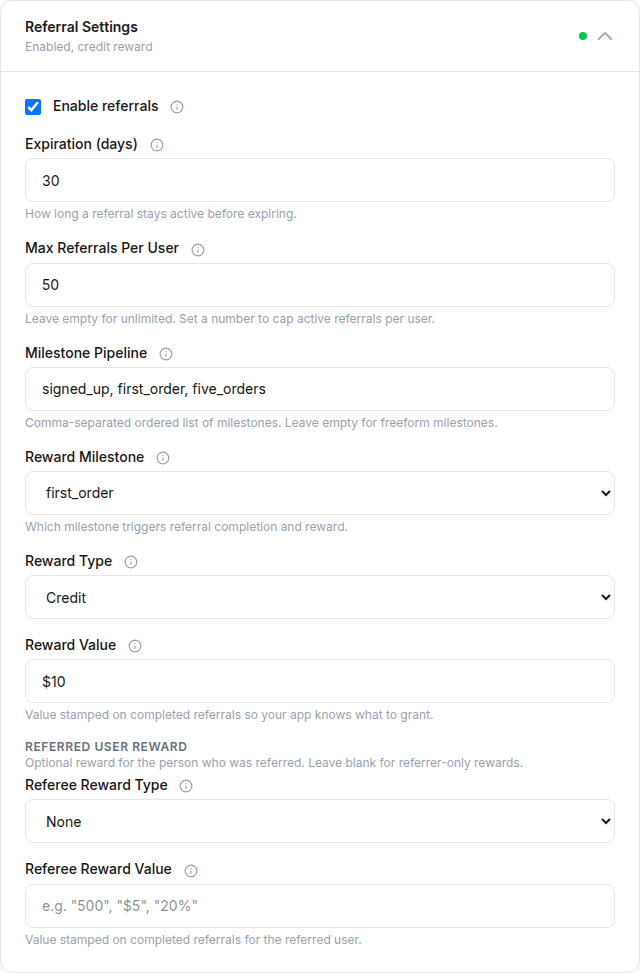 The referral configuration section with enable toggle, expiration, limits, milestones, and rewards.
Why One-Sided Programs Underperform
A one-sided program rewards only the referrer. The implicit dynamic is: "Share our product with your friends so you can get something." That framing puts the referrer in a position that many people find uncomfortable. They are asking their friends to do something primarily for their own benefit.
Social capital is real and finite. People share things with their networks when they believe the share is genuinely useful to the recipient. A referral where the new user gets nothing feels transactional in the wrong direction.
The result is lower sharing rates, lower conversion rates from the new user's perspective, and often lower-quality referrals because the referrer is motivated to cast a wide net rather than target people who would genuinely benefit.
Why Double-Sided Programs Work
A double-sided program changes the framing entirely. Now the referrer is sharing something that benefits both of them. "I thought you might like this, and you'll get $20 when you sign up" is a very different message than "Sign up and I'll get $20."
The psychological principle of reciprocity plays a role here too. When someone offers you something, you feel a pull toward giving something back. In a referral context, the new user who receives a discount or credit is more likely to complete the signup because they feel positively disposed toward the brand from the moment of first contact.
Research from the Wharton School on customer referral programs found that referred customers have consistently higher lifetime value than non-referred customers, partly because the referral carries an implicit quality signal. Double-sided programs amplify this by ensuring the new user arrives with a positive first experience (they got something).
Symmetric vs. Asymmetric Rewards
A symmetric program gives referrer and new user the same reward. An asymmetric program gives them different rewards.
Symmetric example: Both get $10 credit.
Asymmetric examples:
- Referrer gets $25, new user gets $10
- Referrer gets 1 month free, new user gets 30% off first 3 months
- Referrer gets cash, new user gets credits
When to Use Symmetric Rewards
Symmetric rewards are easier to communicate. "Give $10, get $10" fits on a button. They also feel fair and reinforce the mutual-benefit framing. For consumer products with relatively equal value to both parties, symmetric rewards are a good default.
Dropbox's storage referral program was essentially symmetric in spirit: both parties got more storage. The amounts differed slightly (referrer got 500MB, new user got 250MB in the early version), but both parties clearly benefited.
When to Use Asymmetric Rewards
Asymmetric rewards make sense when the economic or motivational weight is different between the two parties.
Referrer-heavy asymmetry (referrer gets more) makes sense when:
- You need to incentivize the act of sharing more than the act of converting
- Your existing users have large relevant networks and will share broadly if incentivized
- The new user already has strong reason to sign up (your product is well-known, there is existing demand)
New user-heavy asymmetry (new user gets more) makes sense when:
- Conversion rate from invitation to signup is your bottleneck
- Your product has a cost or commitment barrier for new users
- The referral is asking someone to try something unfamiliar
Uber's early referral program leaned new-user-heavy. The new rider got a free ride (sometimes $20+ value), while the referring rider got a smaller credit. This made sense because Uber needed new users to take that first ride before they would understand the product's value. The new user reward was a conversion catalyst.
The Referrer Psychology
Referrers are asking their social capital. When they share a referral link with friends, they are implicitly vouching for the product. If the product disappoints, the referrer looks bad.
This means two things:
1. Referrers are self-selecting for product quality. Users who are not satisfied with a product generally do not share referral links, regardless of the reward. High referral participation rates are often a signal of genuine user satisfaction, not just incentive effectiveness.
2. The reward for the referrer should feel proportionate to the ask. If you are asking users to send personal invitations to their close contacts, a meaningful reward ($20+) is appropriate. If you are asking them to post a public link on social media, a smaller reward might be fine.
The New User Psychology
The new user is evaluating two things simultaneously: whether they want the product, and whether the referral itself is trustworthy.
Receiving an invitation from a friend or colleague is already a trust signal. The new user knows who sent it and implicitly trusts that person's judgment. Your job is not to overcome skepticism, it is to make the decision easy. A concrete, immediate benefit (a discount, free trial, credits) removes the "let me think about it" friction.
Urgency matters here. If the new user reward is time-limited ("Your friend's invitation expires in 7 days"), conversion rates from the invitation are higher. The urgency is credible because it is tied to a real referral event, not a generic marketing claim.
Examples: What Worked
Dropbox
Dropbox's referral program is the most cited example in growth marketing. Both referrer and new user got additional storage. The reward was:
- Directly tied to the core product value (more of the thing that makes Dropbox useful)
- Symmetric in type (both got storage, though different amounts)
- Permanent (the storage did not expire)
The result was a 3900% increase in signups over 15 months. The key insight was that the reward was the product. There was no disconnect between what Dropbox sold and what they gave away.
Airbnb
Airbnb's referral program went through several iterations. Their most effective version offered travel credit to both the referrer (when the referred friend made their first trip) and the new user (discount on their first booking). The amounts were asymmetric, with the new user getting a larger discount as a conversion catalyst.
Notably, Airbnb invested significantly in the referral flow itself, making it easy to share and personalize invitations. The reward structure mattered, but the user experience around the referral was equally important.
Uber
Uber's early referral program used new-user-heavy rewards because the product required behavioral change (getting in a stranger's car). The high new-user reward covered the psychological cost of trying something new. Once the product established trust and became mainstream, Uber scaled back referral incentives significantly because organic demand reduced the need.
This is an important lesson: the right referral reward is not fixed. It should change as your product matures.
Setting Reward Amounts
The math starts with your unit economics. If a new customer generates $200 in gross margin over their lifetime, you can spend up to that amount to acquire them. Referral programs typically target a CAC well below that ceiling.
A rough framework:
- Determine the LTV of a referred customer (often 10-25% higher than organic, because of social trust and pre-qualification)
- Set a target CAC as a percentage of that LTV (common range: 10-30%)
- Divide the CAC budget between referrer and new user based on where your conversion bottleneck is
If your program converts 40% of invited users to signups but only 15% of eligible users share at all, allocate more to the referrer reward. If sharing rates are healthy but conversion is low, allocate more to the new user reward.
Attribution and Reward Triggering
The reward triggering rules matter as much as the reward amounts. Common triggers:
- New user signs up: Low bar, high volume, but some signups may not be high-quality
- New user completes first meaningful action: (first purchase, first session > 5 min, first project created) Better quality signal, slightly lower conversion to reward
- New user reaches 30/60/90 days active: Best quality signal, but rewards are delayed (referrer may forget they made the referral)
Tolinku lets you configure reward triggers per program. The rewards and attribution documentation covers the available trigger events and how to configure dual-sided payouts.
Communicating the Double-Sided Reward
The most common mistake with double-sided programs is burying the new user reward. The referral invite the new user receives should lead with what they get, not with what the referrer gets.
Weak version: "My friend invited you to join. I'll get $15 when you sign up."
Stronger version: "Your friend thinks you'd love this. Sign up now and you'll get $25 credit."
The referrer's reward is irrelevant to the new user's decision. What matters to the new user is: what do I get, and is this product right for me?
Make both rewards visible in your referral dashboard, referral email templates, and in-app sharing flows. Users are more likely to share when they can see both rewards clearly and feel good about the value they are offering their friends.
Summary
Double-sided referral programs outperform one-sided ones because they align incentives on both sides of the transaction, make sharing feel prosocial rather than self-interested, and give the new user an immediate reason to convert.
The key decisions are:
- How much to allocate to each side (based on where your conversion bottleneck is)
- Whether to use symmetric or asymmetric rewards (based on product maturity and user behavior)
- What event triggers the reward (based on what "quality user" means for your product)
- How to communicate the double-sided reward in your invite flows
For configuration details, see the Tolinku referral setup guide and the referral features overview.
Related reading: Referral Reward Strategies: Finding the Right Incentive, Building Referral Programs That Work, Referral Fraud Prevention.
Get deep linking tips in your inbox
One email per week. No spam.