

Startups cannot outspend established competitors on user acquisition. But they can outmaneuver them. This article covers growth tactics that work with minimal budget, focusing on strategies that compound over time rather than requiring ongoing spend.
For the full growth playbook, see mobile app growth: 25 strategies that work in 2026. For organic channels, see organic growth channels for mobile apps.

Prioritization Framework
With limited resources, focus on strategies with the highest impact-to-effort ratio:
| Strategy | Cost | Time to Results | Compounding? |
|---|---|---|---|
| App Store Optimization (ASO) | Free | 2-4 weeks | Yes |
| Content marketing (blog/SEO) | Free (time) | 3-6 months | Yes |
| Community building | Free (time) | 1-3 months | Yes |
| Referral program | Low (rewards) | 1-2 weeks | Yes |
| Social media organic | Free (time) | 1-3 months | Moderate |
| Product Hunt / launch sites | Free | 1-2 days | No |
| Cold outreach | Free (time) | 1-2 weeks | No |
| Paid ads | High | Days | No |
Start with the strategies that compound: ASO, content, and community. These build assets that continue driving installs long after the initial effort.
Free and Low-Cost Tactics
1. App Store Optimization (ASO)
Your app store listing is your highest-leverage asset. Optimize:
- Title: Include your primary keyword (e.g., "BudgetBee: Expense Tracker & Budget Planner").
- Subtitle (iOS) / Short description (Android): Secondary keywords and value proposition.
- Screenshots: Show the app solving the user's problem, not just UI screens.
- Description: Front-load the first 2-3 sentences (most users do not expand).
- Keywords (iOS): Use all 100 characters. No spaces after commas.
Cost: Free. Time: A few hours. Test new screenshots and descriptions monthly.
2. Launch on Product Hunt and Alternatives
Product Hunt, Indie Hackers, Hacker News, and similar platforms provide a burst of initial users.
Preparation:
- Create a compelling tagline and description.
- Prepare screenshots and a demo video.
- Line up supporters to upvote and comment early.
- Schedule for a Tuesday or Wednesday (highest traffic days on Product Hunt).
Cost: Free. Time: 1-2 days of preparation. One-time burst, not recurring.
3. Content That Ranks
Write blog posts targeting searches your users make:
Example for a meditation app:
- "How to start meditating (beginner guide)"
- "5-minute meditation techniques for busy people"
- "How to reduce anxiety without medication"
Each post targets a problem your app solves. Include a call to action with a deep link to the relevant app feature.
Cost: Free (your time). Time: 3-6 months for SEO results. Compounding: each post drives traffic indefinitely.
4. Referral Program
Give existing users a reason to invite friends:
Invite a friend, both get 1 month free premium.
The key: make the reward valuable to both sides. One-sided rewards (only the referrer gets rewarded) convert poorly.
Use deep links so the referral is attributed correctly even when the invitee installs the app after clicking:
https://yourapp.com/referral/user123
Cost: Cost of the reward (free tier access, in-app currency). Time: 1-2 weeks to build. Compounding: each new user can refer more users.
5. Partnerships with Complementary Apps
Find apps that serve the same audience but are not competitors:
- A fitness app partners with a nutrition app.
- A budgeting app partners with a banking app.
- A language learning app partners with a travel app.
Partnership formats:
- Cross-promote in each other's apps (in-app banners or recommendations).
- Co-create content (joint blog posts, webinars).
- Bundle offers ("Download both apps and get a discount").
Cost: Free (time investment). Time: 2-4 weeks to establish.
6. Reddit and Online Communities
Participate authentically in communities where your target users spend time:
- Answer questions related to your app's domain.
- Share genuinely helpful content (not promotional).
- Mention your app only when directly relevant and helpful.
- Include your app in your Reddit flair or profile.
Cost: Free. Time: Ongoing (30 minutes/day). Build trust before promoting.
7. Email List from Day One
Collect email addresses before launch:
- Create a landing page: "Sign up for early access."
- Offer a freebie (template, guide, checklist) related to your app's domain.
- Nurture the list with valuable content before launching.
On launch day, email the list with a download link. These are your most engaged first users.
What to Skip Early On
| Strategy | Why to Skip |
|---|---|
| Paid ads (at scale) | Expensive, does not compound, hard to optimize without data |
| PR agencies | Costly, results are unpredictable |
| Large influencer partnerships | Expensive, better after product-market fit |
| Conference sponsorships | High cost, low direct ROI for early-stage apps |
| Building features for growth before retention | Pointless to pour users into a leaky bucket |
Focus on retention first. A startup with 40% day-30 retention and 100 users will outgrow a startup with 5% day-30 retention and 10,000 users.
Measuring on a Budget
Free Analytics Tools
| Tool | Purpose |
|---|---|
| App Store Connect / Google Play Console | Install and retention data |
| Google Analytics (GA4) | Website and landing page traffic |
| Mixpanel (free tier) | In-app event tracking |
| Google Search Console | SEO performance |
| Social media built-in analytics | Social media engagement |
Key Metrics to Track
| Metric | Why It Matters |
|---|---|
| Daily Active Users (DAU) | Are people coming back? |
| Day-1, Day-7, Day-30 retention | Is the product sticky? |
| Organic install trend | Is word-of-mouth working? |
| Referral conversion rate | Is the referral program effective? |
| Cost per install (if running any paid) | Is paid acquisition sustainable? |
The First 1,000 Users
The first 1,000 users should come from channels you can personally manage:
- Friends, family, colleagues (20-50 users): Your first testers.
- Online communities (100-300 users): Reddit, Discord, forums.
- Product Hunt launch (200-500 users): One-time burst.
- Content marketing (ongoing): Starts slow, builds over time.
- Referral program (multiplier): Each user brings 0.2-0.5 new users.
Do not try to scale paid ads until you have product-market fit signals: strong retention, positive reviews, and organic referrals.
Tolinku for Startups
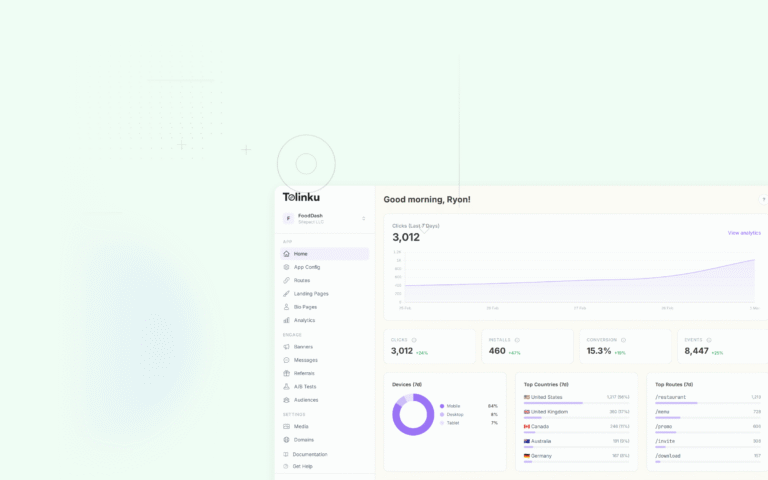
Tolinku's free tier includes 1 Appspace, 5 routes, and 1,200 clicks per month at no cost. This covers a startup's initial deep linking, referral, and analytics needs. As you grow, the Standard plan ($39/month) provides 50,000 clicks and full features.
For launch strategies, see app launch strategy: pre-launch to post-launch playbook. For the full growth guide, see mobile app growth: 25 strategies that work in 2026.
Get deep linking tips in your inbox
One email per week. No spam.