

Every app team faces the same question: should we spend our next dollar getting a new user or keeping an existing one? The answer depends on where your app is in its lifecycle, but too many teams default to acquisition when retention would deliver more growth per dollar spent.
This guide breaks down the economics of each lever and helps you decide where to invest.
The Leaky Bucket Problem
Imagine your app as a bucket. Acquisition pours water in. Retention determines how fast it leaks out.
If your bucket has a hole in the bottom, pouring water in faster doesn't fill it up. It just wastes water. Yet many apps spend 80% or more of their growth budget on acquisition while losing 75% of users within the first week.
The math is straightforward. If you acquire 1,000 users per month with 10% D30 retention, you have 100 active users after a month. If you improve retention to 20% (still not great), you have 200 active users from the same 1,000 acquisitions. That's the equivalent of doubling your acquisition spend, except it's usually cheaper.
The Economics
Acquisition Costs
Acquiring a new user costs money, whether through paid ads, content marketing, or referral incentives. Typical cost-per-install (CPI) ranges:
- Casual games: $1.50-$4.00
- E-commerce: $2.00-$5.00
- Finance/Fintech: $5.00-$15.00
- Health and Fitness: $2.00-$6.00
- Social/Dating: $3.00-$7.00
These costs have been rising year over year as more apps compete for the same users on the same ad platforms.
Retention Economics
Improving retention doesn't have a direct per-user cost. Instead, it requires product investment: better onboarding, push notification strategy, feature improvements, and bug fixes. These are often one-time or ongoing engineering costs that benefit every user, not just the next one.
The classic statistic (originally from Bain & Company) says it costs 5-7x more to acquire a new customer than to retain an existing one. While the exact multiplier varies by industry, the direction is consistent: retention is almost always cheaper per user retained than acquisition is per user acquired.
Compounding Effects
Retention improvements compound in ways that acquisition improvements don't.
If you improve your D30 retention by 5 percentage points this month, you keep those extra users next month, and the month after, and every month going forward. Each cohort benefits from the improvement.
If you increase acquisition by 500 users this month, you get 500 more users that month. To get 500 more next month, you need to spend again.
Over 12 months, a retention improvement can be worth 3-5x the equivalent acquisition spend.
When to Prioritize Retention
Your D1 Retention Is Below 30%
Industry benchmarks for D1 (day-one) retention hover around 25-35% for most categories. If you're below 30%, your onboarding has a problem. Pouring users into a broken onboarding funnel is wasteful.
Fix what's causing users to leave on day one before spending to bring more in.
Your D7 Retention Is Below 15%
D7 retention of 15% or higher is a reasonable benchmark for most app categories. Below that, users aren't finding enough value to form a habit.
Common fixes:
- Shorten the time to the "aha moment" (the action that delivers value)
- Add triggers that bring users back (push notifications, email reminders)
- Remove friction from core workflows
- Add social features that create external motivation to return
You Have Product-Market Fit Questions
If you're not sure whether users want what you've built, acquiring more users won't answer that question efficiently. A small, retained user base that actively uses your app tells you more than a large, churning one.
Your LTV Is Below Your CPI
If users don't generate enough revenue to cover their acquisition cost, you have two options: increase LTV (through better retention, engagement, and monetization) or decrease CPI. Retention directly improves LTV.
When to Prioritize Acquisition
Your Retention Is Already Strong
If your D1 is above 40%, D7 above 20%, and D30 above 10%, your product is retaining users well. The bottleneck is getting more people through the door. This is the time to scale acquisition.
You Need to Reach a Network Effects Threshold
Some apps (social, marketplace, communication tools) need a critical mass of users before the product works well. A messaging app with 50 users isn't useful. A marketplace with 100 sellers has no buyers. In these cases, you may need to prioritize acquisition even with imperfect retention, because retention will naturally improve once network density increases.
You're Launching
At launch, you have zero users. You can't retain users you don't have. The first phase of any app's life is acquisition-heavy by necessity. But set up analytics from day one so you can measure retention as your first cohorts come in.
You're Testing Paid UA Channels
Early paid acquisition tests are about learning which channels work, not about scale. Small test budgets across 2-3 channels help you find your most efficient acquisition paths for when you're ready to scale.
See Paid User Acquisition for Mobile Apps for a detailed guide on getting started.
A Framework for Deciding
Here's a simple decision framework based on your current metrics:
Stage 1: Pre-Launch / Early Launch (0-1,000 users)
- Focus: 80% acquisition, 20% retention
- Goal: Get users in the door, start measuring retention
- Key actions: Launch marketing, referral program, initial PR push
Stage 2: Finding Product-Market Fit (1,000-10,000 users)
- Focus: 40% acquisition, 60% retention
- Goal: Improve D1/D7/D30 retention to benchmark levels
- Key actions: Optimize onboarding, add retention loops, analyze drop-off points
Stage 3: Scaling (10,000+ users with healthy retention)
- Focus: 60% acquisition, 40% retention
- Goal: Grow the user base while maintaining retention
- Key actions: Scale paid UA, expand organic channels, continue retention optimization
Stage 4: Mature (large user base, stable growth)
- Focus: 50% acquisition, 50% retention (balanced)
- Goal: Sustainable growth with strong unit economics
- Key actions: Re-engagement campaigns, referral programs, LTV optimization
Strategies for Both
Some strategies improve both retention and acquisition simultaneously:
Referral Programs
A referral program acquires new users through your existing users. Referred users typically retain 25-40% better than users acquired through paid ads because they come with a personal recommendation and social connection.
Use deep links in referral URLs so new users land on a personalized welcome screen that references the friend who invited them. This improves both the acquisition conversion rate and the first-session experience.
Content Marketing
Blog posts and videos that solve problems your target audience faces bring in new users (acquisition) while also providing value to existing users (retention). A fitness app's blog about workout routines attracts searchers and gives existing users reasons to re-engage.
Push Notifications Done Right
Well-timed, relevant push notifications bring lapsed users back (retention) and, when users share content triggered by a notification, can drive new installs (indirect acquisition).
Onboarding Optimization
Better onboarding directly improves retention. But it also improves acquisition efficiency: every dollar you spend on acquisition delivers more value when a higher percentage of acquired users stick around.
Measuring the Impact
Track these metrics to understand how your investment split is performing:
Retention metrics:
- D1, D7, D30 retention by cohort
- Session frequency (sessions per user per week)
- Feature adoption rate
- Churn rate (monthly active users lost / total MAU)
Acquisition metrics:
- Cost per install (CPI) by channel
- Organic vs. paid install ratio
- Referral rate (installs from existing users)
- Install-to-registration conversion rate
Combined metrics:
- Lifetime value (LTV) by acquisition channel
- LTV:CPI ratio (should be above 3:1 for healthy economics)
- Monthly active user growth rate
- Revenue per user
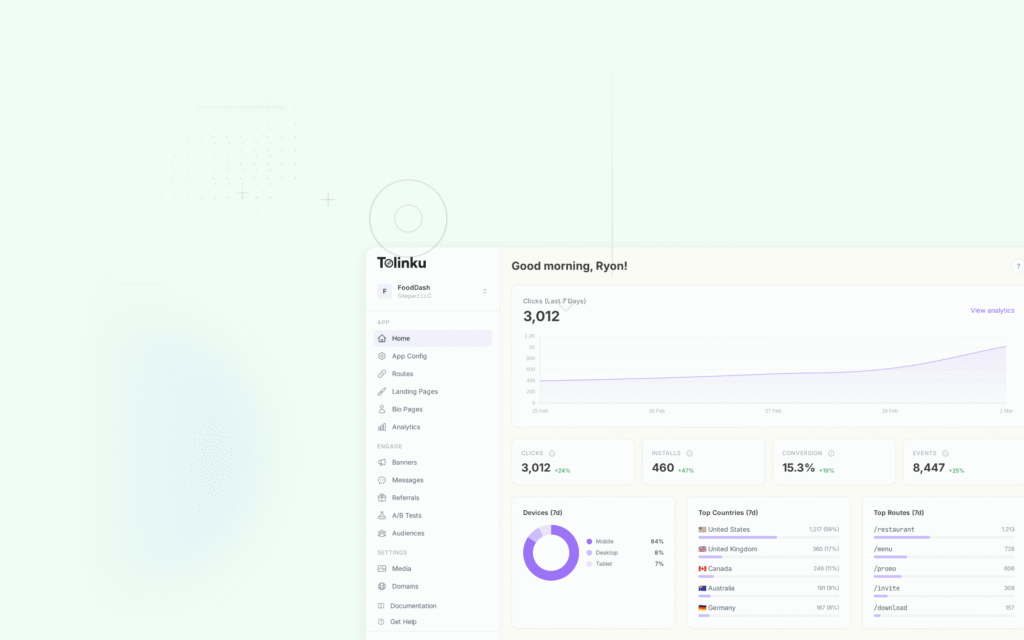
Use your analytics dashboard to monitor these metrics and correlate changes with your retention and acquisition investments.
The Right Answer Changes
The optimal split between retention and acquisition isn't static. It changes as your app matures, as market conditions shift, and as you hit new bottlenecks.
Review your metrics monthly. If retention is declining, shift investment toward retention regardless of your current stage. If retention is strong and stable, lean into acquisition.
The teams that grow fastest aren't the ones that spend the most on acquisition. They're the ones that build a product worth retaining, then spend efficiently to fill it with users.
For a comprehensive view of growth strategies that cover both sides, see Mobile App Growth: 25 Strategies That Work.
Get deep linking tips in your inbox
One email per week. No spam.