

Open source deep linking tools promise zero licensing costs and full control over your data. But the reality is more nuanced: the open source deep linking ecosystem is limited, and running a self-hosted solution requires infrastructure and engineering investment that often exceeds the cost of a managed platform.
This guide surveys what is available in open source deep linking and when it makes sense to use it. For build vs buy analysis, see build vs buy deep linking. For free managed options, see free deep linking tools.
The Open Source Landscape
What Exists
The open source deep linking ecosystem is sparse compared to other categories. There is no widely adopted open source equivalent to Branch or AppsFlyer. What exists falls into these categories:
1. URL Shortener Projects
Open source URL shorteners like YOURLS and Shlink provide link shortening with analytics. They can be adapted for basic deep linking by configuring redirect rules, but they do not provide:
- Universal Link / App Link verification file management.
- Platform detection (iOS vs Android vs web routing).
- Deferred deep linking.
- Smart banners.
- Mobile SDKs.
2. Link-in-Bio and Landing Page Tools
Projects focused on creating link landing pages. These can serve as web fallback pages for deep links, but they do not handle the deep linking infrastructure itself.
3. Custom Implementations
Many teams have built and open-sourced their own deep linking servers. These are typically:
- Specific to one company's use case.
- Not maintained after the original team moves on.
- Lacking documentation for production deployment.
- Missing critical features (deferred deep linking, smart banners).
What Open Source Deep Linking Requires
To run a self-hosted deep linking service, you need:
Server Infrastructure
- Web server to handle link clicks, serve verification files, and render fallback pages.
- Database to store link configurations, route patterns, and analytics.
- CDN to serve verification files quickly from edge locations (Apple and Google cache these, but initial fetch speed matters).
- DNS for your custom link domain.
Application Code
- Link resolution engine. Parse incoming URLs, match against route patterns, detect platform, redirect or render accordingly.
- Verification file generator. Automatically generate and serve
apple-app-site-associationandassetlinks.jsonbased on your app configuration. - Web fallback renderer. Generate HTML pages for users without the app.
- Deferred deep linking backend. Store link data, generate tokens, handle post-install retrieval.
- Analytics pipeline. Track clicks, app opens, and conversions. Store and query this data.
- Admin dashboard. Manage routes, links, domains, and view analytics.
Mobile SDKs
- iOS SDK. Handle Universal Link callbacks, deferred deep link retrieval, route matching.
- Android SDK. Handle App Link intents, Install Referrer, route matching.
- Cross-platform SDKs. React Native, Flutter wrappers if needed.
Maintenance
- OS compatibility updates. Apple and Google change deep linking behavior with each OS release.
- Security patches. Keep all components up to date.
- Infrastructure management. Monitoring, scaling, backup, disaster recovery.
Cost Comparison: Open Source vs Managed
| Cost Component | Open Source (Self-Hosted) | Managed Platform |
|---|---|---|
| Licensing | $0 | $0-149/month |
| Server hosting | $50-500/month | $0 (included) |
| Initial development | 200-400 hours ($30,000-60,000) | 4-16 hours ($600-2,400) |
| Annual maintenance | 80-160 hours ($12,000-24,000) | 2-4 hours ($300-600) |
| Year 1 total | $42,600-85,800 | $900-4,188 |
| Year 2+ annual | $12,600-30,000 | $468-2,388 |
Open source deep linking is only "free" if engineering time is free.
When Open Source Makes Sense
1. Extreme Data Sensitivity
If your regulatory environment prohibits any user data from passing through a third-party service (not just storage, but transit), self-hosted is required. This applies to some government, defense, and healthcare applications.
2. You Have a Platform Engineering Team
Large organizations with dedicated platform engineering teams may already have the infrastructure and expertise to run a self-hosted deep linking service. The incremental cost of adding deep linking to existing infrastructure is lower.
3. You Need Custom Behavior
If your deep linking requirements are highly unusual (custom matching algorithms, proprietary routing logic, integration with internal systems), a custom implementation gives you full control.
4. Learning and Education
Building a deep linking service is an excellent way to learn how Universal Links, App Links, and deferred deep linking work at a low level. For educational purposes, open source projects are valuable references.
When Open Source Does Not Make Sense
1. Small or Mid-Sized Teams
If your team has fewer than 50 engineers, the engineering investment in building and maintaining deep linking infrastructure is disproportionate to its value. Use a managed platform and allocate engineering time to your product.
2. You Need Production Reliability Quickly
Self-hosted solutions require months to reach production quality. Managed platforms are production-ready on day one.
3. You Do Not Have DevOps Capacity
Running a self-hosted service requires monitoring, scaling, backup, and incident response. If you do not have DevOps capacity, a self-hosted solution will eventually fail without you knowing.
4. Edge Case Coverage
Managed platforms handle hundreds of edge cases across email clients, social media in-app browsers, QR code scanners, and messaging apps. Self-hosted solutions start with basic functionality and discover edge cases in production.
Adapting URL Shorteners for Deep Linking
If you choose to build on an open source URL shortener:
Shlink Configuration
Shlink supports device-specific redirects. You can configure different destinations for iOS, Android, and desktop:
Short URL: https://links.yourapp.com/promo
  iOS: yourapp://promo (or Universal Link URL)
  Android: intent://promo#Intent;scheme=yourapp;package=com.yourapp;end
  Desktop: https://yourapp.com/promo
Missing: AASA/assetlinks.json hosting, deferred deep linking, smart banners, mobile SDKs.
Building on Top of a Shortener
To turn a URL shortener into a deep linking platform, you would need to add:
- Verification file endpoints (
/.well-known/apple-app-site-association,/.well-known/assetlinks.json). - Platform detection middleware (User-Agent parsing for iOS/Android/desktop).
- Web fallback page templates.
- Deferred deep linking token storage and retrieval API.
- Mobile SDK for each platform.
This is essentially building a deep linking platform from scratch, using the URL shortener as a starting point for link management.
Tolinku as an Alternative
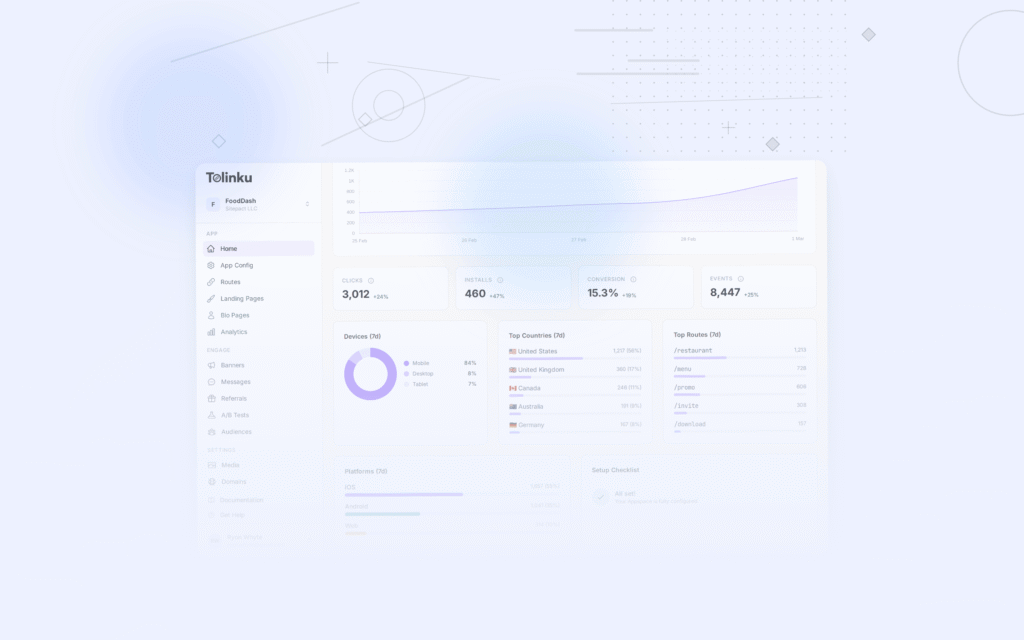
If you are considering open source because of cost, Tolinku's free tier provides deep linking at no cost for small apps (1,200 clicks/month). If you are considering open source for data control, Tolinku's managed infrastructure handles data within your configured region.
For build vs buy analysis, see build vs buy deep linking. For the full platform comparison, see deep linking platform comparison.
Get deep linking tips in your inbox
One email per week. No spam.