

Personalization is one of those ideas that sounds obviously good. Of course users prefer content tailored to them. Of course a greeting with their name converts better than a generic one. But "of course" is not evidence, and assuming personalization always wins is a great way to waste engineering time on features that don't move the needle.
The only reliable way to know whether personalization improves your deep link campaigns is to test it. A/B testing personalized deep link experiences against generic ones tells you exactly which elements are worth the effort, and which ones your users don't care about.
This article walks through the practical side: what to test, how to set it up, and how to measure the results without violating your users' privacy.
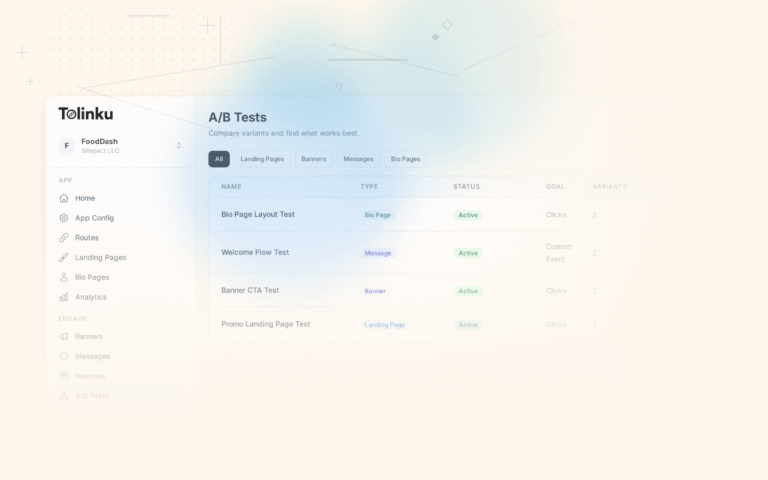
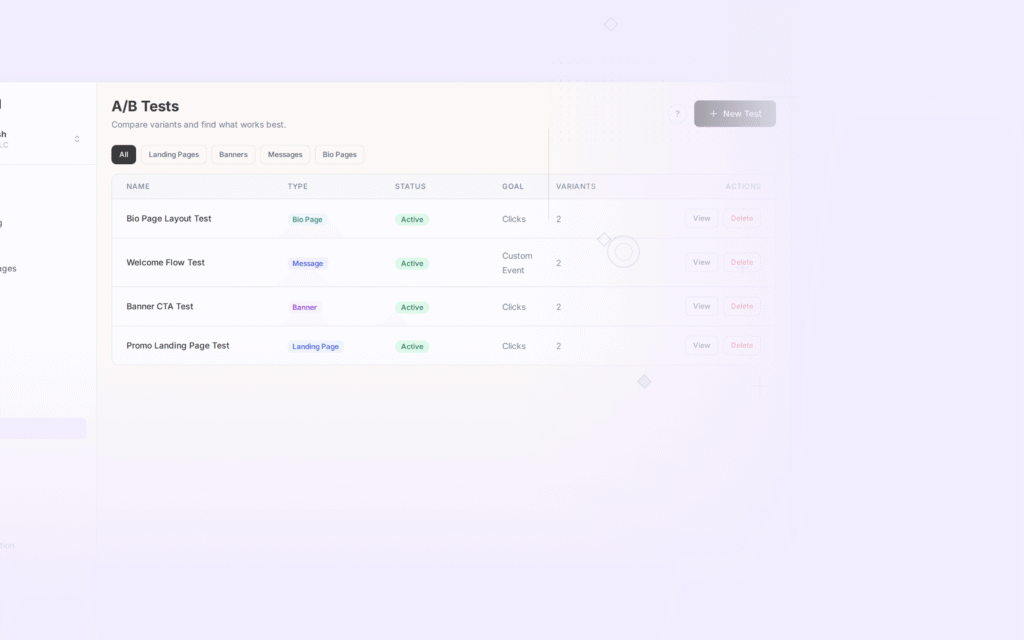
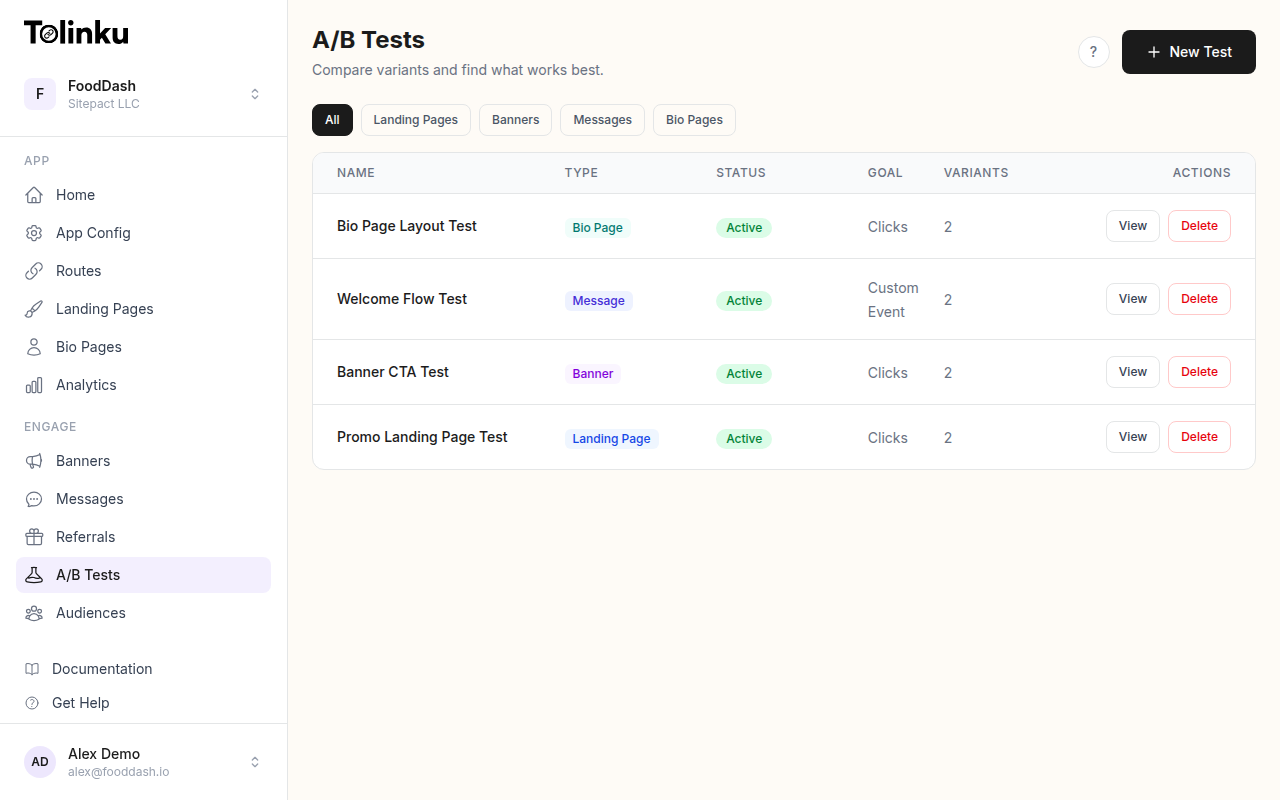 The A/B tests list page showing test names, status, types, and variant counts.
Why Personalization Matters for Deep Links
Deep links are unique because they carry context. Unlike a standard URL, a deep link can encode who the user is, where they came from, what they were doing, and where they should land. That context creates an opportunity for personalization that static URLs simply can't match.
Consider two users clicking the same promotional link for a fitness app:
- User A is a returning user who completed three workouts last week. The deep link routes them to a personalized workout plan based on their history.
- User B is a new user from a social media ad. The deep link routes them to a curated onboarding flow highlighting the feature mentioned in the ad.
Both users get a relevant experience, but "relevant" is doing a lot of work in that sentence. Without testing, you don't know whether User A would have converted just as well landing on the generic home screen. You don't know whether User B finds the curated onboarding helpful or confusing.
Personalization adds complexity. Every personalized variant requires data, logic, and maintenance. A/B testing tells you which of those investments actually pays off.
What Personalization Elements to Test
Not all personalization is created equal. Some elements are high-effort, low-impact. Others are low-effort, high-impact. Testing helps you find the sweet spot.
| Personalization Element | What to Test | Effort Level | Typical Impact |
|---|---|---|---|
| Dynamic content | Personalized product recommendations vs. bestseller list | Medium | High |
| User-specific routing | Route to last-viewed screen vs. home screen | Low | Medium-High |
| Contextual messaging | Campaign-aware CTA vs. generic CTA | Low | Medium |
| Personalized CTAs | "Continue your workout" vs. "Start a workout" | Low | High |
| Geo-targeted content | Local offers vs. global offers | Medium | Medium |
| User-segment pages | VIP landing page vs. standard page | High | Variable |
The key insight is that you don't need to test everything at once. Start with low-effort, high-impact elements like CTA copy and routing logic, then graduate to more complex personalization.
Setting Up Personalized A/B Tests
A personalized deep link A/B test has three parts: variant definition, routing logic, and tracking. Here's how to implement each one.
Defining Variants
Each variant represents a different level of personalization. The control is typically your current (often generic) experience.
// Define test variants with personalization levels
const testConfig = {
  testId: "onboarding-personalization-q2",
  variants: [
    {
      id: "control",
      weight: 50,
      personalization: "none",
      destination: "/home",
      cta: "Get Started"
    },
    {
      id: "personalized",
      weight: 50,
      personalization: "full",
      destination: "/recommendations",
      cta: null  // dynamically generated
    }
  ]
};
Building Personalized CTAs
The CTA is often the highest-impact element to personalize. Here's a pattern for generating CTAs based on user context:
function getPersonalizedCTA(userContext) {
  // Returning user with purchase history
  if (userContext.lastPurchaseCategory) {
    return `See new ${userContext.lastPurchaseCategory} arrivals`;
  }

  // User referred from a specific campaign
  if (userContext.campaignType === "discount") {
    return `Claim your ${userContext.discountAmount} discount`;
  }

  // User with items in cart
  if (userContext.cartItemCount > 0) {
    return `Complete your order (${userContext.cartItemCount} items)`;
  }

  // Default fallback
  return "Start shopping";
}
Routing Logic with Personalization
When a user clicks a deep link, the routing logic needs to determine which variant they see and apply the appropriate level of personalization:
function resolveDeepLink(linkData, userContext) {
  const variant = assignVariant(linkData.testId, userContext.userId);

  if (variant.personalization === "none") {
    // Generic experience: same destination for everyone
    return {
      destination: variant.destination,
      cta: variant.cta,
      content: getDefaultContent()
    };
  }

  // Personalized experience: adapt based on user context
  return {
    destination: resolvePersonalizedDestination(userContext),
    cta: getPersonalizedCTA(userContext),
    content: getRecommendations(userContext.userId)
  };
}

function resolvePersonalizedDestination(userContext) {
  // Route returning users to their last activity
  if (userContext.isReturning && userContext.lastScreen) {
    return userContext.lastScreen;
  }

  // Route new users from campaigns to campaign-specific pages
  if (userContext.campaignId) {
    return `/campaigns/${userContext.campaignId}/landing`;
  }

  return "/home";
}
Tolinku's A/B testing feature handles variant assignment and traffic splitting automatically, so you can focus on defining the personalization logic rather than building test infrastructure from scratch.
Tracking Personalization Impact
Every personalized experience needs to be tracked with enough detail to understand what's working. Attach the personalization level, the specific elements shown, and the outcome:
function trackPersonalizationEvent(variant, userContext, outcome) {
  const event = {
    testId: variant.testId,
    variantId: variant.id,
    personalizationType: variant.personalization,
    // Track which personalization elements were active
    elements: {
      dynamicCTA: variant.cta !== testConfig.variants[0].cta,
      personalizedRouting: variant.destination !== "/home",
      dynamicContent: variant.personalization === "full"
    },
    // Outcome metrics
    converted: outcome.converted,
    timeToAction: outcome.timeToAction,
    engagementScore: outcome.pagesViewed + outcome.actionsCompleted
  };

  analytics.track("personalization_experiment", event);
}
The granularity matters. If your personalized variant wins, you want to know which element drove the improvement. Was it the custom CTA? The routing? The content recommendations? Tracking individual elements lets you isolate the effect. For deeper guidance on measurement methodology, see A/B Testing Deep Links and Landing Pages.
Common Test Patterns
These patterns cover the most common scenarios teams encounter when testing personalization in deep links.
Pattern 1: Personalized Landing Pages
Test whether users who don't have your app installed respond better to a personalized fallback page or a generic one.
| Variant | Landing Page | Content | Expected Outcome |
|---|---|---|---|
| Control | Generic app store redirect | App icon, rating, screenshots | Baseline install rate |
| Variant A | Campaign-specific page | Ad creative match, social proof | Higher install rate from ads |
| Variant B | User-segment page | Content tailored to referral source | Higher install rate from referrals |
This is especially effective when combined with personalized smart banners, which let you test banner content alongside the landing page experience.
Pattern 2: Dynamic Deep Link Destinations
Test whether routing users to a personalized destination converts better than a static one.
// Pattern: test static vs. dynamic destination routing
const destinationTest = {
  control: {
    // Everyone goes to the same screen
    getDestination: () => "/products/featured"
  },
  personalized: {
    // Destination varies by user segment
    getDestination: (user) => {
      if (user.segment === "power_user") return "/products/new";
      if (user.segment === "bargain_hunter") return "/deals";
      if (user.segment === "browser") return "/collections/trending";
      return "/products/featured";
    }
  }
};
Pattern 3: Contextual Messaging
Test whether acknowledging the user's context (time of day, location, referral source) improves engagement.
function getContextualMessage(context) {
  const hour = new Date().getHours();

  if (context.referralSource === "email") {
    return "Welcome back! Here's what we picked for you.";
  }

  if (hour < 12) {
    return "Good morning! Check out today's fresh picks.";
  }

  // Generic fallback
  return "Welcome! Browse our latest collection.";
}
Privacy Considerations
Personalization and privacy exist in tension, and your A/B tests need to respect that tension carefully.
Use aggregated data, not individual profiles. Segment-level personalization (e.g., "users from email campaigns" or "users in the US") is both more privacy-friendly and often more effective than individual-level targeting. Test segment-based approaches before investing in individual personalization.
Respect consent boundaries. If a user hasn't opted into tracking, your personalization should rely only on contextual signals: the referral source encoded in the link, the time of day, the platform (iOS vs. Android). These signals don't require stored user data.
Minimize data in deep link parameters. Deep link URLs are visible in browser histories, server logs, and analytics tools. Never encode personally identifiable information (PII) directly in link parameters. Use opaque tokens that resolve server-side instead.
// Don't encode PII in deep link parameters
// Bad:  https://app.example.com/[email protected]&segment=vip
// Good: https://app.example.com/dl?ref=abc123&ctx=campaign_spring

function resolvePersonalization(params) {
  // Look up context server-side using the opaque token
  const context = await fetchContext(params.ref);
  return buildPersonalizedExperience(context);
}
Test the privacy-friendly version first. Before building personalization that requires user data, test whether contextual personalization (based only on link parameters and public signals) achieves similar results. You may find that a campaign-aware CTA performs just as well as a user-history-aware one.
For more on structuring your A/B tests and choosing appropriate sample sizes, the Tolinku A/B testing documentation covers setup, variant configuration, and statistical analysis.
Best Practices
1. Test one personalization element at a time. If you change the CTA, the routing, and the content simultaneously, you won't know which change drove the result. Isolate variables.
2. Always include a generic control. Your control variant should be the simplest, least personalized version. This gives you a clear baseline and prevents you from over-investing in personalization that doesn't help.
3. Set clear success metrics before launching. Decide upfront whether you're optimizing for click-through rate, install rate, in-app conversion, or engagement depth. Different personalization strategies optimize for different metrics.
4. Run tests long enough to account for user segments. Personalization tests often show different effects across segments. A test that looks neutral overall might show a strong positive effect for returning users and a negative effect for new users. Run tests until you have sufficient data per segment, not just overall.
5. Plan for the "personalization fails" scenario. Sometimes the generic experience wins. That's a valuable result. It means you can skip the engineering complexity and maintenance cost of personalization for that touchpoint.
6. Document what you tested and what you learned. Personalization tests generate institutional knowledge. If personalized CTAs boosted conversions by 15% but personalized routing had no effect, that insight should inform every future campaign.
Wrapping Up
Personalization in deep links is a powerful lever, but only when it's validated through testing. The generic experience is simpler, cheaper to maintain, and sometimes just as effective. A/B testing tells you when personalization is worth the investment and when it's not.
Start with low-effort tests: personalized CTAs and contextual messaging. Measure rigorously. Respect user privacy. And let the data, not assumptions, guide your personalization strategy.
Get deep linking tips in your inbox
One email per week. No spam.