Referral programs work for SaaS. But the design that works for a consumer app often fails when applied directly to a B2B product. Sales cycles are longer. The decision-maker and the user are often different people. Organizational purchasing involves procurement and legal. And the reward that gets a consumer to share might be completely irrelevant to a business buyer.
This guide covers how to design referral programs that actually work for SaaS products, including self-serve and sales-assisted models.
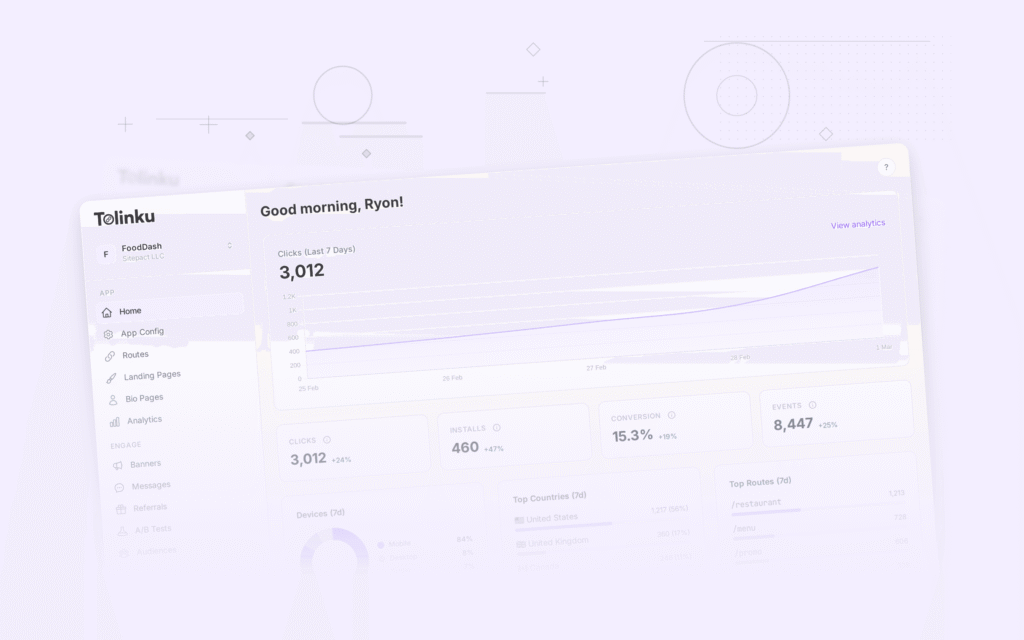
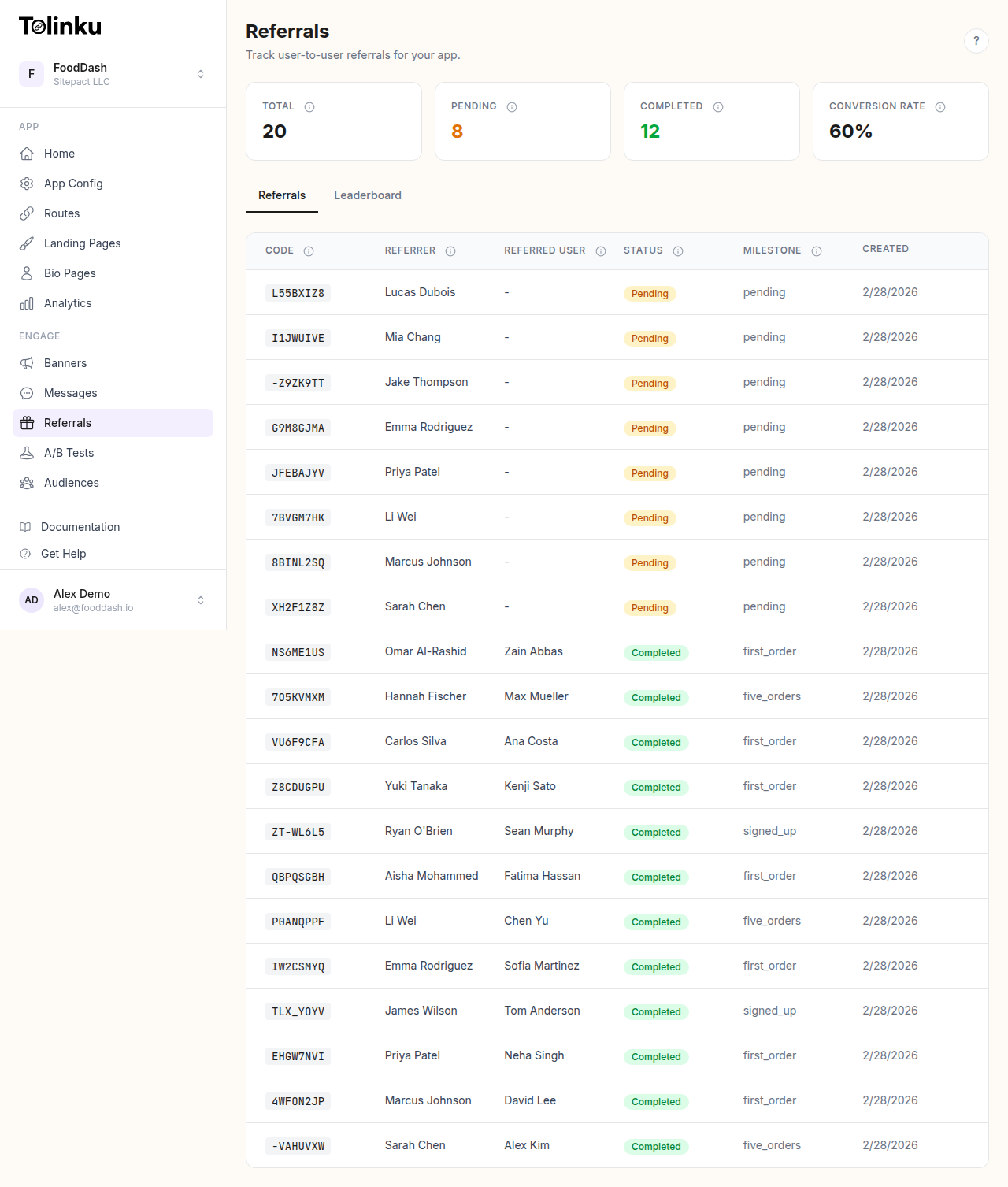 The referrals page with stats cards, referral list, and leaderboard tabs.
Why SaaS Referral Programs Are Different
Longer consideration cycles. A consumer app might convert a referred user in minutes. A SaaS product might take weeks or months from introduction to signed contract. Standard attribution windows (7-30 days) often miss SaaS conversions entirely.
Multiple stakeholders. The person who receives a referral is often not the person who signs contracts or allocates budget. A product manager might love your tool and refer a colleague, but the purchase decision goes through IT security review and finance approval.
Organizational identity vs. individual identity. In consumer products, a user is a person. In SaaS, the billing entity is often an organization, but individual users within that organization are the product's actual users and potential referrers.
Compliance constraints. Employees in some roles (sales, procurement, finance) cannot accept personal cash gifts. Any referral program that rewards employees personally may create compliance problems for your B2B customers.
What to Reward in a SaaS Referral Program
Consumer referral rewards (cash, personal credits) often do not translate well to B2B. Here are the categories that work better.
Subscription Credits
Credits applied to the referrer's account reduce their next invoice. This is the most common SaaS referral reward and it works because:
- It is an account-level reward (goes to the organization, not an individual employee)
- It directly reduces a cost the organization is already paying
- The accounting treatment is clean (it is a discount, not a payment)
The challenge is getting the credit to the right person within the organization. If the referral reward is credited to an account that the person who did the referring never sees, the incentive is weakened.
Free Months or Seat Expansions
Giving the referring customer one month free or a certain number of additional seats has the same account-level character as credits but is expressed in product terms rather than dollars. This works well when the product is seat-priced and the customer is already expansion-minded.
"Refer a customer and we'll give you 5 additional seats for 3 months" is a compelling offer for a team that is approaching their seat limit.
Feature Tier Upgrades
Unlocking a higher feature tier for a referral has zero marginal cost to deliver and high perceived value if the referrer actually wants those features.
This works best when:
- There is a meaningful capability gap between tiers that the referrer is already aware of and wants
- The upgrade can be time-limited without causing friction at the end of the period ("3 months of Growth tier on us")
- The features are genuinely compelling, not a minor incremental improvement
The risk is that feature unlocks create a two-class user experience within the same team. If a team has some members on an upgraded tier and others on a lower tier, that creates usability confusion.
Charitable Donations and Conference Credits
As noted in the referral rewards overview, some B2B programs offer charitable donations in the referrer's name. This sidesteps the personal compensation compliance issue entirely.
Another option specific to B2B: credits toward industry conferences or professional development. "Refer a customer and we'll cover your registration for [relevant conference]" is perceived as a professional benefit, not a personal financial payment.
Handling the B2B Sales Cycle
The core challenge with SaaS referral attribution is time. If your median sales cycle is 45 days, and your attribution window is 30 days, you are missing nearly half of your referral-influenced conversions.
Attribution Window Configuration
Extend your attribution window to match your actual sales cycle. For self-serve SaaS with short trials, a 30-day window may be appropriate. For sales-assisted deals with a 3-6 month cycle, you need a 90-180 day window or attribution based on an intermediate event (demo booked, trial started) rather than final conversion.
Consider using the first meaningful engagement event as the attribution trigger rather than the final purchase:
- Trial signup (for self-serve products)
- Demo request (for sales-assisted products)
- First use of core feature (for product-led growth)
This shortens the effective attribution gap while still ensuring the referral was causally related to the eventual purchase.
Referral-Influenced vs. Referral-Sourced
In B2B sales, distinguishing between these two categories matters:
Referral-sourced: The referral was the primary reason the prospect entered your funnel. Without the referral, they would not have known about you or reached out.
Referral-influenced: The prospect was already in your funnel (or discovered you independently) but a peer referral accelerated the decision or provided additional confidence.
Track both, but design your reward program around referral-sourced conversions. Referral-influenced conversions are valuable but harder to attribute cleanly.
CRM Integration for Sales-Assisted Programs
For products with a sales team, referral attribution needs to live in your CRM, not just in your link management platform. When a sales rep identifies that a deal was referred, they should be able to log that attribution even if it was not captured automatically.
A manual attribution path is important for B2B. Perhaps the referral happened at a conference, or over email outside your tracked channels. Give sales reps a way to record referral relationships that trigger the appropriate reward.
Product-Led Growth and Referral Programs
Many SaaS companies are pursuing product-led growth (PLG), where the product itself drives acquisition through free tiers, viral features, and in-product sharing. PLG and referral programs are complementary.
In a PLG model, the natural referral surface is often the product itself. A team collaboration tool where you can invite colleagues to a shared workspace has a built-in referral mechanic. Adding a formal incentive on top of that natural sharing behavior can amplify it.
The Tolinku content sharing use case covers how in-product sharing flows can be instrumented with deep links and attribution tracking, which is the foundation for turning organic product sharing into a measurable referral channel.

Designing for Team Accounts
SaaS products with team accounts have a structural advantage: existing users are already in a context where they are thinking about their colleagues and collaborators. Natural referral moments include:
- Inviting a new team member (could trigger a referral reward if the new member's organization is new to you)
- Sharing a report or output externally (the recipient sees the product and might inquire)
- Recommending the tool to a peer in a community or forum
The challenge is instrumenting these moments correctly. If a user invites a colleague to their existing account, that is a seat expansion, not a referral. If they share something with someone at a different organization who then signs up for a new account, that is a referral. Your system needs to distinguish between these.
Partner and Affiliate Programs as Referral Extensions
B2B referral programs often evolve into more formal partner or affiliate programs. The distinction:
- Customer referral program: Existing customers refer other businesses, rewarded with account-level benefits
- Affiliate/partner program: External parties (consultants, agencies, complementary SaaS tools) refer customers in exchange for a commission (typically a percentage of first-year revenue)
Both are worth building eventually, but start with the customer referral program first. It requires less infrastructure, has a more predictable reward structure, and generates higher-quality leads (customers are vouching with their professional reputation).
Communicating the Referral Program to B2B Customers
B2B customers are busy. Your referral program will not get traction through passive discoverability alone. You need proactive communication:
- In-app prompts: At moments of high satisfaction (after a successful report, at renewal, after a product milestone)
- Customer success touchpoints: CSMs mention the referral program in regular check-ins, particularly with customers who are enthusiastic advocates
- Email campaigns: Targeted to high-NPS customers, explaining the program and making it easy to refer
- Community participation: In Slack communities, forums, or user groups, customers who are already engaged are natural referrers
For enterprise customers, your CSM or account manager is often the best channel for referral requests. A personal ask from a known contact is far more effective than an automated email.
Measuring SaaS Referral Programs
Standard referral metrics apply (see the full guide at referral program analytics), but SaaS adds some specific considerations:
MRR added from referrals: Track not just "number of referrals" but the monthly recurring revenue each referred customer contributes. A referral that brings in a 500-seat enterprise customer is worth far more than one that brings in a single-seat startup.
Time-to-close for referred vs. non-referred leads: Referrals often close faster because trust is established earlier. Measuring this demonstrates the program's value beyond raw revenue.
Expansion revenue from referred customers: Do referred customers expand (add seats, upgrade tiers) at higher rates than non-referred customers? This compounds the LTV benefit.
NPS of referred cohort: Referred customers who came in through a peer recommendation often have higher NPS, partly because expectations were set accurately by the referrer. High NPS referred customers become referrers themselves.
Implementation Notes
Tolinku handles referral link generation, attribution tracking, and reward triggering for SaaS products. The referral features page covers the available program configurations, including extended attribution windows suitable for longer sales cycles.
For API-driven integration with your CRM or billing system, the referrals API documentation covers the webhook events that fire on referral completion, which can trigger your internal reward workflows.
The referral use cases documentation includes SaaS-specific configuration examples.
Summary
SaaS referral programs require adapting several consumer referral defaults:
- Extend attribution windows to match your actual sales cycle length
- Reward at the account level (credits, free months, seat expansions) rather than the individual level, to stay within B2B compliance norms
- Use intermediate attribution events (trial starts, demo requests) rather than final purchase events to capture value before the window closes
- Build CRM integration for sales-assisted programs where referral attribution happens outside automated tracking
- Measure MRR contribution from referrals, not just headcount, to capture the true value of high-value B2B referrals
The underlying economics of referred customers being higher-quality than cold-acquired customers holds in B2B as much as consumer. The structural challenge is that B2B referrals are harder to instrument and take longer to close. Getting the technical infrastructure right is what makes the difference between a program that looks like it is not working and one that actually generates measurable MRR.
Related reading: Building Referral Programs That Work, Referral Reward Strategies: Finding the Right Incentive, Referral Program Analytics: Metrics That Matter.
Get deep linking tips in your inbox
One email per week. No spam.