A referral program without the right reward is just a sharing button. The incentive you choose determines who participates, how enthusiastically they share, and whether the people they invite actually convert. Pick too little and participation is low. Pick too much and your economics break. Pick the wrong type and you attract the wrong users.
This guide covers the main categories of referral rewards, what we know about their effectiveness, and how to think about choosing between them.
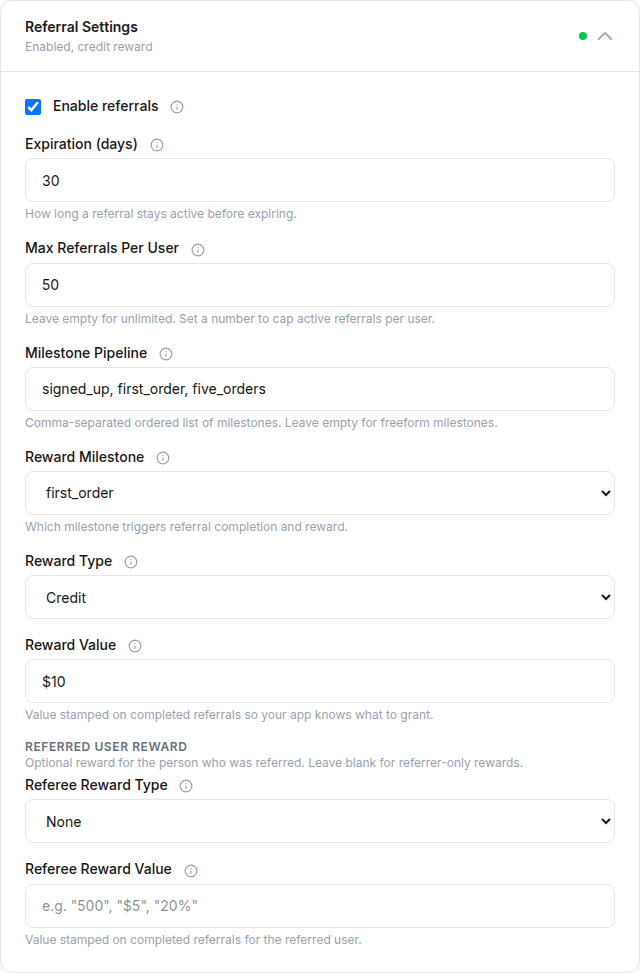 The referral configuration section with enable toggle, expiration, limits, milestones, and rewards.
1. Cash Rewards
Cash rewards are the most direct incentive. The referrer gets a dollar amount deposited to their account, paid via PayPal, or issued as a gift card for each successful referral.
Best for: Financial products, insurance, credit cards, high-margin subscription services.
Typical amounts: $5 to $100+ per referral, depending on the LTV of a new customer.
Why they work: Cash is universally valued. There is no ambiguity about whether the reward is useful. Users who care about cash rewards are often active sharers who will put real effort into getting conversions.
Why they can fail: Cash rewards attract reward-seekers who may not be your ideal customer profile. Fraud is more common because the reward has clear monetary value. Programs that offer cash referral bonuses sometimes see a spike in low-quality signups from users who only joined to get the referring bonus from a friend.
A 2018 study published in the Journal of Marketing Research found that cash incentives increased referral sharing rates significantly, but that referred users were less loyal than organic users in some categories. The implication is that cash rewards can accelerate growth without improving cohort quality.
2. Account Credits
Account credits are a discount on future spend within your platform. Instead of cash, the referrer gets $10 off their next bill, store credit, or in-app currency.
Best for: E-commerce, SaaS, marketplaces, subscription apps.
Why they work: Credits increase retention as well as acquisition. A user who has $25 in account credit has a reason to stay. You also only pay out value when the referrer actually spends, so the economic exposure is lower than cash.
Why they can fail: Credits are only valuable to users who actually plan to keep using the product. If a user is considering cancelling, $10 credit is not much of an incentive to share. The perceived value of a credit is also lower than its face value for many users ("Is $10 credit really $10?").
Amazon has used credit-based referrals extensively, particularly in their digital products. The model works because their platform is sticky enough that credits will almost certainly be used.
3. Free Time or Extended Subscriptions
Subscription products often reward referrals with additional free time: one month free per referral, two weeks added to the trial, etc.
Best for: Subscription services, SaaS, streaming, productivity tools.
Why they work: Free time rewards are directly tied to product value. The referrer gets more of what they already like. The perceived value is high because the reward is expressed in terms of the product rather than dollars.
Why they can fail: For users who are not sure they want to continue the subscription, free time has low value. Also, these rewards are harder to communicate clearly ("You get 30 days free" is clear; "You get 1/12th of your annual subscription" is not).
Dropbox's referral program, which offered additional storage rather than free time, is the canonical example of this category. Their approach delivered a 3900% growth in signups over 15 months. The reward (more storage) was directly tied to the core value of the product, making it highly motivating for existing users who were getting value from it.
4. Feature Unlocks
Feature unlock rewards give the referrer access to functionality that is otherwise gated behind a higher tier or not available at all.
Best for: Products with meaningful feature tiers, tools where power users want specific capabilities.
Examples: Unlock advanced analytics, remove watermarks, increase API rate limits, access beta features.
Why they work: Feature unlocks attract power users who are already invested in the product. These users tend to have large networks of relevant contacts. The reward has zero marginal cost to deliver (enabling a feature costs you nothing).
Why they can fail: Feature unlocks do not appeal to users who do not care about those specific features. They are hard to explain briefly ("Refer 3 friends to unlock advanced reporting" requires the referrer to believe the recipient will find advanced reporting valuable). Feature unlocks also create equity concerns in team/collaborative products if some users have features others do not.
5. Tiered Rewards
Tiered rewards scale the incentive with referral volume. Refer 1 user and get X. Refer 5 and get Y. Refer 10 and get Z.
Best for: Products where a small number of power users can drive a large volume of referrals, influencer-adjacent programs.
Why they work: Tiers create goal-seeking behavior. Users who have referred 3 people and know that 5 unlocks the next tier are motivated to close that gap. The economics are better than flat rewards because users who refer many people get more total reward but your CAC per referral stays manageable.
Why they can fail: Complexity. If users cannot quickly understand the reward structure, they will not engage with it. Keep tiers to 2-3 levels maximum and make the thresholds clear.
6. Limited-Time Bonuses
Time-limited rewards add urgency to the baseline incentive. "Refer a friend this month and get double the standard reward" or "First 100 referrals this quarter get an extra $20."
Best for: Relaunching a stale program, driving a spike in acquisition around a product launch or event.
Why they work: Urgency is one of the most reliable behavioral levers in consumer psychology. Cialdini's research on scarcity and urgency shows that time-limited offers reliably increase action rates.
Why they can fail: Users learn that bonuses come around regularly and wait for them. Also, a spike in referrals from a bonus period may not reflect the program's sustainable performance.
7. Charitable Donations
Some products let referrers direct a donation to a charity of their choice. The referral generates a $5 donation instead of a personal reward.
Best for: Products with a mission-driven audience, B2B products where employees cannot accept personal gifts.
Why they work: Prosocial motivations are real. A segment of users is more motivated by contributing to something meaningful than by personal financial gain. B2B is a specific case where this solves a compliance problem: employees often cannot accept personal cash or gifts, but a donation to charity on their behalf is fine.
Why they can fail: Participation rates are generally lower than personal rewards. It is difficult to know in advance whether your audience skews toward prosocial motivation.
What the Research Says
A few findings from referral program research worth knowing:
Referred users have higher LTV in many verticals. A study of a major European bank's referral program found that referred customers were 18% more likely to stay and generated 25% more profit. The effect was attributed to the social trust transferred with the referral.
Intrinsic motivation matters. Users who refer because they genuinely like a product refer higher-quality contacts than users who refer only for the reward. Programs that minimize reward salience and emphasize authentic sharing sometimes outperform heavily incentivized programs in cohort quality.
The reward for the new user matters as much as the reward for the referrer. Programs where only the referrer benefits see lower conversion rates from the new user. Double-sided programs (more on this in the companion article on double-sided referral incentives) typically outperform one-sided programs on conversion rate.
How to Choose
Ask these four questions:
1. What do your best users actually value? Survey them. If they are cost-sensitive, credits or cash matter. If they are power users, feature unlocks may be more exciting than cash.
2. What is the LTV of a referred user? Your reward budget is bounded by the economic value of a new user. If a new subscriber is worth $300 over their lifetime, a $30 referral reward has a sensible CAC. If they are worth $30, you have very little room.
3. What motivates sharing vs. conversion? The referrer needs a reason to share. The new user needs a reason to sign up. These are different incentives and often require different rewards.
4. What can you operationally deliver? Cash requires payout infrastructure. Feature unlocks require development. Credits require accounting for deferred liability. Choose a reward type your team can actually implement and support.
Implementation Notes
Tolinku handles reward attribution automatically once you configure what event triggers a reward. The rewards and attribution documentation covers the configuration options, including attribution window, reward triggers, and dual-sided reward setup.
The referral analytics dashboard shows reward payout rates, conversion rates by reward type if you are A/B testing, and reward economics by cohort.
Full setup guide at tolinku.com/docs/user-guide/referrals/setup/.
Summary
| Reward Type | Best Signal | Main Risk |
|---|---|---|
| Cash | High participation | Fraud, low-quality users |
| Credits | Retention boost | Low perceived value |
| Free time | High perceived value | Only works for committed users |
| Feature unlock | Power user activation | Narrow appeal |
| Tiered | Volume sharing | Complexity |
| Limited-time | Urgency spike | Creates boom/bust cycles |
| Charitable | B2B, mission-driven | Lower participation |
There is no universally correct referral reward. The right choice depends on your product, your users, and what a new customer is worth. Start with the reward type most aligned with your product's core value, test it, and iterate based on actual participation and conversion data.
Related reading: Building Referral Programs That Work, Referral Program Analytics: Metrics That Matter.
Get deep linking tips in your inbox
One email per week. No spam.