


Deferred deep linking connects a pre-install link click to a post-install app open. The accuracy of that connection determines whether the user lands on the right content after installing your app, or whether they land on the generic home screen. Accuracy varies widely depending on the matching method, the platform, the time between click and install, and the user's device configuration.
This guide covers what accuracy rates to expect from different matching techniques, what factors degrade accuracy, and how to improve your match rates. For the mechanics of deferred deep linking, see how deferred deep linking works. For a comparison of matching methods, see fingerprinting vs. deterministic matching.
Matching Methods and Their Accuracy
Deterministic Matching (Near 100%)
Deterministic methods use a unique identifier that persists from the click to the app open. The match is either correct or it does not happen; there are no false positives.
Google Play Install Referrer (Android): When a user clicks a link and installs from the Play Store, Google passes the referrer data through the Play Install Referrer API. This is a direct, cryptographically backed handoff. Match rate: ~99% (fails only in edge cases like sideloading or enterprise distribution).
Clipboard-based matching: A token is copied to the clipboard on click and read on app open. When the token is present, the match is 100% accurate. Practical match rate: 60-80%, because users often copy something else before installing. See clipboard-based deferred linking for details.
Apple's App Clip / Universal Link handoff: When an App Clip transitions to a full app install, the context can be passed deterministically. Limited to App Clip scenarios.
Probabilistic Matching (50-70%)
Probabilistic methods use device attributes collected at click time and match them against attributes collected at app open. No unique identifier persists across the install.
Device fingerprinting collects:
- IP address
- User agent string (browser, OS version, device model)
- Screen resolution
- Language and timezone
- Accept headers
The server matches these attributes within a time window (typically 1-24 hours). Match rates depend heavily on conditions:
| Condition | Typical Match Rate |
|---|---|
| Same IP, same device, within 1 hour | 70-85% |
| Same IP, same device, within 24 hours | 50-65% |
| IP changed (mobile network, VPN) | 20-40% |
| Shared IP (corporate network, university) | 30-50% |
Fingerprinting accuracy has declined over the past several years due to:
- iOS Intelligent Tracking Prevention limiting cross-site data
- Android's privacy sandbox reducing available signals
- Increasing VPN adoption changing IP addresses between click and install
- Browser privacy features normalizing user agents
Combined Matching
Production systems combine multiple methods and use the highest-confidence match available:
1. Deterministic match (Install Referrer / clipboard) → use if available
2. Strong probabilistic match (same IP, same device, <1 hour) → use with high confidence
3. Weak probabilistic match (partial attribute match, >1 hour) → use cautiously
4. No match → fall back to default onboarding
Factors That Affect Accuracy
Time Between Click and Install
This is the single biggest factor. The longer the gap, the lower the accuracy:
- Immediate install (< 5 minutes): Highest accuracy. IP address, device state, and clipboard contents are all unchanged.
- Same session (< 1 hour): Good accuracy. IP is usually the same. Clipboard may still have the token.
- Same day (1-24 hours): Moderate accuracy. IP may have changed (mobile networks rotate IPs). Clipboard is likely overwritten.
- Multi-day (> 24 hours): Low accuracy for probabilistic matching. Only deterministic methods (Install Referrer) still work reliably.
Most deferred linking implementations set a match window (e.g., 24 hours). Clicks older than the window are not matched, reducing false positives at the cost of missing legitimate slow installs.
IP Address Stability
Mobile users frequently change IP addresses:
- Switching between Wi-Fi and cellular
- Moving between cell towers (carrier-grade NAT reassignment)
- VPN connections
- Traveling
On shared networks (offices, universities, coffee shops), multiple users share the same IP. This creates both false positives (matching the wrong user) and ambiguity (multiple clicks from the same IP).
IPv6 adoption helps somewhat: IPv6 addresses are more unique per device, reducing shared-IP collisions. But IPv6 adoption varies by carrier and region.
Device Attribute Diversity
Fingerprinting works better when device attributes are distinctive. A user with an uncommon combination (niche device model, unusual screen resolution, rare language setting) is easier to match than a user with a common setup.
The problem: the most common devices are also the most popular. An iPhone 15 Pro with English locale, Pacific timezone, and a major carrier's IP matches millions of users. Distinguishing one from another requires additional signals or a very short match window.
Platform Differences
Android has a significant advantage: the Play Install Referrer API provides a deterministic matching path for most installs. Apps distributed through the Play Store can achieve near-100% accuracy on deferred link matching.
iOS has no equivalent to the Play Install Referrer. Apple removed the IDFA (Identifier for Advertisers) as a default in iOS 14.5 with App Tracking Transparency. iOS deferred linking relies on:
- Clipboard matching (requires paste permission on iOS 16+)
- Probabilistic fingerprinting (declining accuracy)
- SKAdNetwork (limited data, no deep link context)
This means iOS deferred linking accuracy is generally lower than Android.
Measuring Your Match Rate
What to Track
Track these metrics to understand your deferred linking accuracy:
- Click-to-install rate: How many link clicks result in an app install? This is your conversion funnel, not your match rate, but it contextualizes the numbers.
- Match rate: Of installs that should have a deferred link (user clicked a link before installing), how many successfully matched? This requires knowing which installs came from a link click.
- False positive rate: How many installs were matched to the wrong click? Hard to measure directly, but proxy signals include users reporting wrong landing content.
- Match latency: How long after app open does the match resolve? Deterministic matches are instant; probabilistic matches may require a server round-trip.
- Fallback rate: How many installs fell through to default onboarding because no match was found?
Attribution Windows
Set your match window based on your use case:
- Referral programs: Longer windows (24-48 hours) are acceptable because the referrer link is intentional and users may not install immediately.
- Ad campaigns: Shorter windows (1-6 hours) reduce false positives from shared IPs on ad networks.
- Content sharing: Medium windows (6-24 hours) balance accuracy with the natural delay of receiving and acting on shared content.
Improving Accuracy
Use Deterministic Methods First
Always prefer deterministic matching when available:
- Android: Integrate the Play Install Referrer API. Pass your deferred link data as the referrer parameter.
- iOS: Implement clipboard-based matching with a good UX for the paste permission prompt. See iOS paste permission and deferred links.
Reduce Time-to-Install
The faster a user installs after clicking, the higher the match rate. Optimize your landing page to minimize friction:
- Clear app store redirect (don't make users search for your app)
- App Store / Play Store badges prominently displayed
- Minimal steps between click and install
Combine Multiple Signals
Use every available signal for probabilistic matching:
Score = 0
if (same IP address)          score += 40
if (same device model)        score += 15
if (same OS version)          score += 10
if (same screen resolution)   score += 10
if (same language)            score += 5
if (same timezone)            score += 5
if (within 1 hour)            score += 15
else if (within 6 hours)      score += 5

// Match if score >= threshold (e.g., 60)
Weight signals by their distinctiveness. IP address is the strongest single signal; timezone alone is nearly worthless.
Handle Ambiguous Matches
When multiple clicks could match a single install (same IP, similar timing), you have options:
- Pick the most recent click. Usually correct, but not always.
- Pick the best scoring match. More robust if your scoring is well-calibrated.
- Don't match. If confidence is low, default onboarding is better than wrong routing.
Option 3 is underrated. A user who lands on the home screen and navigates manually has a better experience than a user who lands on the wrong product page.
Tolinku's Approach
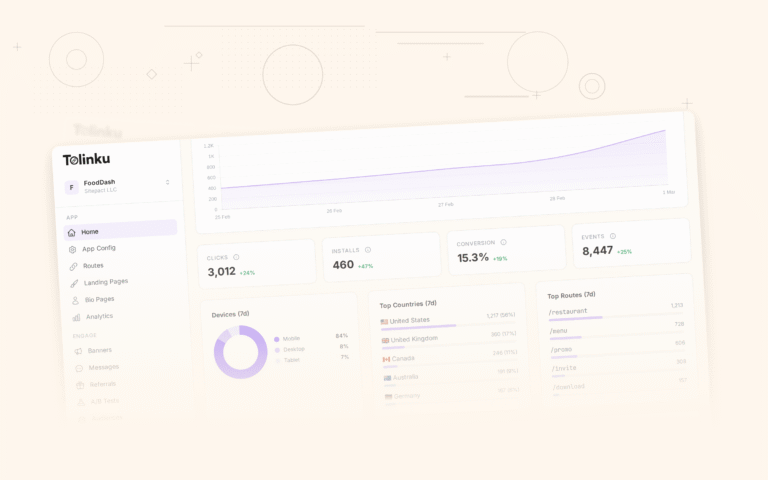
Tolinku's deferred deep linking combines deterministic and probabilistic matching to maximize accuracy. The SDK uses the Play Install Referrer on Android, clipboard matching where appropriate, and server-side probabilistic matching as a fallback. Match confidence scores are exposed in the analytics dashboard so you can see your actual match rates and tune your attribution windows.
For conversion tracking across deferred links, see deferred linking conversion rates. For the full deferred deep linking overview, see how deferred deep linking works.
Get deep linking tips in your inbox
One email per week. No spam.