

Deferred deep linking adds a critical step to the user acquisition funnel: after the click and before the app open, there is an install. Each step in that funnel has a conversion rate, and understanding those rates helps you identify where users drop off and where to focus optimization efforts.
This guide provides benchmark conversion rates for each stage of the deferred deep linking funnel, broken down by industry and acquisition channel. For the technical foundations, see how deferred deep linking works. For accuracy rates of different matching methods, see deferred linking accuracy.
The Deferred Deep Linking Funnel
The funnel has four stages, each with its own conversion rate:
1. Link Click
   ↓ Click-to-Install Rate
2. App Install
   ↓ Install-to-Open Rate
3. First App Open
   ↓ Match Rate (deferred link resolves)
4. Content Landing (user sees the intended content)
The overall deferred link conversion rate is the product of these three rates. If your click-to-install rate is 15%, your install-to-open rate is 70%, and your match rate is 80%, your end-to-end rate is: 0.15 x 0.70 x 0.80 = 8.4% of clicks result in a successful deferred link resolution.
Benchmark Rates by Funnel Stage
Stage 1: Click-to-Install Rate
This measures how many link clicks result in an app install. It depends on the landing page experience, the app store listing, and the user's intent.
| Channel | Typical Click-to-Install Rate |
|---|---|
| Referral links (friends/family) | 15-30% |
| Email campaigns (existing users inviting friends) | 8-15% |
| Social media sharing | 5-12% |
| Paid ads (Facebook, Google) | 3-8% |
| Content marketing / blog | 2-5% |
| QR codes (physical media) | 10-20% |
Referral links have the highest conversion because they carry social proof: a trusted person recommended the app. Paid ads have the lowest because the intent is weaker.
Stage 2: Install-to-Open Rate
Not every install results in an app open. Some users install but never launch the app. This rate varies by platform:
| Platform | Typical Install-to-Open Rate |
|---|---|
| iOS | 65-80% |
| Android | 60-75% |
iOS rates tend to be slightly higher because the App Store has a more engaged user base. The gap narrows for high-intent installs (referral links, specific content links).
Timing matters: most first opens happen within the first hour after install. If a user has not opened the app within 24 hours of installing, they are significantly less likely to ever open it.
Stage 3: Deferred Link Match Rate
This is the rate at which the deferred link successfully resolves, routing the user to the intended content. It depends on the matching method:
| Matching Method | Typical Match Rate |
|---|---|
| Google Play Install Referrer (Android) | 95-99% |
| Clipboard (token present) | 60-80% |
| Fingerprint (< 1 hour) | 65-85% |
| Fingerprint (1-24 hours) | 45-65% |
| Combined methods | 75-90% |
See deferred linking accuracy for detailed analysis of each method.
Stage 4: Content Landing Rate
Even after the deferred link resolves, the user may not reach the intended content. Reasons for failure:
- The content no longer exists (expired promotion, deleted product).
- The user is forced through onboarding before reaching the content.
- A login wall blocks access to the content.
- The app crashes or errors on the content screen.
A well-implemented deferred linking flow should achieve 95%+ content landing rates (given a successful match). If your rate is lower, the issue is in your app's routing or onboarding flow, not in the deferred linking system.
Benchmark Rates by Industry
E-Commerce
| Metric | Benchmark |
|---|---|
| Click-to-install (paid ads) | 4-7% |
| Click-to-install (referral) | 15-25% |
| End-to-end deferred link conversion | 5-12% |
| Average deferred link order value | 10-20% higher than organic |
E-commerce apps benefit significantly from deferred linking because users who land on a specific product are more likely to purchase than users who land on the home screen. Deferred link users show higher average order values because they arrive with specific purchase intent.
Social / Messaging
| Metric | Benchmark |
|---|---|
| Click-to-install (friend invite) | 20-35% |
| Click-to-install (content share) | 8-15% |
| End-to-end deferred link conversion | 12-22% |
Social apps have the highest deferred link conversion rates because the sharing mechanism is integral to the product. A shared post or group invitation carries strong intent.
Fintech / Banking
| Metric | Benchmark |
|---|---|
| Click-to-install (referral with reward) | 10-20% |
| Click-to-install (partner promotion) | 3-8% |
| End-to-end deferred link conversion | 6-14% |
Fintech referral programs are effective because they typically offer monetary incentives. The higher friction (KYC, identity verification) is offset by the reward motivation.
Gaming
| Metric | Benchmark |
|---|---|
| Click-to-install (friend invite) | 10-20% |
| Click-to-install (ad) | 5-12% |
| End-to-end deferred link conversion | 8-15% |
Gaming installs from ads have higher conversion than most verticals because the "try it" barrier is low. Deferred links that drop players into specific game modes or give them a bonus item see the highest post-install engagement.
Media / Content
| Metric | Benchmark |
|---|---|
| Click-to-install (shared article/video) | 3-8% |
| Click-to-install (subscription promotion) | 5-10% |
| End-to-end deferred link conversion | 3-7% |
Content apps have lower click-to-install rates because users can often consume the content on the web without installing. The deferred link conversion is most valuable for subscription-based apps where the app experience is significantly better than the web.
Optimizing Each Funnel Stage
Improving Click-to-Install
- Optimize your landing page. Show a preview of the content the link points to. Include app store badges. Make the install CTA prominent.
- Use smart banners. On mobile web, show a banner linking to the app store. See Tolinku's smart banner feature for implementation.
- Reduce redirects. Every redirect between the click and the app store listing adds latency and loses users. Minimize the redirect chain.
- A/B test store listings. Your App Store / Play Store listing is part of the funnel. Test screenshots, descriptions, and app previews.
Improving Install-to-Open
- Send a push notification (if the user granted permission at install time on Android). A well-timed notification within the first hour can prompt the open.
- Reduce app size. Smaller apps install faster, and users are more likely to open them immediately.
- Pre-register / app clips. iOS App Clips and Android Instant Apps let users experience the app before a full install, which increases full install-to-open rates.
Improving Match Rate
- Use deterministic methods first. Play Install Referrer on Android, clipboard on iOS. See deferred linking without fingerprinting for details.
- Reduce time-to-install. The faster the install happens after the click, the higher the match rate for all methods.
- Handle the iOS paste permission well. A pre-prompt explanation screen can increase paste acceptance rates from ~35% to ~60%. See iOS paste permission.
Improving Content Landing
- Show content before onboarding. Let deferred link users see the content first, then onboard them. See first-open experience with deep links.
- Handle expired content gracefully. If the linked product or promotion has expired, show a relevant fallback, not an error page. See deferred link expiration.
- Skip login walls for guest-accessible content. If the content can be viewed without an account, let the user see it first.
Tracking with Tolinku
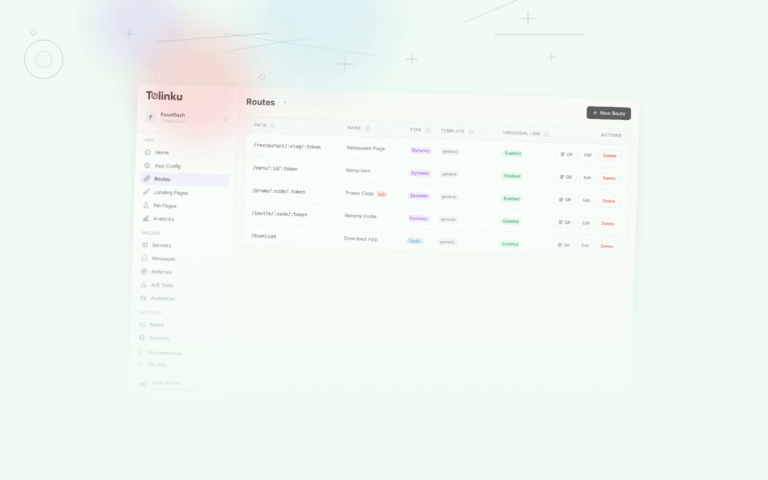
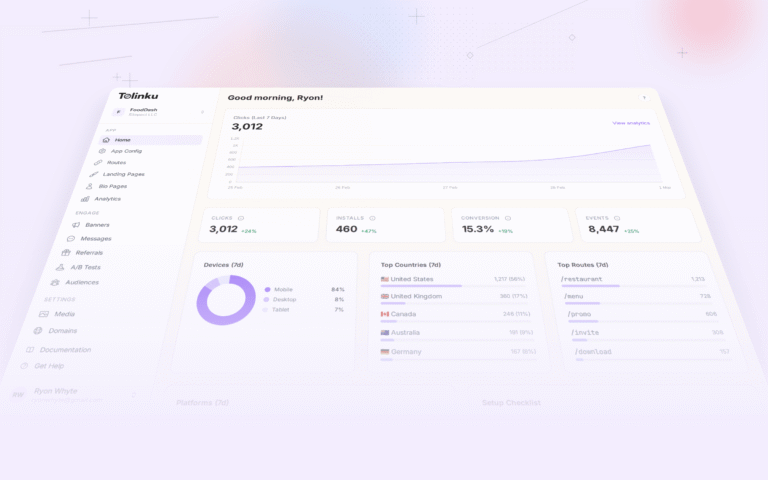
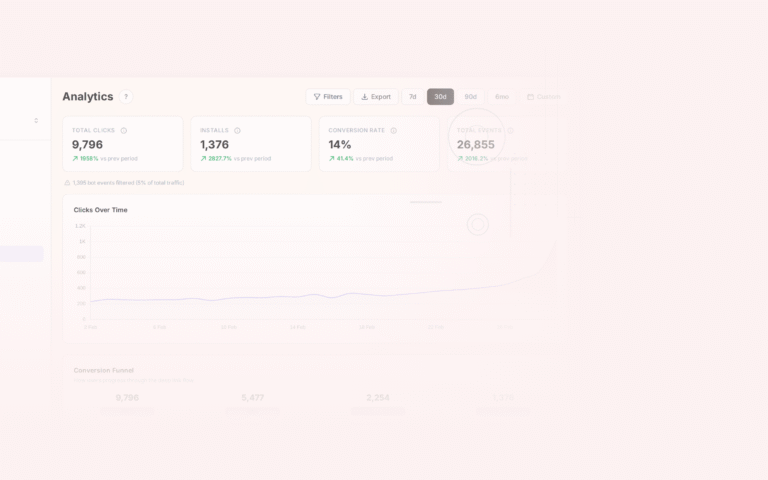
Tolinku's analytics tracks each stage of the deferred linking funnel: clicks, installs, first opens, and successful matches. Use the analytics dashboard to monitor conversion rates and identify drop-off points.
For the deferred linking setup, see the Tolinku documentation. For related optimization guides, see first-open experience and deferred linking accuracy.
Get deep linking tips in your inbox
One email per week. No spam.