

Content marketing drives app growth by attracting users through valuable content rather than paid ads. A blog post that ranks for "best budgeting tips" brings potential users to a budgeting app. A tutorial video that shows how to edit photos brings potential users to a photo editing app. The content demonstrates the value; the app delivers it.
For the full app growth playbook, see mobile app growth: 25 strategies that work in 2026. For organic channels specifically, see organic growth channels for mobile apps.

Why Content Marketing Works for Apps
Paid user acquisition costs keep rising. The average cost per install varies by category but often exceeds $3-5 on mainstream ad platforms. Content marketing has a different cost structure:
- Upfront cost: Creating the content (articles, videos, tools).
- Ongoing cost: Low (hosting, occasional updates).
- Compounding returns: A blog post published today can drive installs for years.
- Trust signal: Users who find your app through helpful content arrive with positive intent.
Content marketing does not replace paid acquisition. It complements it by building an organic funnel that reduces dependency on ad spend.
Content Types That Drive App Installs
Blog Posts
Blog posts target search queries from potential users:
| App Category | Content Example | Target Query |
|---|---|---|
| Fitness | "15-minute home workout routines" | "quick home workouts" |
| Finance | "How to create a monthly budget" | "monthly budget template" |
| Recipes | "Easy weeknight dinners for families" | "easy dinner ideas" |
| Language learning | "Common Spanish phrases for travelers" | "Spanish travel phrases" |
| Productivity | "How to organize your tasks with time blocking" | "time blocking method" |
Each blog post solves a problem. The app is the tool that helps the reader implement the solution.
Tutorial Videos
Short-form video (YouTube, TikTok, Instagram Reels) demonstrates what the app does:
- Before/after: Show the result the app produces (photo editing, design).
- How-to: Walk through a specific workflow in the app.
- Tips: Share expert tips that happen to use the app.
Video content has higher engagement but lower search longevity compared to blog posts.
Interactive Tools
Free web-based tools that provide a taste of the app's value:
- A calorie calculator for a nutrition app.
- A savings goal simulator for a finance app.
- A color palette generator for a design app.
The tool demonstrates value. The app provides the full experience. Include a "Get the full version in our app" call to action.
Email Courses and Newsletters
Multi-part email sequences educate users over time:
Day 1: "Why most budgets fail (and what to do instead)"
Day 3: "The 50/30/20 rule explained"
Day 5: "How to track spending without spreadsheets"
Day 7: "Your first month with [App Name]: a walkthrough"
By day 7, the reader understands the problem and sees the app as the solution.
User-Generated Content
Encourage existing users to create content:
- Feature user success stories on your blog.
- Create templates that users share (workout plans, budget templates, meal plans).
- Run challenges with a branded hashtag.
SEO for App Content
Keyword Research
Find queries that your target users search for. Focus on:
- Problem-aware queries: "how to save money" (they know the problem but not the solution).
- Solution-aware queries: "best budgeting app" (they know they need an app).
- Feature-specific queries: "expense tracking with receipt scanning" (they want a specific feature).
Problem-aware queries have higher volume but lower conversion. Solution-aware queries convert better but have more competition.
Content Structure for App SEO
Each blog post should:
- Address the user's question directly.
- Provide actionable value (not just "download our app").
- Naturally mention how the app helps (one or two places, not every paragraph).
- Include a clear call to action with a deep link to the relevant app screen.
Deep Links in Content
Blog posts should include deep links that open the app to the relevant screen:
<a href="https://yourdomain.com/feature/budget-tracker">
  Try the budget tracker in our app
</a>
If the user has the app installed, this opens the budget tracker screen. If not, it redirects to the app store. See the deep linking documentation for setup details.
Distribution
Creating content is half the work. Distribution determines reach.
Search (SEO)
- Optimize for search intent (answer the question the user is asking).
- Build internal links between related posts.
- Update content annually to maintain rankings.
Social Media
- Share blog posts on platforms where your audience spends time.
- Repurpose blog posts into social media formats (threads, carousels, short videos).
- Engage in relevant communities (Reddit, Discord, Facebook groups).
- Send new content to your email list.
- Segment by user activity (non-users get acquisition content; active users get engagement content).
Partnerships
- Guest post on complementary blogs.
- Co-create content with non-competing apps in adjacent categories.
- Get featured in newsletters and roundups.
Measuring Content Marketing for Apps
Key Metrics
| Metric | What It Measures |
|---|---|
| Organic traffic | How many people find your content via search |
| Content-to-install rate | What percentage of content readers install the app |
| Content-assisted installs | Installs where the user visited content before installing |
| Time to install | How long after reading content the user installs |
| Cost per content-driven install | Total content spend / content-driven installs |
Attribution
Track the path from content to install:
- User reads a blog post.
- User clicks a deep link or CTA.
- User installs the app (or opens it if already installed).
- User completes a key action (signup, first session, purchase).
Use UTM parameters on content CTAs and deep links to attribute installs to specific content pieces.
Content Calendar
Maintain a publishing cadence:
| Frequency | Content Type |
|---|---|
| Weekly | 1-2 blog posts |
| Bi-weekly | 1 video (tutorial or tip) |
| Monthly | 1 interactive tool or resource |
| Quarterly | 1 comprehensive guide or report |
Consistency matters more than volume. A weekly blog post published for 12 months outperforms 50 posts published in one month followed by silence.
Common Mistakes
| Mistake | Impact | Fix |
|---|---|---|
| Content is all about the app | Reads like an ad, users bounce | Focus on the user's problem, mention the app naturally |
| No call to action | Content drives traffic but not installs | Include a clear CTA with a deep link |
| No SEO strategy | Content does not rank, no organic traffic | Research keywords before writing |
| Inconsistent publishing | Audience and search engines lose interest | Commit to a sustainable cadence |
| Ignoring existing users | Content only targets acquisition | Create content for engagement and retention too |
Tolinku for Content Marketing
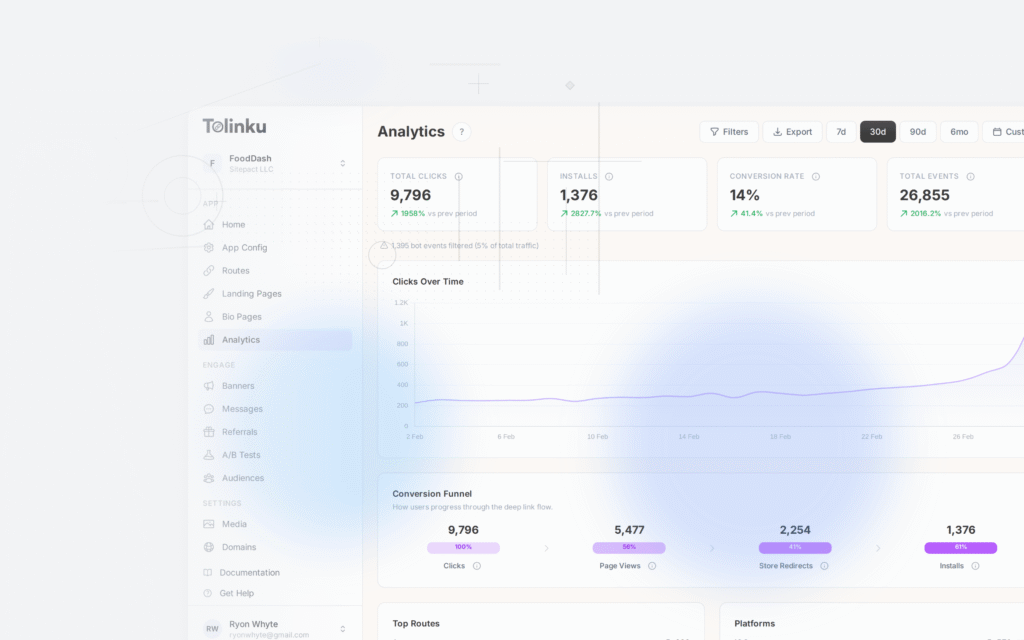
Tolinku provides deep links that you can embed in blog posts and content. When a reader clicks the link, they are taken directly to the relevant screen in your app. For readers who do not have the app installed, Tolinku handles deferred deep linking so they reach the correct screen after installation. Analytics track which content pieces drive the most installs.
For influencer partnerships, see influencer marketing for mobile apps. For the full growth guide, see mobile app growth: 25 strategies that work in 2026.
Get deep linking tips in your inbox
One email per week. No spam.