

"Should we build a referral program or an affiliate program?" is one of the most common growth questions for mobile apps. The answer depends on your product, your audience, and your growth stage, but many teams conflate the two because they share surface-level similarities: someone promotes your product and gets paid when a new user signs up.
The mechanics, audiences, cost structures, and outcomes are fundamentally different. This guide breaks down the comparison so you can make an informed choice (or run both). For the referral program framework, see building referral programs that actually work. For reward design, see the referral reward strategies guide.
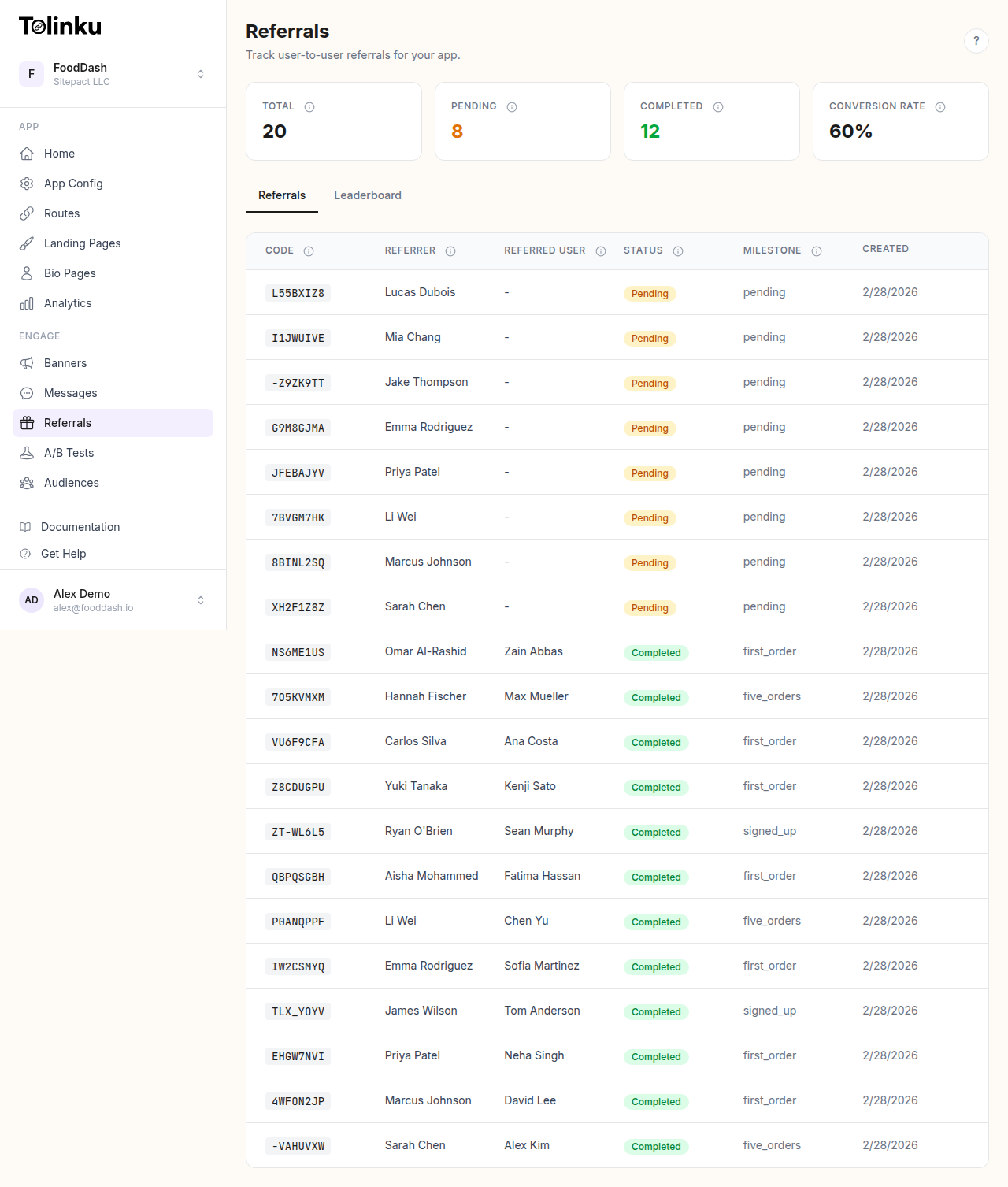 The referrals page with stats cards, referral list, and leaderboard tabs.
The Core Difference
Referral programs leverage your existing users. A customer who loves your product recommends it to friends, family, or colleagues. The relationship between the referrer and the referred person is personal.
Affiliate programs leverage third-party marketers. A blogger, influencer, or content creator promotes your product to their audience. The relationship between the affiliate and the potential customer is professional or parasocial.
This single distinction drives every other difference.
Side-by-Side Comparison
| Dimension | Referral Program | Affiliate Program |
|---|---|---|
| Who promotes | Your existing customers | Third-party marketers, bloggers, influencers |
| Relationship | Personal (friend-to-friend) | Professional (marketer-to-audience) |
| Motivation | Help a friend + earn a reward | Earn commission income |
| Trust signal | Personal recommendation | Content authority |
| Reward structure | Fixed reward (e.g., $10 each) | Commission (% of sale or fixed CPA) |
| Reward recipient | Both referrer and friend | Affiliate only |
| Scale | Bounded by user base | Unbounded (recruit more affiliates) |
| User quality | Typically higher LTV | Variable; depends on affiliate quality |
| Fraud risk | Self-referral, referral rings | Click fraud, cookie stuffing, brand bidding |
| Setup complexity | Moderate | Higher (tracking, payouts, affiliate management) |
| Cost predictability | High (fixed reward per conversion) | Moderate (variable commissions) |
When to Choose Referral Programs
Your product has high trust barriers
Financial apps, health apps, and any product that handles sensitive data. Users are more likely to try these products when a friend recommends them than when a blogger does. The personal relationship lowers the perceived risk.
Your users have natural sharing moments
Products with built-in sharing contexts: sending money (Venmo, Cash App), sharing playlists (Spotify), splitting bills, collaborative tools. The product itself creates moments where users naturally talk about it.
You want higher-quality users
Referred users have 15-25% higher LTV than users from other channels, according to research from the Wharton School. This is because people refer friends who are similar to themselves. If your referrers are good customers, their friends likely will be too.
You're early stage
Referral programs are simpler to build and manage than affiliate programs. You don't need an affiliate portal, commission tracking, or payout infrastructure. A referral code, a reward, and a tracking system are enough to start. See the referral program ROI guide for measuring the return.
When to Choose Affiliate Programs
Your product needs education
Complex products (B2B SaaS, developer tools, investment platforms) benefit from affiliates who create detailed tutorials, reviews, and comparison content. A friend's recommendation gets someone interested; an affiliate's 2,000-word review helps them evaluate.
You want to reach new audiences
Referral programs are limited by your existing user base. If you have 1,000 users, your referral reach is the social networks of those 1,000 people. Affiliate programs can reach entirely new audiences through content creators in adjacent niches.
You're scaling and can invest in management
Affiliate programs require ongoing management: recruiting affiliates, reviewing content for brand compliance, managing payouts, preventing fraud. This overhead is worth it at scale but can be distracting for small teams.
You sell high-ticket products
Products with high average order values (financial products, premium SaaS, e-commerce) work well with affiliate commissions. A 10% commission on a $100/month subscription ($120/year payout) is attractive enough to motivate serious content creators.
Running Both
Many successful companies run both programs simultaneously. They serve different purposes and reach different audiences.
Referral program: Drives friend-to-friend recommendations from your user base. Optimized for trust and user quality.
Affiliate program: Drives content-driven discovery from third-party creators. Optimized for reach and new audience acquisition.
The key is keeping them separate:
- Separate tracking: Referral links should be distinct from affiliate links. Use different URL patterns or parameters so you can attribute conversions correctly.
- Separate rewards: Referral rewards are typically smaller and double-sided ($10 each). Affiliate commissions are typically larger and one-sided (20% of first purchase).
- Separate terms: Referral terms are simple ("share with friends, you both get $10"). Affiliate terms are detailed (content guidelines, brand usage, prohibited tactics, payout schedules).
- Separate management: Referral programs run mostly on autopilot. Affiliate programs need a dedicated manager once you have more than 20-30 active affiliates.
Use Tolinku referral tracking for the referral program and a dedicated affiliate platform (PartnerStack, Impact, or similar) for the affiliate program.
Technical Differences
Attribution
Referral attribution is user-to-user. Each user has a unique referral code or link. When their friend signs up, the referral is attributed to the specific referrer. Deferred deep linking preserves this attribution through the app store install process.
Affiliate attribution is click-based. Affiliates drive traffic through tracked links. Attribution typically uses last-click cookies with a 30-90 day window. This creates disputes when multiple affiliates claim the same conversion.
Fraud Patterns
Referral fraud targets the reward: self-referral (creating fake accounts), referral rings (groups referring each other), and reward churning (signing up, claiming the reward, and leaving).
Affiliate fraud targets the commission: cookie stuffing (placing tracking cookies without user interaction), click injection (claiming credit for organic installs), brand bidding (buying ads on your brand name to intercept traffic), and fake traffic from bot networks.
Affiliate fraud is generally more sophisticated and harder to detect because affiliates are external parties with financial incentives to game the system. See the referral fraud prevention guide for protecting your referral program.
Payout Complexity
Referral payouts are simple: a fixed reward per qualifying action, paid in app credit or cash. You know exactly what each referral costs before it happens.
Affiliate payouts are complex: variable commissions, tiered rates for top performers, recurring commissions for subscription products, net-30 or net-60 payment terms, minimum payout thresholds, and tax documentation (1099s in the US) for every affiliate who earns over $600/year.
Cost Comparison
For a mobile app with a $50 average customer value in the first year:
| Cost Element | Referral Program | Affiliate Program |
|---|---|---|
| Reward/commission per conversion | $10-20 (fixed) | $10-25 (10-50% of first purchase) |
| Double-sided reward | +$10-20 for referred user | N/A |
| Platform costs | Minimal (built in-house or use Tolinku) | $200-2,000/month for affiliate platform |
| Management time | 2-5 hrs/week | 10-20 hrs/week |
| Fraud losses | 2-5% of rewards | 5-15% of commissions |
| Effective CPA | $25-45 | $30-60 |
Referral programs tend to have lower effective CPA and higher user quality, but lower total volume. Affiliate programs can drive more volume but at higher cost and complexity.
Decision Framework
Ask these questions:
- Do your users naturally talk about your product? If yes, start with referrals.
- Does your product need explanation? If yes, consider affiliates for content creation.
- How large is your user base? Under 10,000 users, referrals. Over 100,000, consider adding affiliates.
- What's your team capacity? Referrals need minimal management. Affiliates need dedicated attention.
- What's your budget? Referral programs are cheaper to start. Affiliate programs need platform investment.
Most companies should start with a referral program and add an affiliate program later when they have the user base and team capacity to manage it.
For setting up your referral program, see the referral program documentation. For the complete framework, see building referral programs that actually work.
Get deep linking tips in your inbox
One email per week. No spam.