

Referral programs look simple from the outside: give users a link, reward them when their friends sign up. In practice, there are several places things can go wrong, and most of the failures happen before the first user ever sees the share button.
This checklist is organized into three phases: pre-launch (the setup work), launch (the rollout), and post-launch (the optimization loop). Work through them in order. Each step is either a thing to build, a thing to verify, or a decision to make.
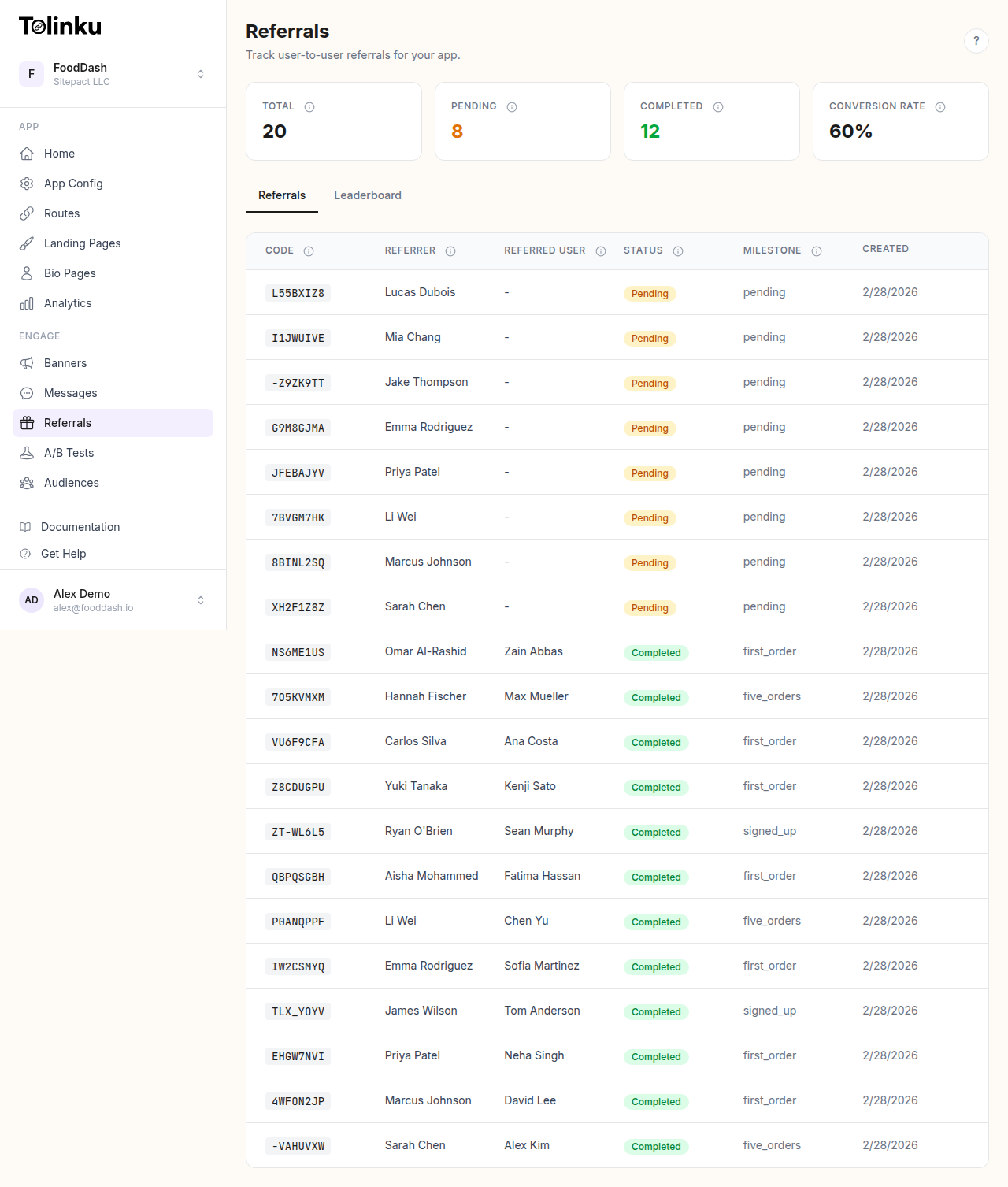 The referrals page with stats cards, referral list, and leaderboard tabs.
Phase 1: Pre-Launch (Steps 1-12)
1. Define your reward structure
Before writing a line of code, decide exactly what referrers get and what new users get. The most common options are discount codes, store credit, cash (via PayPal or Venmo), free time on a subscription, or a free product.
Write it out in plain language: "Referrer gets $10 account credit when their friend completes their first purchase of $25 or more. Friend gets $10 off their first order." Vague reward structures lead to support tickets and disappointed users.
2. Set reward caps and expiration
Decide the maximum a single user can earn through referrals in a month (or total). Decide when rewards expire if unused. These decisions protect your margins and reduce fraud surface area. Write them down because they will need to be in your terms of service.
3. Write your terms of service language
Referral programs need explicit terms. At minimum, address: who qualifies as a "new user," what actions trigger the reward (install vs. first purchase vs. subscription), how long the referrer has to wait for the reward after the qualifying action, what constitutes fraud and what happens to the account if fraud is detected, and whether the program can be changed or cancelled.
Consult a lawyer if you are in a regulated industry or if your rewards could be interpreted as financial instruments (points convertible to cash, for example). The FTC guidelines on endorsements and testimonials are also worth reviewing if your referral program involves any public sharing.
4. Choose your attribution method
For mobile apps, you have two main options: deterministic attribution via deep links (the most reliable method) and probabilistic attribution via device fingerprinting (a fallback for cases where deep links are unavailable).
Deep link attribution preserves referral parameters through the App Store or Google Play install flow using deferred deep linking. This is the approach Tolinku uses, and it is significantly more accurate than fingerprinting. Read how deferred deep linking works before finalizing your attribution approach.
5. Set up your referral link infrastructure
Each referrer needs a unique link. That link needs to: encode the referrer's ID as a parameter, redirect to the App Store or Google Play based on the user's device, survive the install process and pass the referral parameter to the app on first launch, and record the click with a timestamp.
If you are building on Tolinku, the referral links documentation walks through creating and managing referral links. If you are building custom, make sure you have tested the full flow on a real device that does not have the app installed.
6. Build the referral parameter handling in your app
On first launch after install, your app needs to check for a referral parameter and store it. This needs to happen before the user creates an account, so the parameter can be attached to their new user record.
Common mistakes here: checking for the parameter after the onboarding flow (too late), not handling the case where the parameter is missing (should degrade gracefully), and not persisting the parameter if the user drops out of onboarding and comes back later.
7. Build the reward fulfillment logic
When a new user completes the qualifying action (first purchase, subscription, etc.), your system needs to:
- Look up the referral parameter attached to their account
- Identify the referrer
- Issue the reward to both parties
- Send a notification or email confirming the reward
Test this logic with both happy path scenarios and edge cases: what happens if the referrer's account has been deleted? What if the qualifying action happens twice (e.g., two purchases on the same day)? What if the reward issuance fails?
8. Design the referral share UI
The share UI is the moment users decide whether to share or not. It needs to clearly show:
- The referrer's unique link (or a share button, not a raw URL)
- What the referrer earns
- What their friend gets
- How many successful referrals the user has made so far
Keep it clean. Every extra piece of information reduces the likelihood of sharing. One primary action (share) and one secondary option (copy link) is usually enough.
9. Test the end-to-end attribution flow
This is the most important technical test before launch. Run through the full scenario: log out of the app and uninstall it on a test device, generate a referral link from an account, click that link on the test device, go through the App Store download, install the app, create a new account, complete the qualifying action, and confirm the reward appears on both accounts.
Do this on both iOS and Android. Do it on a cellular connection, not just Wi-Fi. Test what happens if the user takes longer than expected to install (try clicking the link, waiting 24 hours, then installing).
10. Set up fraud detection rules
At minimum: require a minimum qualifying action (not just an install) before issuing rewards, flag accounts where the referrer and referee share the same device identifier, set a velocity limit on referral credits per account, and review accounts with more than 10 referrals before automatic payout (if using cash rewards).
More sophisticated fraud prevention (device fingerprint clustering, payment method deduplication) can be added later. Start with the basics.
11. Configure your analytics tracking
Before launch, decide which events you will track and make sure they are instrumented:
- Referral share button shown (impression)
- Referral share button tapped (engagement)
- Referral link clicked (from the link's click tracking)
- Referral link resulted in app install
- New user completed qualifying action
- Reward issued to referrer
- Reward redeemed by referrer
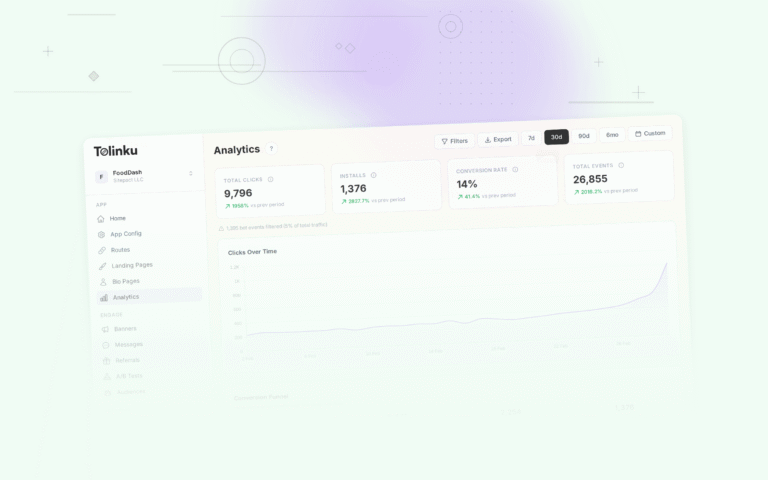
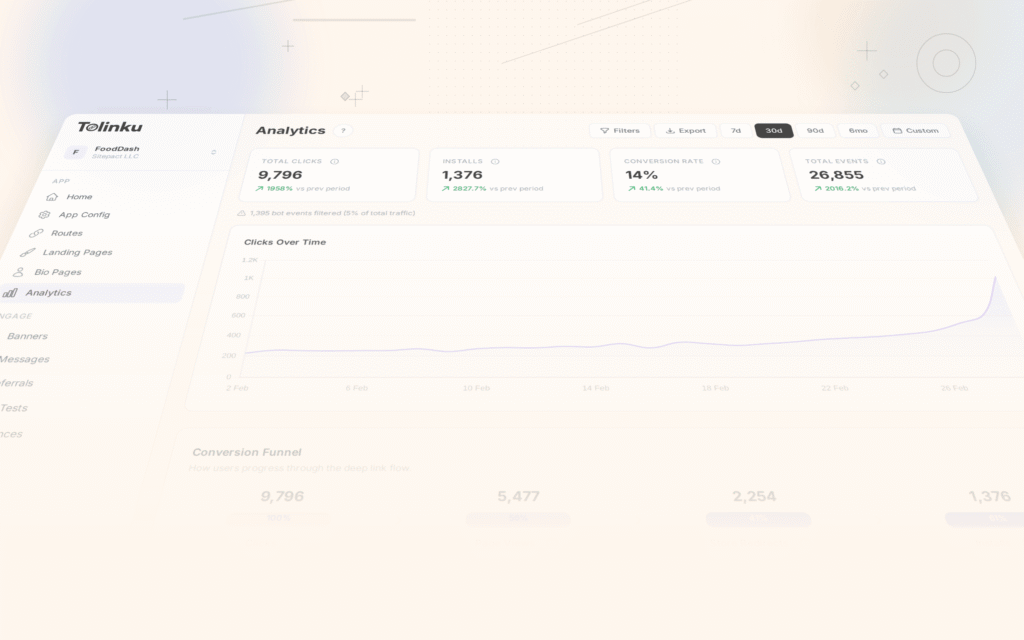
Tolinku's analytics dashboard tracks link clicks and attribution. Your app analytics (Mixpanel, Amplitude, or similar) should capture the app-side events. See the analytics documentation for Tolinku event tracking.
12. Prepare your Open Graph metadata
Your referral link landing page (or the redirect destination) needs correct og:title, og:description, og:image, and og:url tags. Test them using the Facebook Sharing Debugger and the Twitter Card Validator.
The og:image should be 1200×630 pixels, load in under 500ms, and clearly communicate the reward offer. This image is what users see when they share your referral link on most social platforms.

Phase 2: Launch (Steps 13-17)
13. Place the referral prompt in the right location
Post-purchase (or post-completion of the primary value action) is the highest-converting placement for most apps. This is when users are most satisfied and most likely to share. Place a referral prompt on the confirmation screen.
Secondary placements: the settings or account screen (for users actively exploring the app), and a post-onboarding prompt timed 3-5 days after first use (once the user has experienced the product's value).
Do not put the referral prompt on the first launch onboarding. Users do not yet know if the product is worth recommending.
14. Add a referral entry point to navigation
Beyond contextual prompts, give users a permanent way to find the referral program. A "Refer friends" option in the account menu or settings ensures that users who decide later to share can easily find it.
15. Send an announcement to existing users
If you are launching a referral program into an existing app with users, announce it. An email campaign and an in-app notification to existing users is your initial activation moment. Frame it as a reward for loyalty: "As a member, you now have a personal referral link. Share it and you both earn [reward]."
Existing happy customers are your best first referrers. They already have social proof (they use the product) and social capital with their friends. Give them a reason to act immediately.
16. Brief your support team
Make sure your customer support team knows:
- How the referral program works and what the reward terms are
- How to look up a user's referral history
- What the policy is on disputed or missing rewards
- Common issues and how to resolve them (e.g., user clicked link on desktop but installed on phone, link preview shows incorrect image)
The first week after launch will surface edge cases you did not anticipate. A briefed support team can resolve them quickly and feed information back to your product team.
17. Set up monitoring and alerts
Configure alerts for anomalous activity: unusually high referral volume from a single account, reward issuance rate exceeding expected thresholds, or error rates on the attribution API. Catching fraud or technical issues in the first 24 hours is significantly easier than cleaning up a week later.
Phase 3: Post-Launch (Steps 18-20)
18. Review the first week's data
After the first week, check:
- What is the share rate? (percentage of users who saw the prompt and tapped share)
- What is the click-to-install conversion rate?
- What is the install-to-qualifying-action rate?
- Are there any unusual attribution patterns that suggest fraud or tracking failures?
- What is the reward redemption rate? (are referrers using their earned credits)
Compare these numbers against industry benchmarks. For mobile apps, a 5-15% share rate on the post-purchase prompt is typical. A 20-35% click-to-install conversion is common. If your numbers are significantly below these, there is likely a friction point to diagnose.
19. A/B test your highest-leverage variables
The variables with the most impact on referral program performance, in rough order:
- Reward amount and type (the offer itself)
- Prompt placement and timing
- Share button copy and CTA
- Link preview image and title
Start by testing reward amount if your share rate is low. Test prompt placement if your share rate is acceptable but your overall referral volume is low (which often means too few users see the prompt). Test copy and creative if both share rate and prompt exposure are healthy but click-through on the link is low.
For more on A/B testing deep link experiences, see A/B Testing Deep Links and Landing Pages.
20. Build the optimization loop
A referral program is not a one-time launch. Plan a quarterly review that covers: reward structure (is it still competitive and financially sustainable), fraud patterns (are new fraud methods emerging), platform-specific performance (which sharing channels are converting), and cohort analysis (are referred users better or worse than average on LTV).
The programs that compound over time are the ones with an actual review cadence, not just a launch-and-forget approach.
Get deep linking tips in your inbox
One email per week. No spam.