E-commerce apps sit in a uniquely favorable position for referral marketing. A customer who just completed a purchase is at peak satisfaction. They have something to show off, a reason to share, and often a social circle that shops in similar categories. A well-timed referral prompt at that moment can turn a single sale into three or four.
But "well-timed" is doing a lot of work in that sentence. Most e-commerce referral programs fail not because the rewards are bad, but because the structure is sloppy. Wrong trigger moment, confusing reward mechanics, attribution that breaks on mobile. This guide walks through how to build a referral program that actually converts.

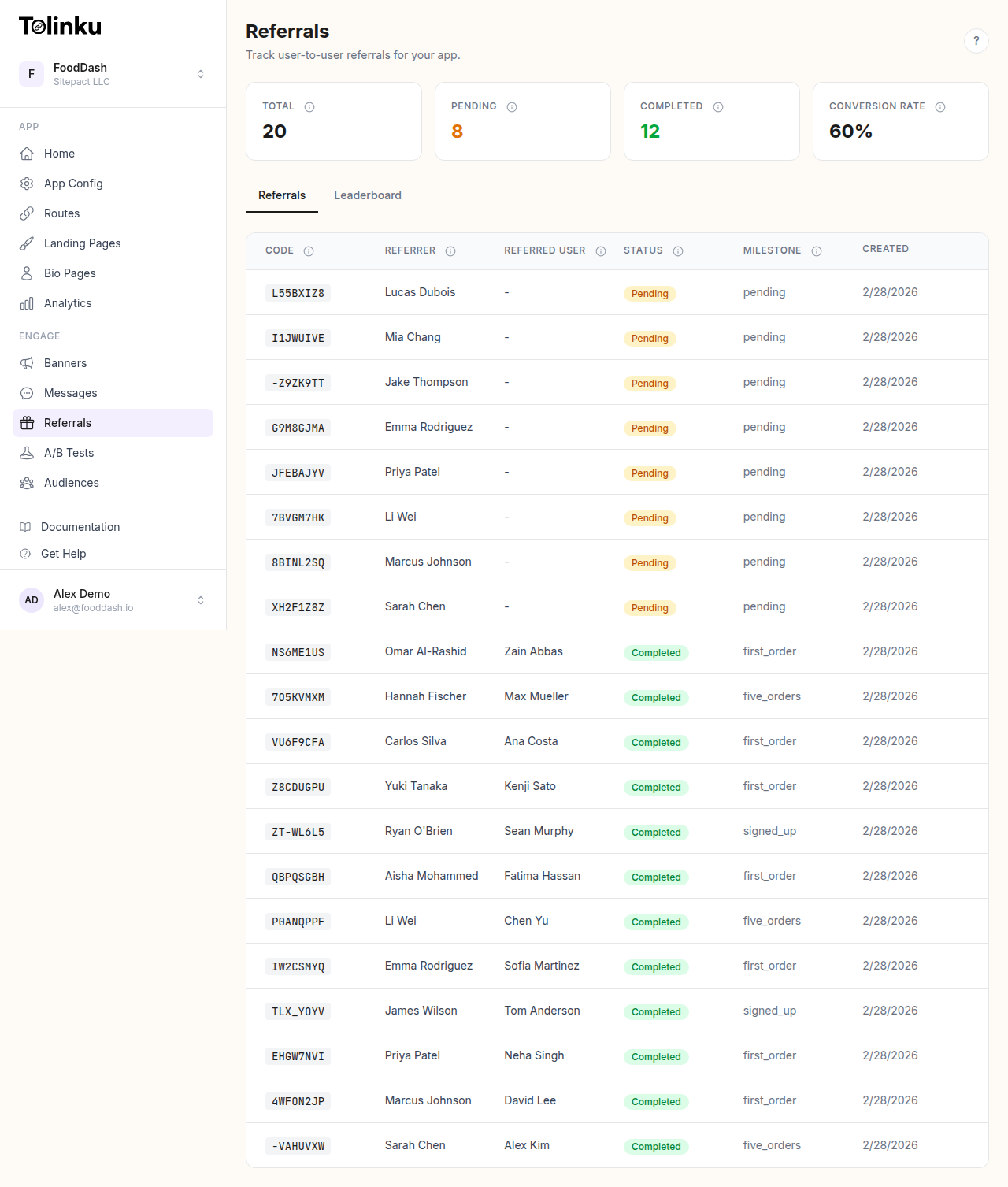 The referrals page with stats cards, referral list, and leaderboard tabs.
Why E-Commerce Referrals Convert Better Than Most
In most app categories, you are asking users to recommend something abstract: a productivity tool, a fitness tracker, a financial service. In e-commerce, users are recommending a specific product they already bought. That specificity is powerful.
When someone shares a link to the exact sneakers they just ordered, their friend can see the product, check the price, and buy in one tap. The referral carries social proof (my friend bought this) and product context (here is what you are getting) in the same moment.
Research from the Wharton School and the Journal of Marketing consistently shows that referred customers have higher lifetime value and lower churn than customers acquired through paid channels. For e-commerce specifically, referred customers tend to have higher average order values because they arrive pre-qualified by someone who knows their preferences.
Choosing Your Reward Structure
The reward is the most consequential decision in your referral program design. Get it wrong and you attract the wrong users, train customers to expect discounts, or give away margin you cannot afford.
Discount Codes
A percentage or fixed-dollar discount code is the most common reward type in e-commerce referral programs. They work because the value is immediately obvious to both the referrer and the referred friend.
The mechanics are straightforward: the referrer gets a unique code or link, their friend uses it at checkout, and both parties receive a discount. The discount for the new customer lowers the barrier to a first purchase. The reward for the referrer (either a discount on their next order or a cash credit) gives them a concrete reason to share.
The risk with discount codes is margin erosion. If your average order value is $40 and you are giving away 20% on both sides of every referral, you are spending $16 per acquisition before you account for your cost of goods. Model this out before you set the discount percentage.
Store Credit
Store credit (sometimes called wallet credit or account credit) has a structural advantage over discount codes: it keeps money inside your ecosystem. A customer with $10 in store credit has a reason to come back and spend it, whereas a one-time discount code disappears after use.
Store credit also feels more like a gift than a promotion. "We added $10 to your account" lands differently than "here is a 10% off coupon."
The downside is that store credit is invisible until the customer logs in. You need to surface it prominently in the app (a banner in the cart, a notification, a wallet section) so the credit does not just sit there forgotten.
Product-Specific Referrals
Some e-commerce apps build referral mechanics around specific products rather than generic discounts. Instead of "share your referral link for 15% off," the prompt is "share this product and earn a free one when your friend buys."
This works especially well for consumable goods (supplements, skincare, coffee) where the referral naturally doubles as a product recommendation. The product-specific framing also makes the ask feel less transactional: you are not asking users to "recruit" friends, you are asking them to share something they genuinely like.
The implementation is more complex because you need to track which product triggered the referral and which product the friend purchased. Tolinku's referral attribution system supports this kind of product-level attribution through parameterized deep links.
Cart Value Incentives
A variation worth testing is tiered rewards based on the referred friend's cart value. The referrer earns more if their friend spends more. This sounds simple but has a meaningful effect on the quality of referrals: users are more likely to share with friends they know will make a real purchase rather than just browsing.
Example structure:
- Friend spends $0-$49: referrer earns $5 credit
- Friend spends $50-$99: referrer earns $10 credit
- Friend spends $100+: referrer earns $20 credit
This ties your acquisition cost directly to the value of the customer being acquired, which is a much healthier model than flat rewards.

The Attribution Problem in Mobile E-Commerce
Referral attribution in mobile apps is harder than it looks. The classic failure mode goes like this:
- User A shares a referral link on Instagram.
- User B taps the link on their phone, but does not have the app installed.
- They get sent to the App Store or Google Play.
- They install the app.
- They open the app. The referral context is gone.
At step 5, there is no way to know that User B came from User A's referral link unless you have deferred deep linking in place.
Deferred deep linking preserves referral parameters through the install process. When User B taps the referral link, those parameters are stored. After the app installs and opens for the first time, the app retrieves those parameters and can attribute the install to the correct referrer.
Tolinku handles this automatically for referral links. When you create a referral link through the referrals feature, the link carries attribution data that survives the App Store redirect and the install. You can read more about how this works in the deferred deep linking documentation.
Getting attribution right matters because it determines who gets rewarded. If your system fails to attribute an install, either the referrer does not get credit (unfair, and they will complain) or you give credit without having a reliable source (which creates fraud surface area).
Seasonal Referral Campaigns
E-commerce has natural gifting moments: holidays, back-to-school, summer sales, Black Friday. Referral programs can be tuned around these moments in ways that amplify the organic sharing behavior that already happens.
The mechanics of a seasonal referral campaign differ from an always-on program in a few ways:
Time-limited rewards. A "double rewards for the next 7 days" campaign creates urgency that a standing program does not have. Users who have been sitting on the referral option suddenly have a reason to act.
Gift-framing. During holiday seasons, "give your friend $20 off their first order" resonates better than "earn $10 when your friend buys." The gift framing shifts the message from self-interested to generous, which matters for sharing behavior.
Product tie-ins. Seasonal campaigns work well when tied to specific seasonal products. A referral link for a gift bundle in December feels natural in a way that a generic referral link does not.
Amplified placement. For a limited-time campaign, it is worth pushing harder on placement: a homepage banner, a push notification, an email to your existing customer base, an in-app modal after purchase. The extra visibility is justified by the time limit.
Track seasonal campaigns separately in your analytics so you can measure lift versus your baseline. If your referral rate jumps from 3% to 9% during a campaign, that is strong signal that the incentive structure is working.
In-App Placement for E-Commerce Referrals
The timing and placement of the referral prompt determines whether users ever see it. For e-commerce, the highest-converting placement is almost always the post-purchase confirmation screen.
The purchase confirmation moment has several things going for it: the customer is happy (they just got what they wanted), they are already in a sharing mindset (showing off new purchases is a normal social behavior), and they have the product context fresh in their mind to share.
Secondary placements worth testing:
- Order status screen. When the order ships or delivers, another satisfaction spike occurs. A "share with friends" option on the delivery confirmation can capture users who did not act right after purchase.
- Product detail page. A share button on product pages lets users share things they are considering buying, not just things they bought. This is a different use case but can drive significant traffic.
- Account or wallet section. Users who are already checking their balance or order history are engaged. A referral section here captures repeat customers who might share with new cohorts over time.
For more on how to set up referral links and connect them to your app flow, see the referral links documentation.
Fraud Prevention
Referral fraud is a real problem in e-commerce. Common patterns include:
- Users creating multiple accounts to refer themselves
- Coordinated rings that refer each other in cycles to collect rewards
- Bot-generated installs that trigger referral credits without real purchases
Basic mitigations:
- Require the referred customer to complete a purchase before the referrer earns credit (not just an install or signup)
- Set a minimum order value for the reward to trigger
- Flag accounts with unusually high referral counts for review
- Check for device fingerprint overlap between referrer and referee accounts
- Set a cap on total referral earnings per account per month
These rules eliminate the majority of fraud without meaningfully impacting legitimate referrers. Platforms like Stripe Radar and device intelligence tools like Fingerprint can assist with more sophisticated fraud detection.
Measuring Your E-Commerce Referral Program
The metrics that matter for an e-commerce referral program:
- Referral share rate: What percentage of customers who see the referral prompt share their link? If this is below 5%, your prompt design or reward needs work.
- Referral conversion rate: What percentage of users who receive a referral link complete a purchase? This measures whether the landing experience and offer are compelling.
- Cost per acquisition via referral: Total rewards paid out divided by new customers acquired. Compare this to your paid acquisition CAC.
- Referred customer LTV: Do referred customers stick around and make repeat purchases? Track this at 30, 60, and 180 days.
- Referral viral coefficient: The average number of new customers each referrer brings in. Even a K-factor above 0.5 means your referral program is meaningfully reducing paid acquisition costs.
Tolinku's analytics dashboard gives you a real-time view of referral link performance including click-through rates, conversion rates, and attribution breakdowns. See the analytics documentation for detail on the available metrics.
Revenue Attribution for Referrals
With ecommerce analytics enabled, you can see the actual revenue generated by each referral, not just whether the referred user installed the app. The Attribution tab in the analytics dashboard shows revenue attributed to referral campaigns alongside your other channels, so you can compare referral ROI directly against paid acquisition.
Automatic Milestone Completion
Tolinku can auto-complete referral milestones based on ecommerce events. If your milestone pipeline includes a "purchased" step, you can configure Tolinku to automatically advance the referral when the referred user makes their first purchase. No manual API call needed: the ecommerce event triggers the milestone, the referral completes, and the referral.completed webhook fires for your backend to issue the reward.
This eliminates the most common integration gap in e-commerce referral programs: the disconnect between "user installed" and "user purchased." Configure ecommerce milestones in Appspace Settings > Ecommerce > Referral Ecommerce Milestones. See the rewards and attribution documentation for details.
Getting Started
An e-commerce referral program does not need to be complex to be effective. Start with a simple reward structure (store credit for both parties), place the prompt on your post-purchase screen, and make sure your attribution is solid from day one. Measure what you have before you layer on seasonal campaigns or tiered rewards.
The companies that run the best referral programs are not running the most complicated ones. They are running the ones that are easiest to understand, easiest to share, and most reliably rewarding. Build for clarity first.
For a full walkthrough of setting up referral programs in Tolinku, start with the referrals documentation or explore use case examples for referral programs.
Get deep linking tips in your inbox
One email per week. No spam.