
Referral programs are one mechanism for word-of-mouth growth. But word-of-mouth is bigger than referral programs. People recommend products in conversations, group chats, social media posts, and app reviews without any incentive. The best growth strategies make word-of-mouth happen naturally, then amplify it with tools and incentives.
This guide covers strategies for building word-of-mouth growth into your mobile app, from product design decisions that make sharing natural to amplification tactics that turn casual advocates into consistent promoters. For the structured referral program approach, see building referral programs that actually work. For broader mobile growth strategies, see mobile app growth: 25 strategies that work.
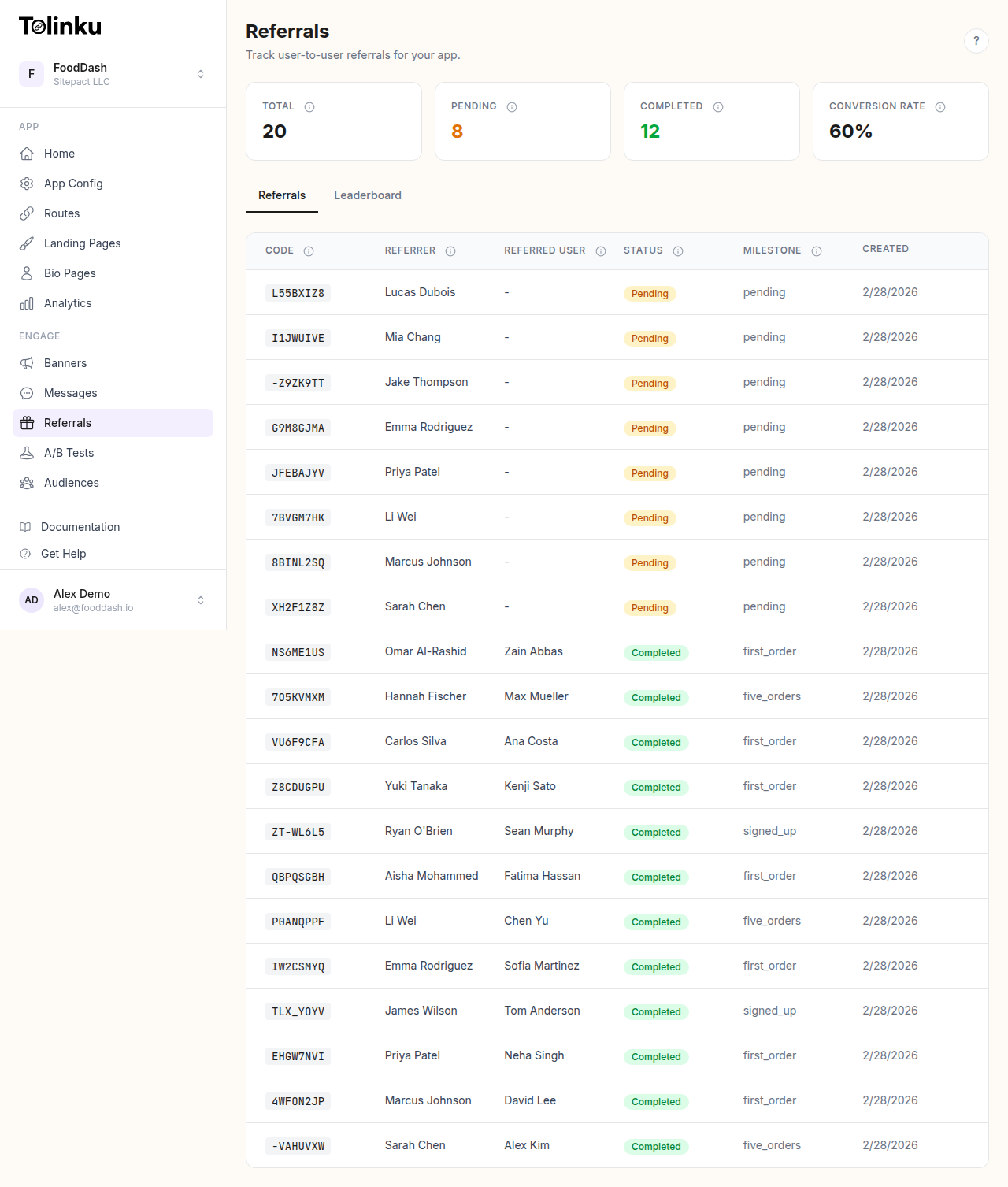 The referrals page with stats cards, referral list, and leaderboard tabs.
Why Word-of-Mouth Outperforms Paid Acquisition
Nielsen's Global Trust in Advertising report found that 88% of consumers trust recommendations from people they know more than any other form of advertising. For mobile apps, this translates into:
- Higher conversion rates. A personal recommendation removes the "will this app waste my time?" barrier.
- Lower cost per acquisition. Organic recommendations cost nothing (or the cost of a referral reward, which is still cheaper than paid ads).
- Better retention. Users who discover an app through word-of-mouth have 37% higher retention rates, according to research published in the Journal of Marketing.
- Compounding growth. Each new user acquired through word-of-mouth can generate more word-of-mouth, creating a flywheel.
Paid acquisition gives you a linear return: spend more, get more users. Word-of-mouth gives you an exponential return: each user can bring more users, who can bring more users. See the K-factor and viral coefficient guide for measuring this effect.
Strategy 1: Build Shareable Moments into the Product
The most effective word-of-mouth comes from product experiences that users naturally want to share. These are "shareable moments," points in the user journey where the urge to tell someone is highest.
Identify Your Shareable Moments
- Achievement moments: Completed a workout streak, hit a savings goal, finished a course.
- Discovery moments: Found a great restaurant, discovered a useful feature, got a surprisingly good result.
- Social moments: Sent money to a friend, split a bill, shared a playlist.
- Status moments: Earned a badge, reached a milestone, got a promotion in a game.
Make Sharing Frictionless
When the shareable moment happens, the sharing action should be one tap away. Don't make users navigate to a separate "share" screen. Put the share button right in the moment.
[Achievement Screen]
"You've saved $1,000! 🎉"

[Share This Achievement]  ← one tap
The share should generate a deep link that takes the recipient to the relevant content in the app (not just the app's home screen). When the recipient opens the link, they should see exactly what their friend shared: the achievement, the content, or the feature.
Design for the Screenshot
Users share screenshots constantly, especially on Instagram Stories and iMessage. Design your key screens to look good when screenshotted:
- Use bold, readable text that's visible at reduced resolution
- Include your app name/logo subtly (not aggressively) so the brand is visible
- Design achievement cards and summaries to be self-contained (they should make sense without context)
Spotify Wrapped is the gold standard. Every card is designed to be screenshotted and shared on social media, with the Spotify brand clearly visible.
Strategy 2: Social Proof Inside the Product
Social proof doesn't just work on landing pages. Embedding social proof into the product experience reminds users that other people use and love the app.
User Counts
"Join 500,000 users" works on a landing page. Inside the product, make it more specific:
- "12,000 people completed this challenge this month"
- "Your friend Sarah also uses this feature"
- "Popular with users in your area"
Activity Indicators
Show that the app is alive and active:
- "45 people are viewing this right now"
- "This item was shared 200 times today"
- "Last used by someone 3 minutes ago"
Testimonials from Peers
App store reviews are external social proof. Internal social proof (reviews or recommendations from users similar to the current user) is even more powerful because it's contextual.
Strategy 3: Make Sharing a Feature, Not a Bolt-On
The best sharing implementations feel like a core feature, not a marketing add-on.
Content Sharing
If your app produces content (photos, videos, charts, summaries, playlists), make that content shareable with deep links that open the content directly in the app.
User A creates a playlist → shares a deep link
User B clicks → installs the app → lands directly on the playlist
The content itself is the marketing. The person who receives the shared content sees the value of the app immediately, without needing a sales pitch.
Collaborative Features
Features that require multiple people create organic sharing:
- Split payments (Venmo, Splitwise)
- Shared lists (Grocery lists, wishlists)
- Group challenges (Fitness apps, learning apps)
- Collaborative documents (Notion, Figma)
Each collaborative feature is a growth mechanism. To use the feature, the user must invite someone else, which means installing the app.
Invite-Only Access
Scarcity creates perceived value. Making a feature (or the entire app) invite-only drives word-of-mouth in two ways:
- Users who have access feel special and talk about it.
- Users who want access ask their friends for invites.
Gmail's early invite system and Clubhouse's invite-only launch are classic examples. This strategy works best for new products or new features; it loses effectiveness once the app is widely available.
Strategy 4: Empower Your Power Users
A small percentage of your users generate a disproportionate amount of word-of-mouth. These are your power users, advocates, or "superfans." Identify them and give them tools to amplify their advocacy.
Identify Power Users
- Users who share referral links frequently (track via Tolinku analytics)
- Users who leave positive app store reviews
- Users who mention your app on social media
- Users with high engagement metrics (daily active, feature adoption)
Give Them Exclusive Tools
- Custom referral links: Let power users create vanity URLs or branded links.
- Early access: Give them new features first. They'll talk about it.
- Community role: Create an ambassador or beta tester program.
- Content creation tools: Help them create content about your app (templates, graphics, stats).
Recognize Them
Public recognition motivates continued advocacy:
- Feature them in your app's community section
- Mention them in newsletters or social media
- Give them special badges or titles
- Invite them to provide product feedback
Strategy 5: Optimize the Receiving Experience
Word-of-mouth growth has two sides: the person who shares and the person who receives. Most teams focus on making sharing easy but neglect the receiving experience.
Fast Time to Value
When someone downloads your app based on a recommendation, the first 60 seconds determine whether they'll become a user or uninstall. The onboarding should:
- Skip unnecessary steps (long tutorials, feature tours)
- Get the user to the core value proposition immediately
- Show them what their friend shared (if they arrived via a content link)
Deep Link to the Relevant Content
If a user shared a specific piece of content, the recipient should land directly on that content after installing. Deferred deep linking makes this possible: the referral context (what was shared, who shared it) is preserved through the app store install and retrieved on first open.
// iOS: Route new users to shared content
Tolinku.shared.getDeepLinkData { result in
    if let contentId = result.data["content_id"] as? String {
        // Show the shared content immediately
        NavigationManager.shared.navigate(to: .content(id: contentId))
    }
}
Acknowledge the Connection
When a new user arrives via a friend's recommendation, acknowledge it:
- "Welcome! Sarah thought you'd like this."
- "You were invited by Sarah. Here's what she shared with you."
This personalization reinforces the social connection and increases the likelihood that the new user will engage.
Strategy 6: Leverage App Store Reviews
App store ratings and reviews are the public face of word-of-mouth. A 4.5-star app with 10,000 reviews is inherently more trustworthy than a 4.5-star app with 50 reviews.
Ask at the Right Moment
Request reviews after positive experiences, not at random:
- After completing a milestone ("You just finished your first workout! Would you rate us?")
- After a successful transaction ("Your payment went through! Mind leaving a review?")
- After using the app for X days (not on day 1; wait until they've experienced value)
Use the System Review Dialog
On iOS, use SKStoreReviewController (limited to 3 prompts per year per user). On Android, use the In-App Review API. These system dialogs have higher completion rates than custom review screens because users trust them.
Respond to Reviews
Responding to app store reviews (especially negative ones) shows that you care. Potential users who read reviews see that the company is responsive, which builds trust.
Measuring Word-of-Mouth
Word-of-mouth is harder to measure than paid acquisition because much of it is invisible (conversations, texts, in-person recommendations). But you can measure its proxies:
| Metric | What It Measures | How to Track |
|---|---|---|
| Organic install rate | % of installs not attributed to paid channels | Attribution tool |
| K-factor | New users generated per existing user | Referral tracking |
| Share rate | % of users who share content or referral links | In-app analytics |
| NPS (Net Promoter Score) | Willingness to recommend | Survey |
| Branded search volume | How many people search for your app by name | Google Search Console |
| Social mentions | How often your app is mentioned on social media | Social monitoring tool |
| "How did you hear about us?" | Direct source attribution | Onboarding survey |
The simplest and most valuable measurement is the onboarding survey question: "How did you hear about us?" Options: Friend/family, social media, app store search, ad, other. Track this over time.
For referral-specific metrics, use the referral program analytics guide. For tracking the viral coefficient, see the K-factor guide.
The most important thing to understand about word-of-mouth growth is that it's a product strategy, not a marketing strategy. You can't advertise your way into word-of-mouth. You build a product worth talking about, make sharing frictionless, and let your users do the rest.
For the structured referral program framework, see building referral programs that actually work. For setting up referral links with deep linking, see the referral documentation.
Get deep linking tips in your inbox
One email per week. No spam.