

Deep links create a direct path from click to in-app action. But between "user clicks link" and "user completes goal," there are multiple conversion points, each leaking users. Conversion rate optimization (CRO) for deep links means systematically identifying and fixing these leaks: improving click-through rates on the links themselves, optimizing fallback pages for users without the app, and ensuring smooth in-app landing experiences.
For click-through rate strategies, see Click-Through Rate Optimization for Deep Links. For funnel analysis, see Conversion Funnel Analysis for Deep Links.
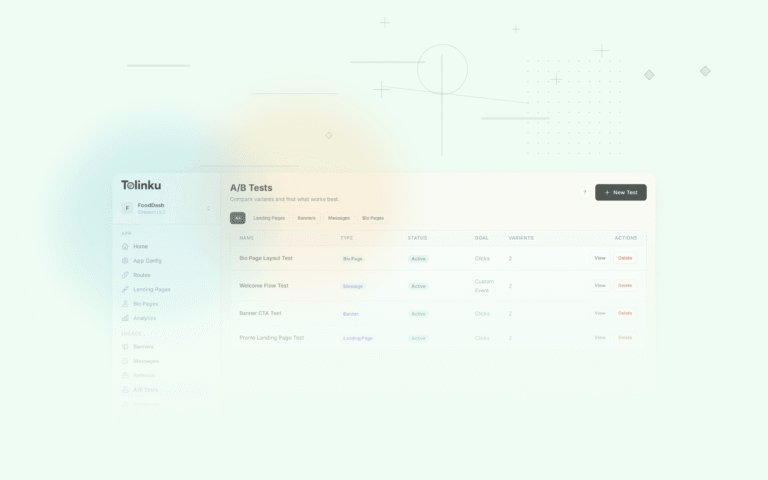
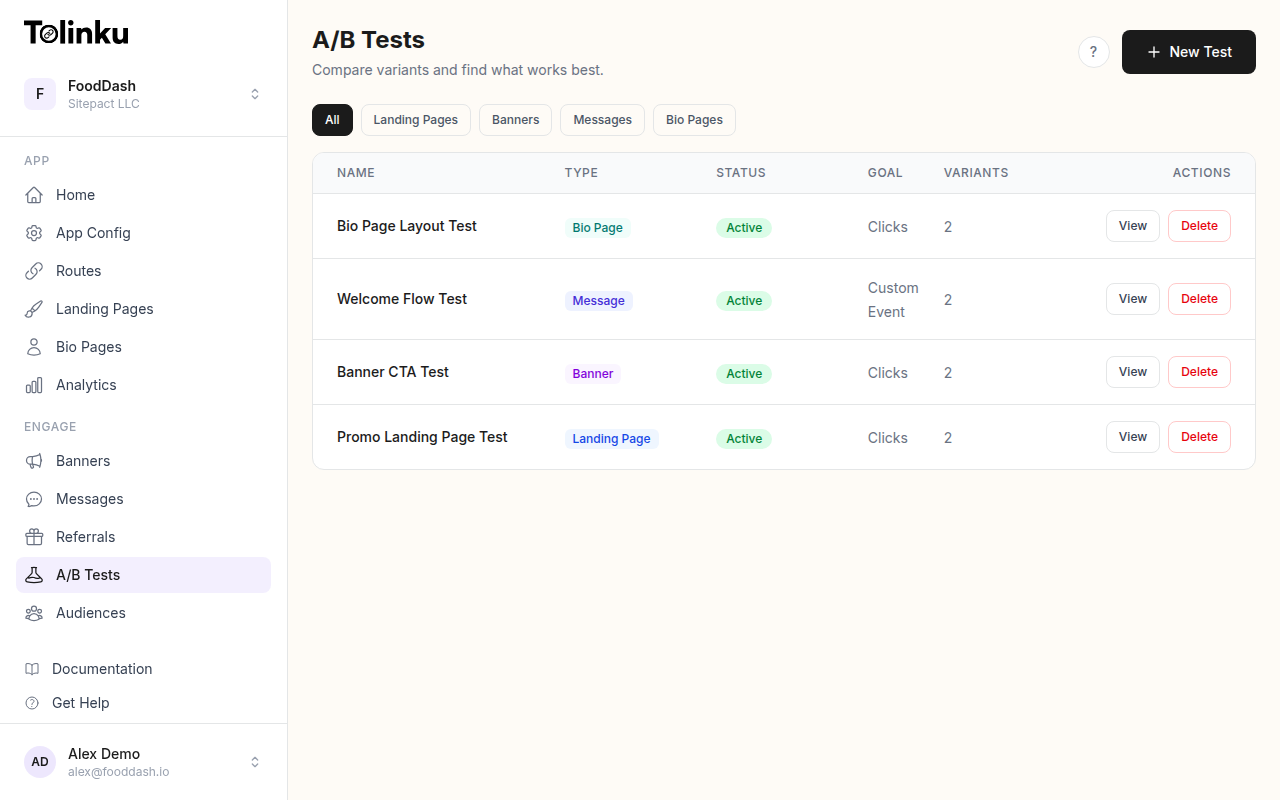 The A/B tests list page showing test names, status, types, and variant counts.
The Deep Link Conversion Funnel
Full Funnel Breakdown
Link impression → Click → Route → App open / Fallback → In-app action → Conversion
Each step has a measurable conversion rate:
| Step | Metric | Typical Range | Optimization Lever |
|---|---|---|---|
| Impression to click | Click-through rate (CTR) | 1-15% | Link placement, CTA, context |
| Click to app open | App open rate | 30-70% | Universal Link setup, fallback quality |
| Click to fallback | Fallback rate | 30-70% | App install base |
| Fallback to install | Install rate | 15-35% | Landing page, app store page |
| Install to first open | Activation rate | 60-80% | Push notification, onboarding |
| First open to action | In-app conversion | 10-40% | Deep link routing, UX |
Identifying the Biggest Leak
async function findBiggestLeak(campaignId) {
  const impressions = await countEvents('link_impression', { campaignId });
  const clicks = await countEvents('link_click', { campaignId });
  const appOpens = await countEvents('app_opened', { campaignId });
  const fallbacks = await countEvents('fallback_shown', { campaignId });
  const installs = await countEvents('app_installed', { campaignId });
  const actions = await countEvents('goal_completed', { campaignId });

  const funnel = [
    { step: 'Impression to Click', rate: clicks / impressions, count: clicks },
    { step: 'Click to App Open', rate: appOpens / clicks, count: appOpens },
    { step: 'Fallback to Install', rate: installs / fallbacks, count: installs },
    { step: 'Open to Action', rate: actions / (appOpens + installs), count: actions },
  ];

  // Find the step with the lowest conversion rate
  const worstStep = funnel.reduce((worst, step) =>
    step.rate < worst.rate ? step : worst
  );

  return {
    funnel: funnel.map(f => ({
      ...f,
      rate: (f.rate * 100).toFixed(1) + '%',
    })),
    biggestLeak: worstStep.step,
    recommendation: getRecommendation(worstStep.step),
  };
}
Optimizing Click-Through Rate
Link Placement
Where the link appears determines how many users see and click it:
const linkPlacementOptimizations = {
  email: {
    above_fold: 'Primary CTA visible without scrolling',
    button_not_text: 'Styled button outperforms text link by 20-30%',
    single_focus: 'One primary deep link, not multiple competing links',
  },
  social_media: {
    native_preview: 'Open Graph tags for rich link previews',
    short_url: 'Branded short links look more trustworthy',
    context: 'Explanation of what clicking will do',
  },
  push_notification: {
    action_button: 'Deep link as notification action, not just body tap',
    personalized: 'Include user-specific content in the notification',
  },
  smart_banner: {
    timing: 'Show after user engagement, not immediately',
    relevance: 'Match banner content to page content',
  },
};
CTA Optimization
The text around the link matters:
| CTA Style | CTR Impact | Example |
|---|---|---|
| Generic | Baseline | "Click here" |
| Action-oriented | +10-20% | "View your order" |
| Benefit-focused | +15-30% | "Save 20% in the app" |
| Urgency | +10-25% | "Claim before midnight" |
| Personalized | +20-40% | "Sarah, your item is back in stock" |
Link Preview Optimization
For links shared on social media and messaging apps, the Open Graph preview determines CTR:
<!-- Optimize these for each campaign -->
<meta property="og:title" content="Your Order Is Ready for Pickup" />
<meta property="og:description" content="Tap to see pickup instructions and your QR code" />
<meta property="og:image" content="https://example.com/og/order-ready.png" />
Test different OG images and titles. A compelling preview image can improve social share CTR by 30-50%.
Optimizing the Routing Step
Universal Link / App Link Success Rate
The percentage of clicks that successfully open the app (vs. falling through to the browser) depends on proper configuration:
const routingChecklist = {
  ios: {
    aasa_valid: 'apple-app-site-association file is valid JSON',
    aasa_served_correctly: 'Content-Type: application/json, no redirects',
    aasa_cached: 'CDN cached, loads in < 200ms',
    team_id_correct: 'Team ID matches the app',
    bundle_id_correct: 'Bundle ID matches the app',
    entitlements: 'Associated Domains entitlement configured',
    paths_specific: 'Path patterns are specific, not wildcard-only',
  },
  android: {
    dal_valid: 'assetlinks.json is valid',
    dal_served_correctly: 'Content-Type: application/json',
    package_name_correct: 'Package name matches the app',
    sha256_correct: 'SHA-256 fingerprint matches signing certificate',
    autoVerify: 'android:autoVerify="true" in manifest',
    intent_filters: 'Intent filters match the link patterns',
  },
};
Common issues that reduce routing success:
- Redirects in the link chain (kills Universal Links on iOS)
- Missing or malformed AASA/DAL files
- Wrong signing certificate fingerprint (Android)
- User has disabled the app's link handling in settings
Handling Routing Failures Gracefully
function handleRoutingResult(result) {
  if (result.openedInApp) {
    // Success path: track and continue
    analytics.track('deep_link_opened_in_app', {
      path: result.path,
      source: result.source,
    });
    return;
  }

  // Fallback path: optimize this page
  analytics.track('deep_link_fallback', {
    path: result.path,
    reason: result.failureReason, // 'app_not_installed', 'link_not_verified', 'user_choice'
    device: result.device,
  });

  // Show optimized fallback
  showFallbackPage({
    originalPath: result.path,
    device: result.device,
    hasAppInstalled: result.hasAppInstalled,
  });
}
Optimizing the Fallback Page
For Users Without the App
The fallback page has one job: convince the user to install the app (or provide a web alternative).
const fallbackOptimizations = {
  headline: 'Match the intent of the original link',
  social_proof: 'App store rating, user count, or testimonial',
  app_preview: 'Screenshot showing what they will see in the app',
  cta: 'Platform-specific: "Get" for iOS, "Install" for Android',
  web_alternative: 'For users who refuse to install, offer a web version',
  smart_banner: 'Persistent reminder at top/bottom of the web page',
};
For Users With the App (But Link Failed)
Sometimes the app is installed but the Universal Link/App Link didn't fire:
function FallbackForAppUsers({ deepLinkPath }) {
  return (
    <Page>
      <Heading>Open in the app</Heading>

      {/* Try custom URL scheme as backup */}
      <CTAButton
        onClick={() => {
          window.location.href = `myapp://${deepLinkPath}`;

          // If custom scheme fails, show app store after timeout
          setTimeout(() => {
            window.location.href = getAppStoreUrl();
          }, 2000);
        }}
      >
        Open in App
      </CTAButton>

      {/* Web fallback */}
      <TextLink href={`/web${deepLinkPath}`}>
        Continue on web
      </TextLink>
    </Page>
  );
}
Optimizing In-App Landing
Context Preservation
When a user opens the app via deep link, they expect to see the content they were promised. Any friction here kills conversion:
const inAppOptimizations = {
  immediate_content: 'Show the linked content instantly, no splash screen',
  loading_state: 'If content needs loading, show skeleton UI, not a spinner',
  auth_handling: 'If login is required, show a minimal login overlay, not a full redirect',
  back_navigation: 'After viewing linked content, where does "back" go?',
  offline_handling: 'If content needs network, show cached preview while loading',
};
Reducing Friction After Deep Link
function handleDeepLinkNavigation(path, params) {
  // Track the deep link arrival
  analytics.track('deep_link_arrived', { path, params, source: params.source });

  // If user is not logged in and route requires auth
  if (requiresAuth(path) && !isLoggedIn()) {
    // Show login overlay, not a full-screen redirect
    // After login, navigate to the deep-linked content
    showLoginOverlay({
      onSuccess: () => navigateTo(path, params),
      onDismiss: () => navigateTo('/home'),
      context: 'You need to sign in to view this content',
    });
    return;
  }

  // Navigate directly to content
  navigateTo(path, params);

  // Track successful deep link resolution
  analytics.track('deep_link_resolved', {
    path,
    params,
    timeToContent: performance.now(),
  });
}
Measuring CRO Impact
Before/After Analysis
async function measureCROImpact(campaignId, changeDate) {
  const before = await getFunnelMetrics(campaignId, {
    start: subtractDays(changeDate, 14),
    end: changeDate,
  });

  const after = await getFunnelMetrics(campaignId, {
    start: changeDate,
    end: addDays(changeDate, 14),
  });

  const metrics = ['ctr', 'appOpenRate', 'installRate', 'conversionRate'];

  for (const metric of metrics) {
    const lift = ((after[metric] - before[metric]) / before[metric] * 100).toFixed(1);
    console.log(`${metric}: ${(before[metric] * 100).toFixed(2)}% -> ${(after[metric] * 100).toFixed(2)}% (${lift}% lift)`);
  }

  // Calculate overall impact
  const beforeOverall = before.clicks * before.conversionRate;
  const afterOverall = after.clicks * after.conversionRate;
  console.log(`\nConversions: ${beforeOverall.toFixed(0)} -> ${afterOverall.toFixed(0)}`);
}
Compound Effect
Small improvements at each step multiply:
function compoundEffect(improvements) {
  // improvements = { ctr: 0.10, appOpenRate: 0.05, installRate: 0.15, conversionRate: 0.08 }
  const compound = Object.values(improvements).reduce(
    (total, lift) => total * (1 + lift),
    1
  );

  console.log('Individual lifts:', improvements);
  console.log('Compound effect:', ((compound - 1) * 100).toFixed(1) + '% total lift');

  // Example: 10% CTR lift + 5% app open + 15% install + 8% conversion
  // = 1.10 * 1.05 * 1.15 * 1.08 = 1.434 = 43.4% total lift
}
A 10% improvement at each of 4 funnel steps produces a 46% total improvement, not 40%.
CRO Prioritization Framework
ICE Score
Prioritize optimizations by Impact, Confidence, and Ease:
const optimizations = [
  {
    name: 'Fix broken Universal Links on iOS',
    impact: 9,      // High: 30% of iOS clicks fail
    confidence: 9,   // High: clear technical fix
    ease: 7,         // Medium: requires AASA update
    iceScore: 9 * 9 * 7, // 567
  },
  {
    name: 'Redesign fallback landing page',
    impact: 7,
    confidence: 6,
    ease: 5,
    iceScore: 7 * 6 * 5, // 210
  },
  {
    name: 'Test CTA button colors',
    impact: 3,
    confidence: 4,
    ease: 9,
    iceScore: 3 * 4 * 9, // 108
  },
  {
    name: 'Add smart banner to all pages',
    impact: 6,
    confidence: 7,
    ease: 8,
    iceScore: 6 * 7 * 8, // 336
  },
];

// Sort by ICE score, work on highest first
optimizations.sort((a, b) => b.iceScore - a.iceScore);
Fix Infrastructure Before Optimizing
Before running A/B tests on CTA colors, make sure:
- Links work: Universal Links and App Links are properly configured
- Tracking works: You can measure the full funnel end-to-end
- Fallbacks work: Users without the app get a functional experience
- Attribution works: You know which source/campaign produced each user
Optimizing a broken funnel is pointless. Fix the plumbing first.
Quick Wins
1. Add UTM Parameters to All Links
function buildTrackedDeepLink(path, campaign) {
  return buildDeepLink(path, {
    utm_source: campaign.source,
    utm_medium: campaign.medium,
    utm_campaign: campaign.name,
    utm_content: campaign.variant,
  });
}
2. Use Platform-Specific CTAs
function getPlatformCTA(userAgent) {
  if (/iPhone|iPad/.test(userAgent)) return 'Get on the App Store';
  if (/Android/.test(userAgent)) return 'Install from Google Play';
  return 'Get the App';
}
3. Pre-Load App Content
// When user lands on fallback page, start loading content
// So when they open the app, it's already ready
function preloadContent(deepLinkPath) {
  // Store in localStorage for deferred deep link matching
  localStorage.setItem('pending_deep_link', JSON.stringify({
    path: deepLinkPath,
    timestamp: Date.now(),
  }));
}
4. Reduce Redirect Chains
Every redirect adds 100-500ms of latency and increases drop-off by 2-5%:
BAD:  marketing.com/link → bit.ly/abc → example.com/r/123 → app
GOOD: links.example.com/campaign → app
Best Practices
- Fix the biggest leak first: Don't optimize CTA colors when 40% of links aren't opening the app.
- Measure the full funnel: A change that improves one step but hurts another can reduce overall conversions.
- Small changes compound: 10% improvement at each step produces 40%+ overall improvement.
- Platform-specific optimization: iOS and Android handle deep links differently. Optimize for each.
- Speed matters: Every 100ms of latency reduces conversion. Minimize redirects and pre-load content.
- Test, don't guess: Use A/B tests for subjective changes (copy, design) and fix infrastructure issues directly.
For A/B testing features, see Tolinku A/B testing. For analytics setup, see the analytics docs and A/B testing docs.
Get deep linking tips in your inbox
One email per week. No spam.